

The tensile mechanical properties of pure EHBT and its hybrid fibers are shown in
Fig. 19. The tensile strength and initial modulus of the C25A/EHBT hybrids
increased with increasing organoclay content. The ultimate tensile strength of
EHBT hybrid fibers increased as the organoclay content increased. When the
C25A was increased from 0 to 6 wt% in the hybrids, the strength improved linearly
from 11.03 to 17.28 MPa. The ultimate strength of 6 wt% C25A/EHBT was 1.6
times higher than that of pure EHBT. The same type of behavior was observed for
the initial moduli. For example, the initial tensile modulus of the 2 wt% C25A hybrid
was 4.03 GPa, which was about 140% higher than that of pure TLCP. When the
organoclay in EHBT reaches 6 wt%, the modulus (5.76 GPa) is about 2.0 times that
of the pure EHBT TLCP.
This large increase in the tensile properties of hybrids owing to the presence of
organoclay can be explained as follows: the amount of the increase due to the clay
layers depends on interactions between rigid, rod-shaped TLCP molecules and layered
120
100
80
Weight (%)
60
40
20
0
0
100 200 300 400
Temperature (°C)
500
C12-MMT in PAM (wt%)
0 (pure PAM)
Na + -MMT
C12-MMT
1
3
5
9
600 700
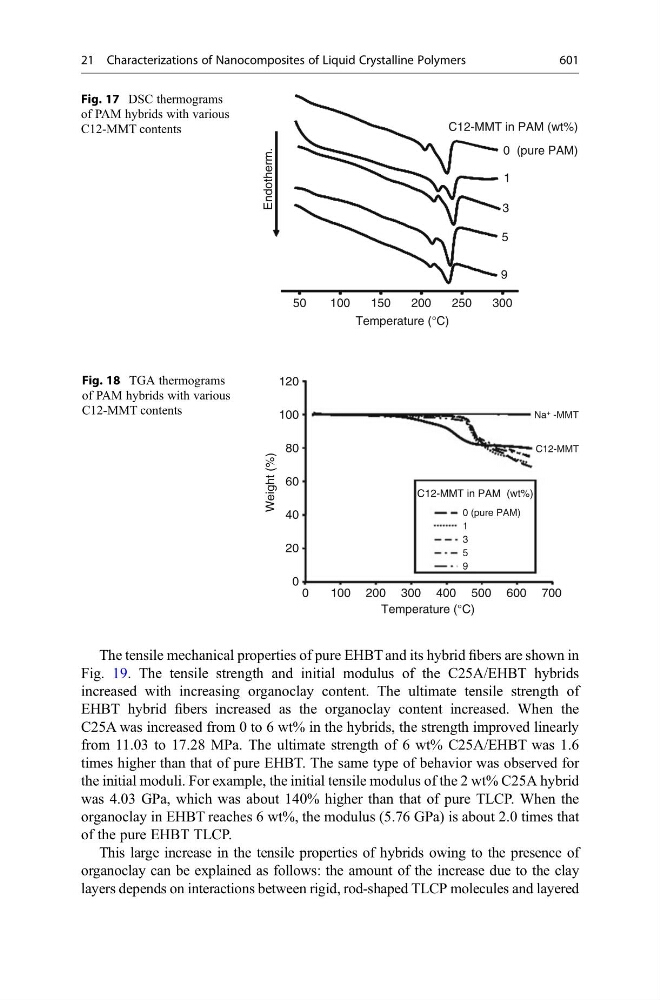
Fig. 18 TGA thermograms
of PAM hybrids with various
C12-MMT contents
Endotherm.
Temperature (°C)
50
100
150
200
250
300
9
5
3
1
0 (pure PAM)
C12-MMT in PAM (wt%)
Fig. 17 DSC thermograms
of PAM hybrids with various
C12-MMT contents
21 Characterizations of Nanocomposites of Liquid Crystalline Polymers
601