

from interactions between the organoclay and the PAM molecular chains. The
presence of the clay also enhances the initial decomposition temperatures by acting
as an insulator and a mass-transport barrier to the volatile products generated during
decomposition. This increase in the thermal stability can also be attributed to the
high thermal stability of the clay and to interactions between the clay particles and
the polymer matrix (Gilman 1999).
In contrast to the behavior observed for C12-MMT contents of 0 to 1 wt%, the
T m , T i , and T D
i values of the hybrids decreased with increasing organo-MMT
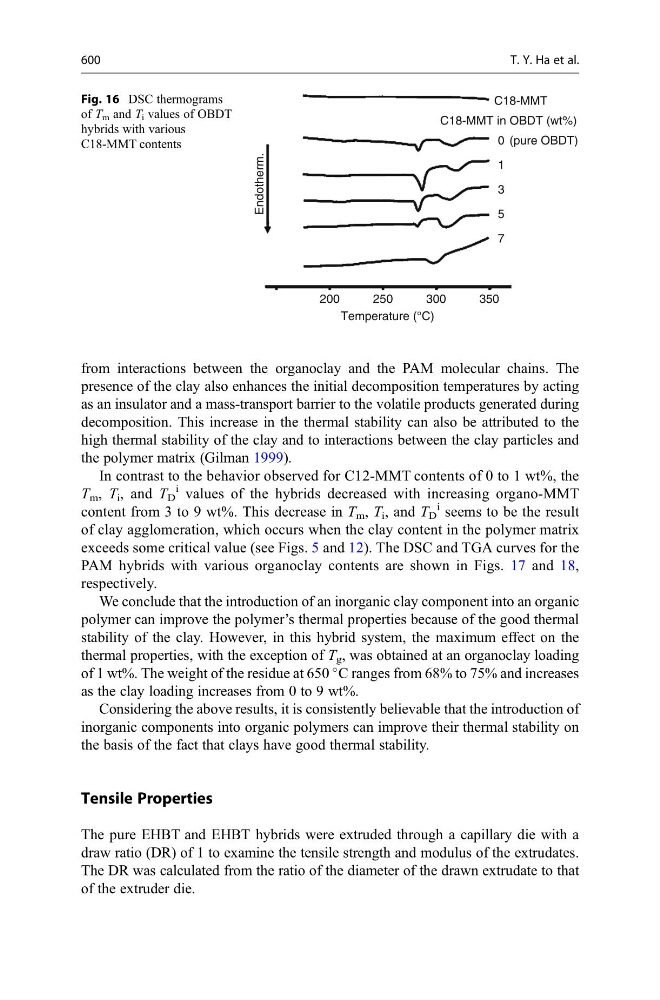
content from 3 to 9 wt%. This decrease in T m , T i , and T D
i seems to be the result
of clay agglomeration, which occurs when the clay content in the polymer matrix
exceeds some critical value (see Figs. 5 and 12). The DSC and TGA curves for the
PAM hybrids with various organoclay contents are shown in Figs. 17 and 18,
respectively.
We conclude that the introduction of an inorganic clay component into an organic
polymer can improve the polymer’s thermal properties because of the good thermal
stability of the clay. However, in this hybrid system, the maximum effect on the
thermal properties, with the exception of T g , was obtained at an organoclay loading
of 1 wt%. The weight of the residue at 650
C ranges from 68% to 75% and increases
as the clay loading increases from 0 to 9 wt%.
Considering the above results, it is consistently believable that the introduction of
inorganic components into organic polymers can improve their thermal stability on
the basis of the fact that clays have good thermal stability.
Tensile Properties
The pure EHBT and EHBT hybrids were extruded through a capillary die with a
draw ratio (DR) of 1 to examine the tensile strength and modulus of the extrudates.
The DR was calculated from the ratio of the diameter of the drawn extrudate to that
of the extruder die.
200
Endotherm.
250
300
Temperature (°C)
350
7
5
3
1
0
C18-MMT
(pure OBDT)
C18-MMT in OBDT (wt%)
Fig. 16 DSC thermograms
of T m and T i values of OBDT
hybrids with various
C18-MMT contents
600
T. Y. Ha et al.