

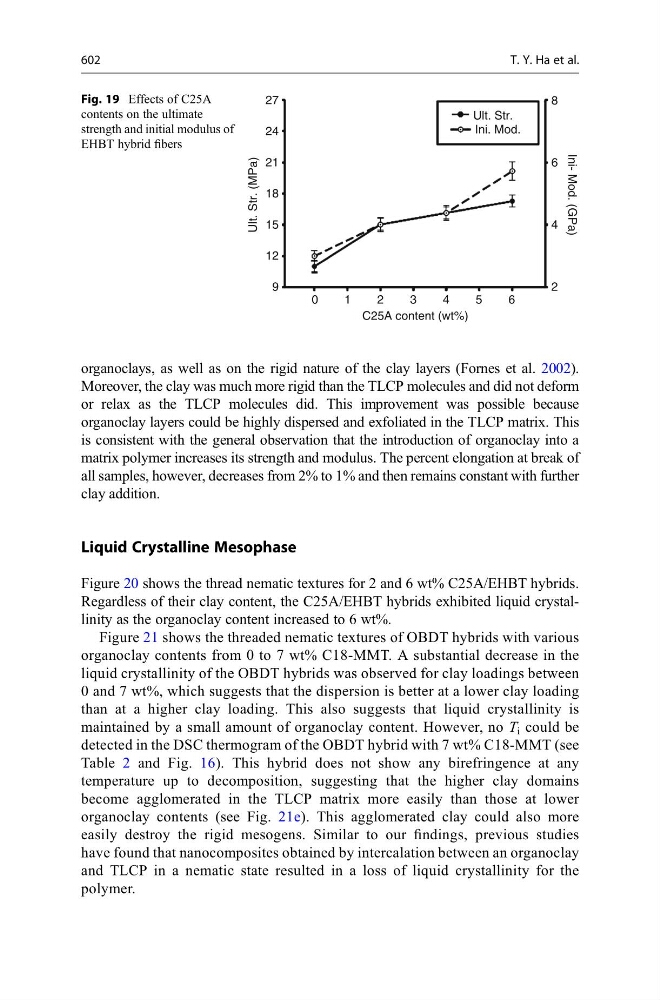
organoclays, as well as on the rigid nature of the clay layers (Fornes et al. 2002).
Moreover, the clay was much more rigid than the TLCP molecules and did not deform
or relax as the TLCP molecules did. This improvement was possible because
organoclay layers could be highly dispersed and exfoliated in the TLCP matrix. This
is consistent with the general observation that the introduction of organoclay into a
matrix polymer increases its strength and modulus. The percent elongation at break of
all samples, however, decreases from 2% to 1% and then remains constant with further
clay addition.
Liquid Crystalline Mesophase
Figure 20 shows the thread nematic textures for 2 and 6 wt% C25A/EHBT hybrids.
Regardless of their clay content, the C25A/EHBT hybrids exhibited liquid crystallinity as the organoclay content increased to 6 wt%.
Figure 21 shows the threaded nematic textures of OBDT hybrids with various
organoclay contents from 0 to 7 wt% C18-MMT. A substantial decrease in the
liquid crystallinity of the OBDT hybrids was observed for clay loadings between
0 and 7 wt%, which suggests that the dispersion is better at a lower clay loading
than at a higher clay loading. This also suggests that liquid crystallinity is
maintained by a small amount of organoclay content. However, no T i could be
detected in the DSC thermogram of the OBDT hybrid with 7 wt% C18-MMT (see
Table 2 and Fig. 16). This hybrid does not show any birefringence at any
temperature up to decomposition, suggesting that the higher clay domains
become agglomerated in the TLCP matrix more easily than those at lower
organoclay contents (see Fig. 21e). This agglomerated clay could also more
easily destroy the rigid mesogens. Similar to our findings, previous studies
have found that nanocomposites obtained by intercalation between an organoclay
and TLCP in a nematic state resulted in a loss of liquid crystallinity for the
polymer.
Ult. Str. (MPa)
27
24
21
18
15
12
9
C25A content (wt%)
0
1
2
3
4
5
6
2
4
6
Ult. Str.
Ini. Mod.
Ini- Mod. (GPa)
8
Fig. 19 Effects of C25A
contents on the ultimate
strength and initial modulus of
EHBT hybrid fibers
602
T. Y. Ha et al.