

composition of the clay from 2 to 6 wt% in the EHBT hybrids, with a maximum
increase of 23
C for the 6 wt% C25A/EHBT as compared to that of the pure EHBT.
The weight of the residue at 600
C increased from 37% to 47% as the clay loading
increased from 0 to 6 wt%. This enhancement of the char formation is ascribed to the
high heat resistance exerted by the clay itself.
The thermal properties of OBDT hybrids with various organoclay contents are
listed in Table 2. The T g values of the OBDT hybrids increase from 110 to 133
C as
the clay loading is increased from 0 to 1 wt%. This increase in T g is ascribed to
confinement of the intercalated polymer chains within the clay galleries, which
prevents segmental motion of the polymer chains. However, the T g values of the
TLCP hybrids with 3–7 wt% organoclay content were found to be virtually
unchanged at 112–113
C (see Fig. 15). This implies that varying the clay content
does not improve the confinement of the TLCP chains. The endothermic peaks of
pure TLCP appear at 283 and 316
C, which correspond to T m and T i , respectively
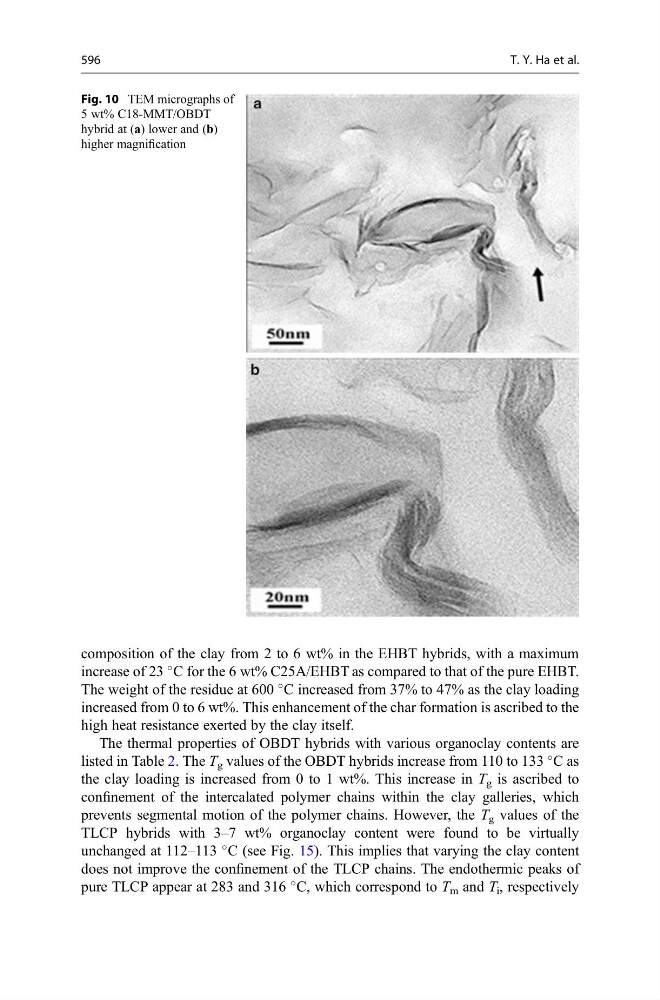
Fig. 10 TEM micrographs of
5 wt% C18-MMT/OBDT
hybrid at (a) lower and (b)
higher magnification
596
T. Y. Ha et al.