

heat insulation effect of the clay layer structure, as well as the strong interaction
between the organoclay and TLCP molecular chains (Chang et al. 2014). The
isotropic transition temperatures (T i ) of pure EHBT was virtually unchanged in the
EHBT hybrids regardless of the organoclay loading.
In addition to the higher melting point, the thermal degradation properties of the
TLCP hybrids also show improvement. A comparative thermal gravimetric analysis
(TGA) of pure EHBT and three hybrids with 2–6 wt% C25A is shown in Table 1 and
Fig. 14. The TGA curves do not show a weight loss below 100
C, as shown in
Fig. 14, indicating that no water remained in the samples. The weight loss due to
decomposition of EHBT and its hybrids was nearly the same up to a temperature of
about 300
C. After this point, the initial thermal degradation temperature (T D
i
) was
influenced by the organoclay loading in the hybrids. Table 1 shows that the T D
i
values of the C25A/EHBT hybrids (at 2% weight loss) increased with increasing
organoclay content. T D
i was observed to be 352–353
C depending on the
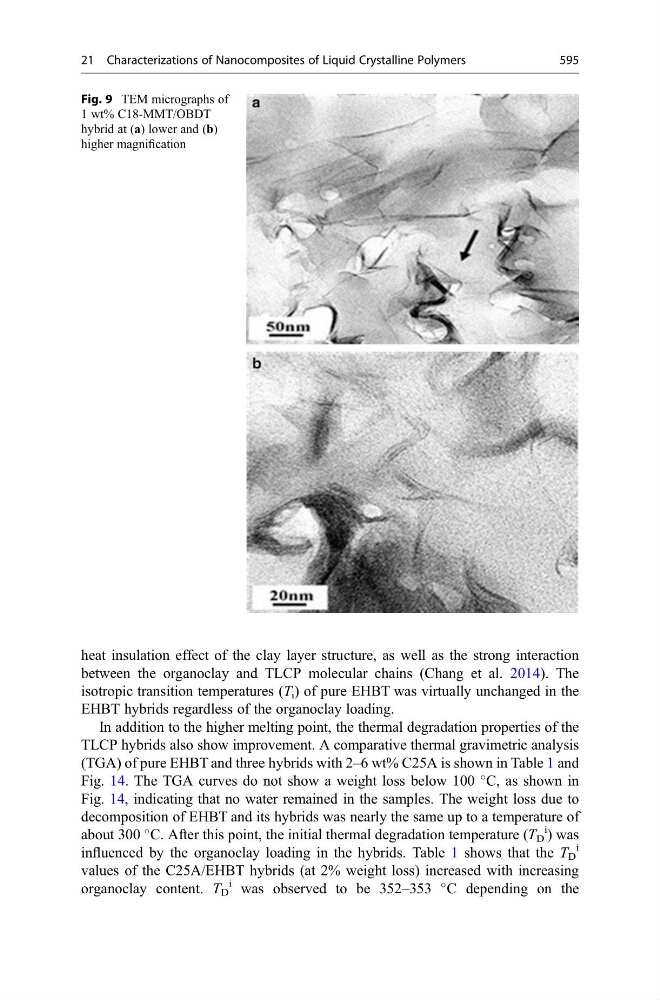
Fig. 9 TEM micrographs of
1 wt% C18-MMT/OBDT
hybrid at (a) lower and (b)
higher magnification
21 Characterizations of Nanocomposites of Liquid Crystalline Polymers
595