

the formation of nematic Schlieren texture in the copolyesters with longer methylene
repeats. However, as for the copolyesters with two or four methylene groups, the
restricted mesogenic movement due to limited spacer size would considerably
disturb the mesogenic alignment, resulting in small microdomains. On the other
hand, the copolyesters demonstrated high thermal stability with high decomposition
residue at 600
C, supposed to be a criterion for the copolyesters to act as flameretardant materials. Both phosphorus-containing segment and ferrocene moiety
contributed to high char formation. As X was substituted from methyoxyl to phenyl,
phenoxyl, or even to biphenoxyl group (Scheme 9), only the copolyesters with more
methylene repeats could exhibit large monodomain to illustrate a nematic Schlieren
texture. The lateral substitution of the bulky pendent group, as the authors revealed,
could considerably affect the arrangement of the mesogenic units to form an ordered
liquid crystalline state.
The authors also calculated the energy minimized structures of the ferrocene
mesogen that the 1,1
0 -disubstituted ferrocene moiety resulted in a “side-step”
structure to the mesogenic unit. Generally, “side-step” is used to describe the
structural mesogenic units that change the shape of rod-like moieties into stairlike ones, thus rendering the molecules with significant flexibility (Laupretre and
Noel 1991). Further, the bulky ion atom disturbed the packing of the mesogenic
unit, also the polymer chains alignment; it thereby caused reduction in both the
glass transition temperature and the liquid crystalline transition temperature of the
resulting copolyesters.
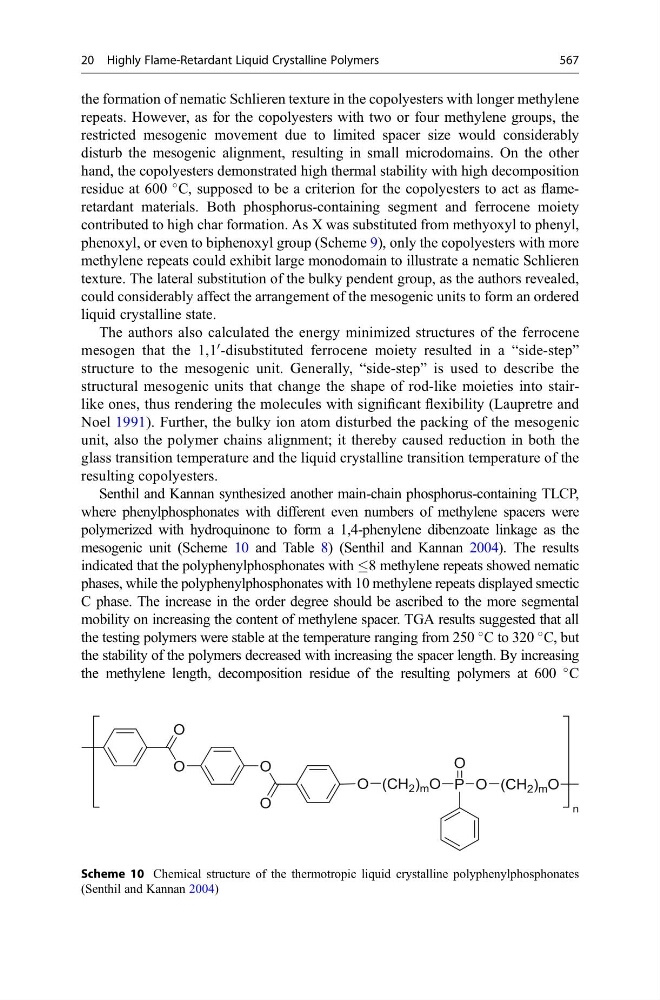
Senthil and Kannan synthesized another main-chain phosphorus-containing TLCP,
where phenylphosphonates with different even numbers of methylene spacers were
polymerized with hydroquinone to form a 1,4-phenylene dibenzoate linkage as the
mesogenic unit (Scheme 10 and Table 8) (Senthil and Kannan 2004). The results
indicated that the polyphenylphosphonates with 8 methylene repeats showed nematic
phases, while the polyphenylphosphonates with 10 methylene repeats displayed smectic
C phase. The increase in the order degree should be ascribed to the more segmental
mobility on increasing the content of methylene spacer. TGA results suggested that all
the testing polymers were stable at the temperature ranging from 250
C to 320
C, but
the stability of the polymers decreased with increasing the spacer length. By increasing
the methylene length, decomposition residue of the resulting polymers at 600
C
Scheme 10 Chemical structure of the thermotropic liquid crystalline polyphenylphosphonates
(Senthil and Kannan 2004)
20 Highly Flame-Retardant Liquid Crystalline Polymers
567
repeats. However, as for the copolyesters with two or four methylene groups, the
restricted mesogenic movement due to limited spacer size would considerably
disturb the mesogenic alignment, resulting in small microdomains. On the other
hand, the copolyesters demonstrated high thermal stability with high decomposition
residue at 600
C, supposed to be a criterion for the copolyesters to act as flameretardant materials. Both phosphorus-containing segment and ferrocene moiety
contributed to high char formation. As X was substituted from methyoxyl to phenyl,
phenoxyl, or even to biphenoxyl group (Scheme 9), only the copolyesters with more
methylene repeats could exhibit large monodomain to illustrate a nematic Schlieren
texture. The lateral substitution of the bulky pendent group, as the authors revealed,
could considerably affect the arrangement of the mesogenic units to form an ordered
liquid crystalline state.
The authors also calculated the energy minimized structures of the ferrocene
mesogen that the 1,1
0 -disubstituted ferrocene moiety resulted in a “side-step”
structure to the mesogenic unit. Generally, “side-step” is used to describe the
structural mesogenic units that change the shape of rod-like moieties into stairlike ones, thus rendering the molecules with significant flexibility (Laupretre and
Noel 1991). Further, the bulky ion atom disturbed the packing of the mesogenic
unit, also the polymer chains alignment; it thereby caused reduction in both the
glass transition temperature and the liquid crystalline transition temperature of the
resulting copolyesters.
Senthil and Kannan synthesized another main-chain phosphorus-containing TLCP,
where phenylphosphonates with different even numbers of methylene spacers were
polymerized with hydroquinone to form a 1,4-phenylene dibenzoate linkage as the
mesogenic unit (Scheme 10 and Table 8) (Senthil and Kannan 2004). The results
indicated that the polyphenylphosphonates with 8 methylene repeats showed nematic
phases, while the polyphenylphosphonates with 10 methylene repeats displayed smectic
C phase. The increase in the order degree should be ascribed to the more segmental
mobility on increasing the content of methylene spacer. TGA results suggested that all
the testing polymers were stable at the temperature ranging from 250
C to 320
C, but
the stability of the polymers decreased with increasing the spacer length. By increasing
the methylene length, decomposition residue of the resulting polymers at 600
C
Scheme 10 Chemical structure of the thermotropic liquid crystalline polyphenylphosphonates
(Senthil and Kannan 2004)
20 Highly Flame-Retardant Liquid Crystalline Polymers
567