

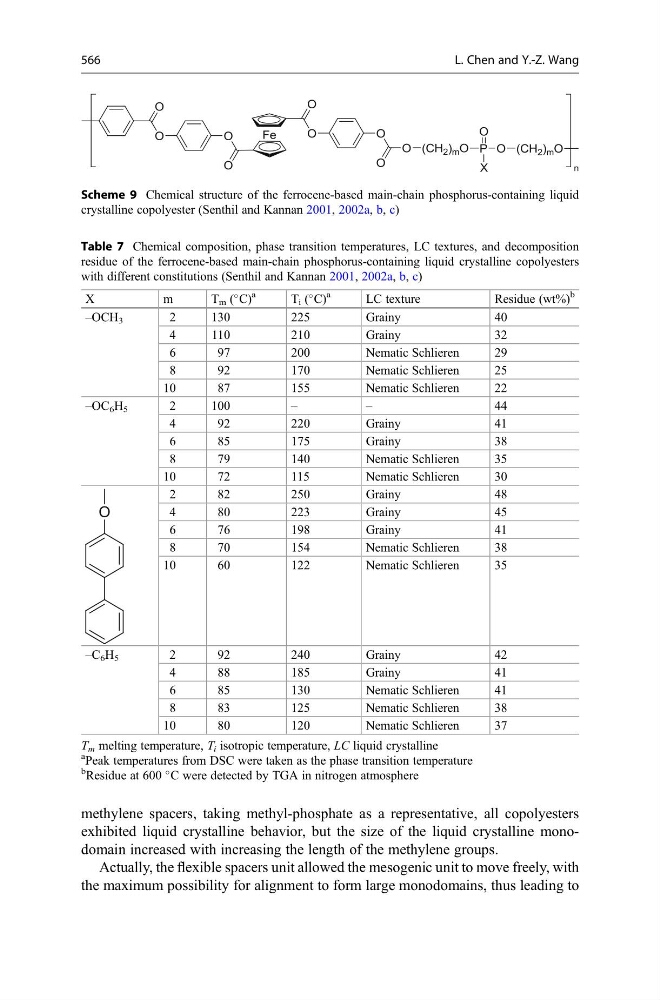
methylene spacers, taking methyl-phosphate as a representative, all copolyesters
exhibited liquid crystalline behavior, but the size of the liquid crystalline monodomain increased with increasing the length of the methylene groups.
Actually, the flexible spacers unit allowed the mesogenic unit to move freely, with
the maximum possibility for alignment to form large monodomains, thus leading to
Scheme 9 Chemical structure of the ferrocene-based main-chain phosphorus-containing liquid
crystalline copolyester (Senthil and Kannan 2001, 2002a, b, c)
Table 7 Chemical composition, phase transition temperatures, LC textures, and decomposition
residue of the ferrocene-based main-chain phosphorus-containing liquid crystalline copolyesters
with different constitutions (Senthil and Kannan 2001, 2002a, b, c)
X
m
T m (
C)
a
T i (
C)
a
LC texture
Residue (wt%)
b
–OCH 3
2
130
225
Grainy
40
4
110
210
Grainy
32
6
97
200
Nematic Schlieren
29
8
92
170
Nematic Schlieren
25
10
87
155
Nematic Schlieren
22
–OC 6 H 5
2
100
–
–
44
4
92
220
Grainy
41
6
85
175
Grainy
38
8
79
140
Nematic Schlieren
35
10
72
115
Nematic Schlieren
30
2
82
250
Grainy
48
4
80
223
Grainy
45
6
76
198
Grainy
41
8
70
154
Nematic Schlieren
38
10
60
122
Nematic Schlieren
35
–C 6 H 5
2
92
240
Grainy
42
4
88
185
Grainy
41
6
85
130
Nematic Schlieren
41
8
83
125
Nematic Schlieren
38
10
80
120
Nematic Schlieren
37
T m melting temperature, T i isotropic temperature, LC liquid crystalline
a Peak temperatures from DSC were taken as the phase transition temperature
b
Residue at 600
C were detected by TGA in nitrogen atmosphere
566
L. Chen and Y.-Z. Wang
exhibited liquid crystalline behavior, but the size of the liquid crystalline monodomain increased with increasing the length of the methylene groups.
Actually, the flexible spacers unit allowed the mesogenic unit to move freely, with
the maximum possibility for alignment to form large monodomains, thus leading to
Scheme 9 Chemical structure of the ferrocene-based main-chain phosphorus-containing liquid
crystalline copolyester (Senthil and Kannan 2001, 2002a, b, c)
Table 7 Chemical composition, phase transition temperatures, LC textures, and decomposition
residue of the ferrocene-based main-chain phosphorus-containing liquid crystalline copolyesters
with different constitutions (Senthil and Kannan 2001, 2002a, b, c)
X
m
T m (
C)
a
T i (
C)
a
LC texture
Residue (wt%)
b
–OCH 3
2
130
225
Grainy
40
4
110
210
Grainy
32
6
97
200
Nematic Schlieren
29
8
92
170
Nematic Schlieren
25
10
87
155
Nematic Schlieren
22
–OC 6 H 5
2
100
–
–
44
4
92
220
Grainy
41
6
85
175
Grainy
38
8
79
140
Nematic Schlieren
35
10
72
115
Nematic Schlieren
30
2
82
250
Grainy
48
4
80
223
Grainy
45
6
76
198
Grainy
41
8
70
154
Nematic Schlieren
38
10
60
122
Nematic Schlieren
35
–C 6 H 5
2
92
240
Grainy
42
4
88
185
Grainy
41
6
85
130
Nematic Schlieren
41
8
83
125
Nematic Schlieren
38
10
80
120
Nematic Schlieren
37
T m melting temperature, T i isotropic temperature, LC liquid crystalline
a Peak temperatures from DSC were taken as the phase transition temperature
b
Residue at 600
C were detected by TGA in nitrogen atmosphere
566
L. Chen and Y.-Z. Wang