

reduced from 38 up to 8 wt%. The decomposition of the polymers occurred through the
pyrolytic cleavage of the phosphonate ester bond, therefore breaking the linkage
between the mesogenic groups with different numbers of methylene unit.
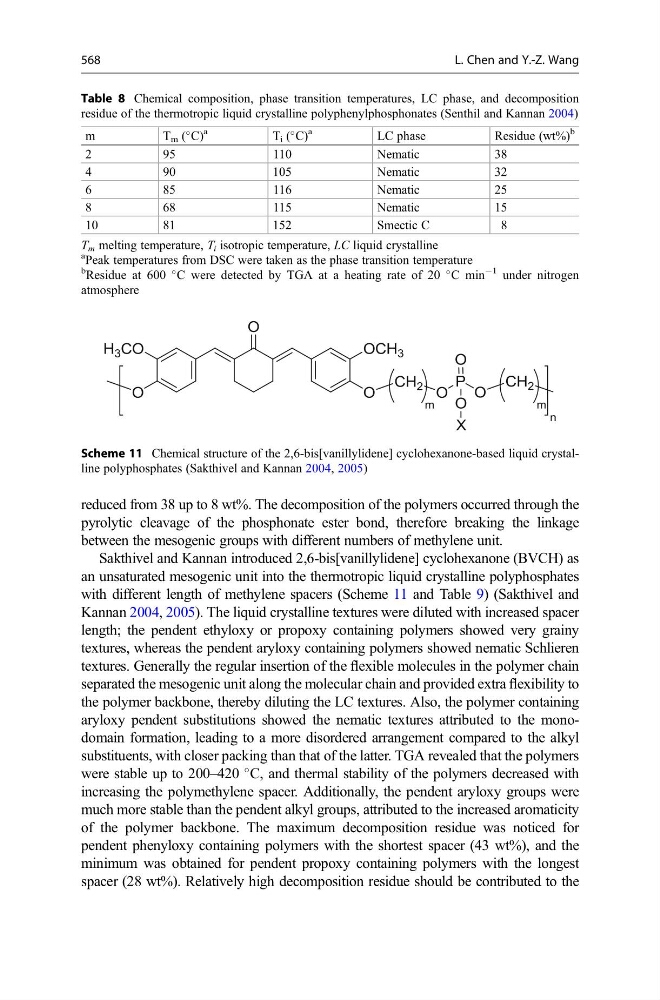
Sakthivel and Kannan introduced 2,6-bis[vanillylidene] cyclohexanone (BVCH) as
an unsaturated mesogenic unit into the thermotropic liquid crystalline polyphosphates
with different length of methylene spacers (Scheme 11 and Table 9) (Sakthivel and
Kannan 2004, 2005). The liquid crystalline textures were diluted with increased spacer
length; the pendent ethyloxy or propoxy containing polymers showed very grainy
textures, whereas the pendent aryloxy containing polymers showed nematic Schlieren
textures. Generally the regular insertion of the flexible molecules in the polymer chain
separated the mesogenic unit along the molecular chain and provided extra flexibility to
the polymer backbone, thereby diluting the LC textures. Also, the polymer containing
aryloxy pendent substitutions showed the nematic textures attributed to the monodomain formation, leading to a more disordered arrangement compared to the alkyl
substituents, with closer packing than that of the latter. TGA revealed that the polymers
were stable up to 200–420
C, and thermal stability of the polymers decreased with
increasing the polymethylene spacer. Additionally, the pendent aryloxy groups were
much more stable than the pendent alkyl groups, attributed to the increased aromaticity
of the polymer backbone. The maximum decomposition residue was noticed for
pendent phenyloxy containing polymers with the shortest spacer (43 wt%), and the
minimum was obtained for pendent propoxy containing polymers with the longest
spacer (28 wt%). Relatively high decomposition residue should be contributed to the
Table 8 Chemical composition, phase transition temperatures, LC phase, and decomposition
residue of the thermotropic liquid crystalline polyphenylphosphonates (Senthil and Kannan 2004)
m
T m (
C)
a
T i (
C)
a
LC phase
Residue (wt%)
b
2
95
110
Nematic
38
4
90
105
Nematic
32
6
85
116
Nematic
25
8
68
115
Nematic
15
10
81
152
Smectic C
8
T m melting temperature, T i isotropic temperature, LC liquid crystalline
a Peak temperatures from DSC were taken as the phase transition temperature
b
Residue at 600
C were detected by TGA at a heating rate of 20
C min
À1 under nitrogen
atmosphere
Scheme 11 Chemical structure of the 2,6-bis[vanillylidene] cyclohexanone-based liquid crystalline polyphosphates (Sakthivel and Kannan 2004, 2005)
568
L. Chen and Y.-Z. Wang