

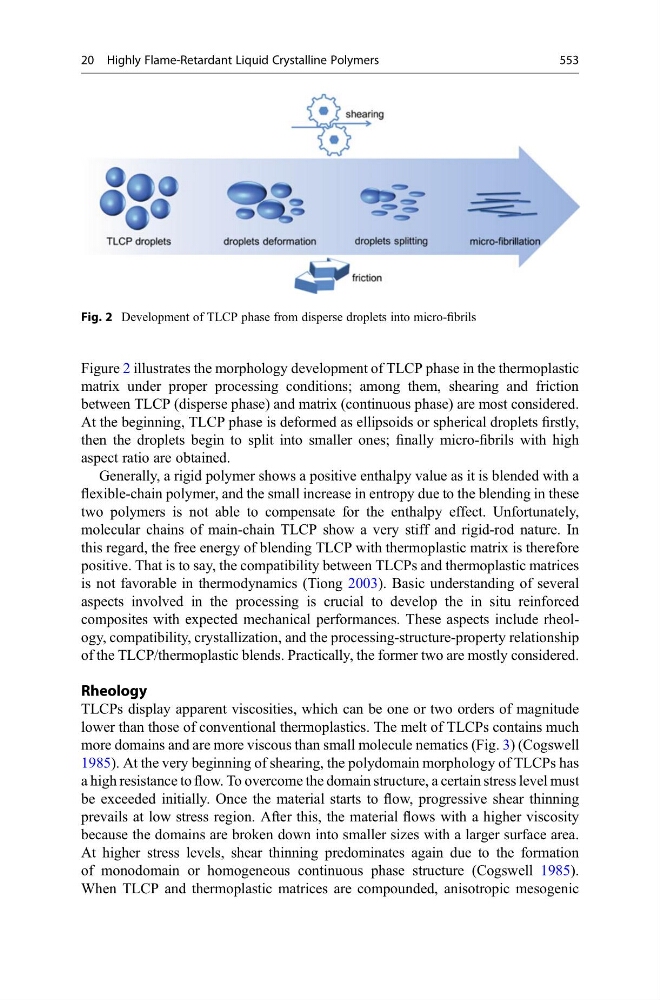
Figure 2 illustrates the morphology development of TLCP phase in the thermoplastic
matrix under proper processing conditions; among them, shearing and friction
between TLCP (disperse phase) and matrix (continuous phase) are most considered.
At the beginning, TLCP phase is deformed as ellipsoids or spherical droplets firstly,
then the droplets begin to split into smaller ones; finally micro-fibrils with high
aspect ratio are obtained.
Generally, a rigid polymer shows a positive enthalpy value as it is blended with a
flexible-chain polymer, and the small increase in entropy due to the blending in these
two polymers is not able to compensate for the enthalpy effect. Unfortunately,
molecular chains of main-chain TLCP show a very stiff and rigid-rod nature. In
this regard, the free energy of blending TLCP with thermoplastic matrix is therefore
positive. That is to say, the compatibility between TLCPs and thermoplastic matrices
is not favorable in thermodynamics (Tiong 2003). Basic understanding of several
aspects involved in the processing is crucial to develop the in situ reinforced
composites with expected mechanical performances. These aspects include rheology, compatibility, crystallization, and the processing-structure-property relationship
of the TLCP/thermoplastic blends. Practically, the former two are mostly considered.
Rheology
TLCPs display apparent viscosities, which can be one or two orders of magnitude
lower than those of conventional thermoplastics. The melt of TLCPs contains much
more domains and are more viscous than small molecule nematics (Fig. 3) (Cogswell
1985). At the very beginning of shearing, the polydomain morphology of TLCPs has
a high resistance to flow. To overcome the domain structure, a certain stress level must
be exceeded initially. Once the material starts to flow, progressive shear thinning
prevails at low stress region. After this, the material flows with a higher viscosity
because the domains are broken down into smaller sizes with a larger surface area.
At higher stress levels, shear thinning predominates again due to the formation
of monodomain or homogeneous continuous phase structure (Cogswell 1985).
When TLCP and thermoplastic matrices are compounded, anisotropic mesogenic
Fig. 2 Development of TLCP phase from disperse droplets into micro-fibrils
20 Highly Flame-Retardant Liquid Crystalline Polymers
553
matrix under proper processing conditions; among them, shearing and friction
between TLCP (disperse phase) and matrix (continuous phase) are most considered.
At the beginning, TLCP phase is deformed as ellipsoids or spherical droplets firstly,
then the droplets begin to split into smaller ones; finally micro-fibrils with high
aspect ratio are obtained.
Generally, a rigid polymer shows a positive enthalpy value as it is blended with a
flexible-chain polymer, and the small increase in entropy due to the blending in these
two polymers is not able to compensate for the enthalpy effect. Unfortunately,
molecular chains of main-chain TLCP show a very stiff and rigid-rod nature. In
this regard, the free energy of blending TLCP with thermoplastic matrix is therefore
positive. That is to say, the compatibility between TLCPs and thermoplastic matrices
is not favorable in thermodynamics (Tiong 2003). Basic understanding of several
aspects involved in the processing is crucial to develop the in situ reinforced
composites with expected mechanical performances. These aspects include rheology, compatibility, crystallization, and the processing-structure-property relationship
of the TLCP/thermoplastic blends. Practically, the former two are mostly considered.
Rheology
TLCPs display apparent viscosities, which can be one or two orders of magnitude
lower than those of conventional thermoplastics. The melt of TLCPs contains much
more domains and are more viscous than small molecule nematics (Fig. 3) (Cogswell
1985). At the very beginning of shearing, the polydomain morphology of TLCPs has
a high resistance to flow. To overcome the domain structure, a certain stress level must
be exceeded initially. Once the material starts to flow, progressive shear thinning
prevails at low stress region. After this, the material flows with a higher viscosity
because the domains are broken down into smaller sizes with a larger surface area.
At higher stress levels, shear thinning predominates again due to the formation
of monodomain or homogeneous continuous phase structure (Cogswell 1985).
When TLCP and thermoplastic matrices are compounded, anisotropic mesogenic
Fig. 2 Development of TLCP phase from disperse droplets into micro-fibrils
20 Highly Flame-Retardant Liquid Crystalline Polymers
553