

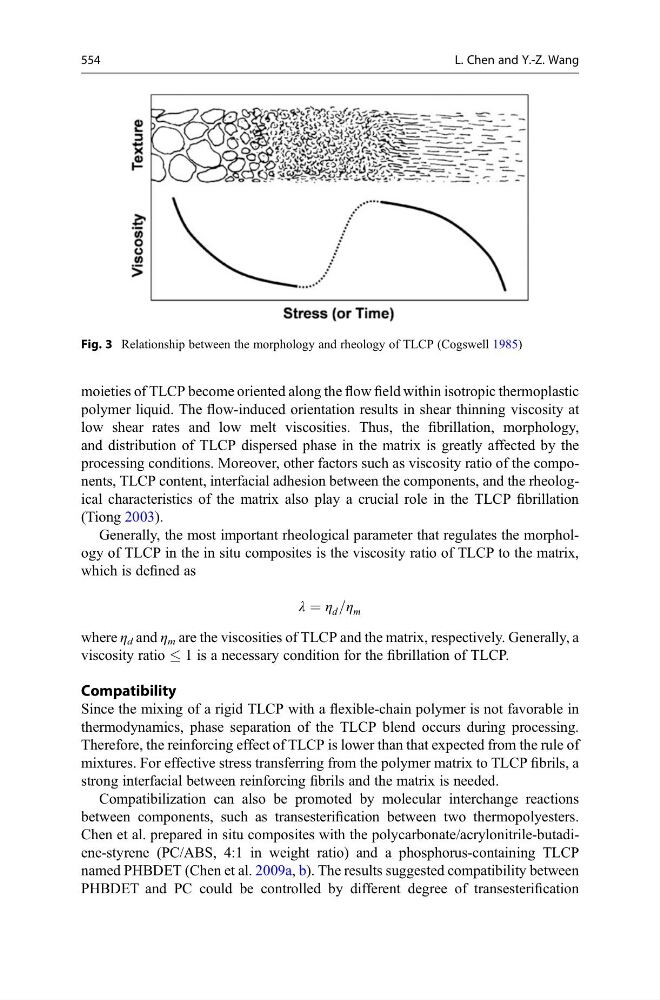
moieties of TLCP become oriented along the flow field within isotropic thermoplastic
polymer liquid. The flow-induced orientation results in shear thinning viscosity at
low shear rates and low melt viscosities. Thus, the fibrillation, morphology,
and distribution of TLCP dispersed phase in the matrix is greatly affected by the
processing conditions. Moreover, other factors such as viscosity ratio of the components, TLCP content, interfacial adhesion between the components, and the rheological characteristics of the matrix also play a crucial role in the TLCP fibrillation
(Tiong 2003).
Generally, the most important rheological parameter that regulates the morphology of TLCP in the in situ composites is the viscosity ratio of TLCP to the matrix,
which is defined as
λ ¼ η d =η m
where η d and η m are the viscosities of TLCP and the matrix, respectively. Generally, a
viscosity ratio 1 is a necessary condition for the fibrillation of TLCP.
Compatibility
Since the mixing of a rigid TLCP with a flexible-chain polymer is not favorable in
thermodynamics, phase separation of the TLCP blend occurs during processing.
Therefore, the reinforcing effect of TLCP is lower than that expected from the rule of
mixtures. For effective stress transferring from the polymer matrix to TLCP fibrils, a
strong interfacial between reinforcing fibrils and the matrix is needed.
Compatibilization can also be promoted by molecular interchange reactions
between components, such as transesterification between two thermopolyesters.
Chen et al. prepared in situ composites with the polycarbonate/acrylonitrile-butadiene-styrene (PC/ABS, 4:1 in weight ratio) and a phosphorus-containing TLCP
named PHBDET (Chen et al. 2009a, b). The results suggested compatibility between
PHBDET and PC could be controlled by different degree of transesterification
Fig. 3 Relationship between the morphology and rheology of TLCP (Cogswell 1985)
554
L. Chen and Y.-Z. Wang
polymer liquid. The flow-induced orientation results in shear thinning viscosity at
low shear rates and low melt viscosities. Thus, the fibrillation, morphology,
and distribution of TLCP dispersed phase in the matrix is greatly affected by the
processing conditions. Moreover, other factors such as viscosity ratio of the components, TLCP content, interfacial adhesion between the components, and the rheological characteristics of the matrix also play a crucial role in the TLCP fibrillation
(Tiong 2003).
Generally, the most important rheological parameter that regulates the morphology of TLCP in the in situ composites is the viscosity ratio of TLCP to the matrix,
which is defined as
λ ¼ η d =η m
where η d and η m are the viscosities of TLCP and the matrix, respectively. Generally, a
viscosity ratio 1 is a necessary condition for the fibrillation of TLCP.
Compatibility
Since the mixing of a rigid TLCP with a flexible-chain polymer is not favorable in
thermodynamics, phase separation of the TLCP blend occurs during processing.
Therefore, the reinforcing effect of TLCP is lower than that expected from the rule of
mixtures. For effective stress transferring from the polymer matrix to TLCP fibrils, a
strong interfacial between reinforcing fibrils and the matrix is needed.
Compatibilization can also be promoted by molecular interchange reactions
between components, such as transesterification between two thermopolyesters.
Chen et al. prepared in situ composites with the polycarbonate/acrylonitrile-butadiene-styrene (PC/ABS, 4:1 in weight ratio) and a phosphorus-containing TLCP
named PHBDET (Chen et al. 2009a, b). The results suggested compatibility between
PHBDET and PC could be controlled by different degree of transesterification
Fig. 3 Relationship between the morphology and rheology of TLCP (Cogswell 1985)
554
L. Chen and Y.-Z. Wang