

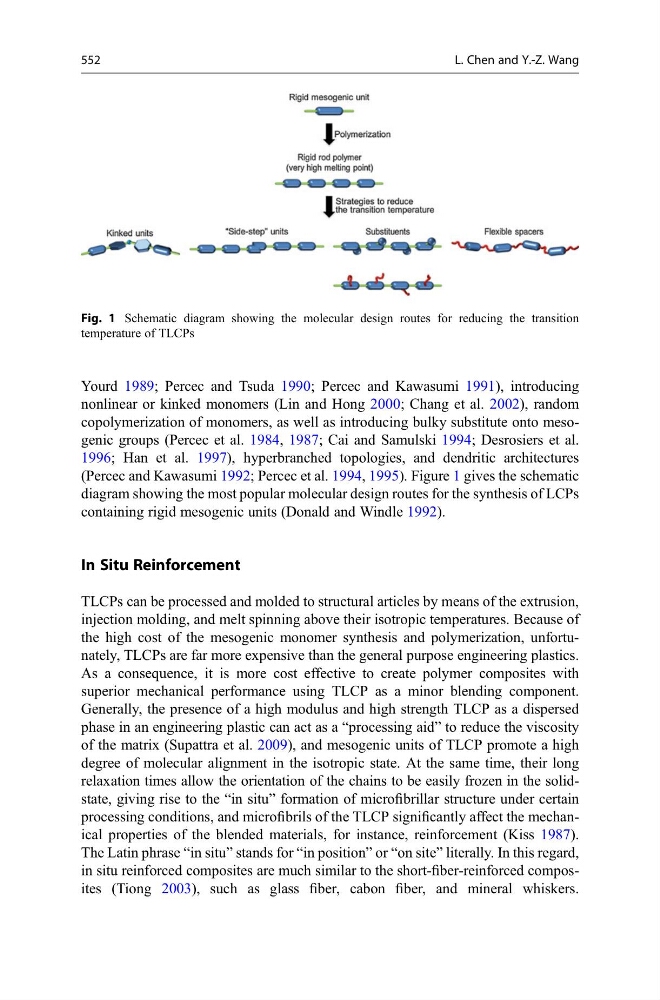
Yourd 1989; Percec and Tsuda 1990; Percec and Kawasumi 1991), introducing
nonlinear or kinked monomers (Lin and Hong 2000; Chang et al. 2002), random
copolymerization of monomers, as well as introducing bulky substitute onto mesogenic groups (Percec et al. 1984, 1987; Cai and Samulski 1994; Desrosiers et al.
1996; Han et al. 1997), hyperbranched topologies, and dendritic architectures
(Percec and Kawasumi 1992; Percec et al. 1994, 1995). Figure 1 gives the schematic
diagram showing the most popular molecular design routes for the synthesis of LCPs
containing rigid mesogenic units (Donald and Windle 1992).
In Situ Reinforcement
TLCPs can be processed and molded to structural articles by means of the extrusion,
injection molding, and melt spinning above their isotropic temperatures. Because of
the high cost of the mesogenic monomer synthesis and polymerization, unfortunately, TLCPs are far more expensive than the general purpose engineering plastics.
As a consequence, it is more cost effective to create polymer composites with
superior mechanical performance using TLCP as a minor blending component.
Generally, the presence of a high modulus and high strength TLCP as a dispersed
phase in an engineering plastic can act as a “processing aid” to reduce the viscosity
of the matrix (Supattra et al. 2009), and mesogenic units of TLCP promote a high
degree of molecular alignment in the isotropic state. At the same time, their long
relaxation times allow the orientation of the chains to be easily frozen in the solidstate, giving rise to the “in situ” formation of microfibrillar structure under certain
processing conditions, and microfibrils of the TLCP significantly affect the mechanical properties of the blended materials, for instance, reinforcement (Kiss 1987).
The Latin phrase “in situ” stands for “in position” or “on site” literally. In this regard,
in situ reinforced composites are much similar to the short-fiber-reinforced composites (Tiong 2003), such as glass fiber, cabon fiber, and mineral whiskers.
Fig. 1 Schematic diagram showing the molecular design routes for reducing the transition
temperature of TLCPs
552
L. Chen and Y.-Z. Wang
nonlinear or kinked monomers (Lin and Hong 2000; Chang et al. 2002), random
copolymerization of monomers, as well as introducing bulky substitute onto mesogenic groups (Percec et al. 1984, 1987; Cai and Samulski 1994; Desrosiers et al.
1996; Han et al. 1997), hyperbranched topologies, and dendritic architectures
(Percec and Kawasumi 1992; Percec et al. 1994, 1995). Figure 1 gives the schematic
diagram showing the most popular molecular design routes for the synthesis of LCPs
containing rigid mesogenic units (Donald and Windle 1992).
In Situ Reinforcement
TLCPs can be processed and molded to structural articles by means of the extrusion,
injection molding, and melt spinning above their isotropic temperatures. Because of
the high cost of the mesogenic monomer synthesis and polymerization, unfortunately, TLCPs are far more expensive than the general purpose engineering plastics.
As a consequence, it is more cost effective to create polymer composites with
superior mechanical performance using TLCP as a minor blending component.
Generally, the presence of a high modulus and high strength TLCP as a dispersed
phase in an engineering plastic can act as a “processing aid” to reduce the viscosity
of the matrix (Supattra et al. 2009), and mesogenic units of TLCP promote a high
degree of molecular alignment in the isotropic state. At the same time, their long
relaxation times allow the orientation of the chains to be easily frozen in the solidstate, giving rise to the “in situ” formation of microfibrillar structure under certain
processing conditions, and microfibrils of the TLCP significantly affect the mechanical properties of the blended materials, for instance, reinforcement (Kiss 1987).
The Latin phrase “in situ” stands for “in position” or “on site” literally. In this regard,
in situ reinforced composites are much similar to the short-fiber-reinforced composites (Tiong 2003), such as glass fiber, cabon fiber, and mineral whiskers.
Fig. 1 Schematic diagram showing the molecular design routes for reducing the transition
temperature of TLCPs
552
L. Chen and Y.-Z. Wang