

crystallinity. This equation is inadequate in explaining the diffusivity in crystalline and liquid crystalline polymers because the crystalline phase seems to
include two factors (Michaels and Bixler 1961). Small molecules are assumed
to be incapable of diffusing or permeating through the crystalline phase. Therefore, they must pass through an elongated path because of the presence of the
crystalline phase. This factor is generally accounted for as the tortuosity or
geometric impedance factor, τ. The other factor is the chain-immobilization
factor, β. The reciprocal of β, (β
À1 ), represents a fractional reduction in diffusivity because of the restriction of the polymer chain segmental mobility in the
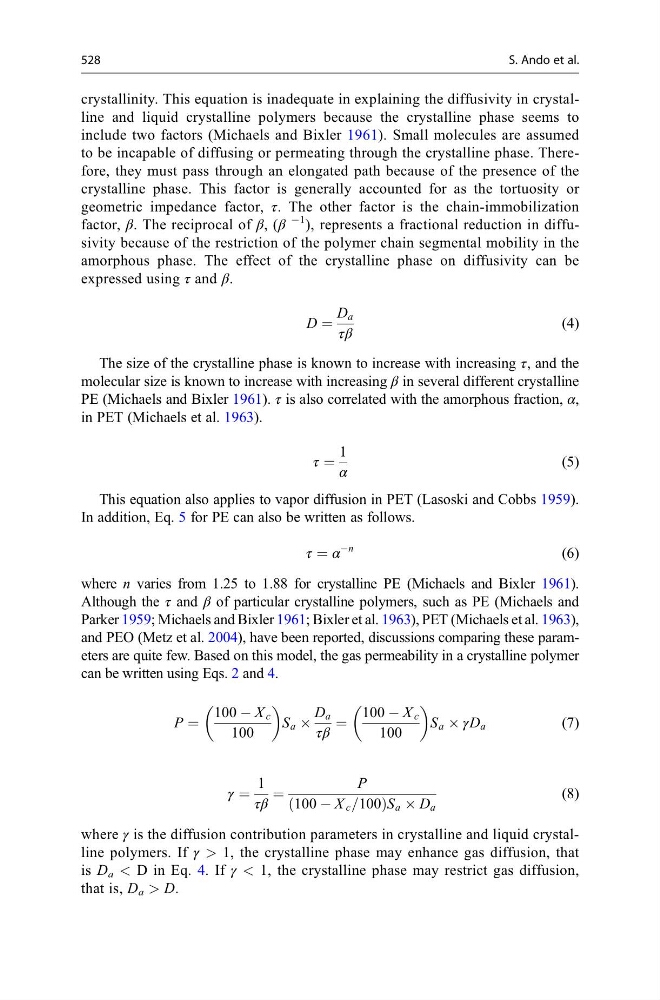
amorphous phase. The effect of the crystalline phase on diffusivity can be
expressed using τ and β.
D ¼
D a
τβ
(4)
The size of the crystalline phase is known to increase with increasing τ, and the
molecular size is known to increase with increasing β in several different crystalline
PE (Michaels and Bixler 1961). τ is also correlated with the amorphous fraction, α,
in PET (Michaels et al. 1963).
τ ¼
1
α
(5)
This equation also applies to vapor diffusion in PET (Lasoski and Cobbs 1959).
In addition, Eq. 5 for PE can also be written as follows.
τ ¼ α
Àn
(6)
where n varies from 1.25 to 1.88 for crystalline PE (Michaels and Bixler 1961).
Although the τ and β of particular crystalline polymers, such as PE (Michaels and
Parker 1959; Michaels and Bixler 1961; Bixler et al. 1963), PET (Michaels et al. 1963),
and PEO (Metz et al. 2004), have been reported, discussions comparing these parameters are quite few. Based on this model, the gas permeability in a crystalline polymer
can be written using Eqs. 2 and 4.
P ¼
100 À X c
100
S a Â
D a
τβ
¼
100 À X c
100
S a  γD a
(7)
γ ¼
1
τβ
¼
P
100 À X c =100
ð
Þ S a  D a
(8)
where γ is the diffusion contribution parameters in crystalline and liquid crystalline polymers. If γ > 1, the crystalline phase may enhance gas diffusion, that
is D a < D in Eq. 4. If γ < 1, the crystalline phase may restrict gas diffusion,
that is, D a > D.
528
S. Ando et al.
include two factors (Michaels and Bixler 1961). Small molecules are assumed
to be incapable of diffusing or permeating through the crystalline phase. Therefore, they must pass through an elongated path because of the presence of the
crystalline phase. This factor is generally accounted for as the tortuosity or
geometric impedance factor, τ. The other factor is the chain-immobilization
factor, β. The reciprocal of β, (β
À1 ), represents a fractional reduction in diffusivity because of the restriction of the polymer chain segmental mobility in the
amorphous phase. The effect of the crystalline phase on diffusivity can be
expressed using τ and β.
D ¼
D a
τβ
(4)
The size of the crystalline phase is known to increase with increasing τ, and the
molecular size is known to increase with increasing β in several different crystalline
PE (Michaels and Bixler 1961). τ is also correlated with the amorphous fraction, α,
in PET (Michaels et al. 1963).
τ ¼
1
α
(5)
This equation also applies to vapor diffusion in PET (Lasoski and Cobbs 1959).
In addition, Eq. 5 for PE can also be written as follows.
τ ¼ α
Àn
(6)
where n varies from 1.25 to 1.88 for crystalline PE (Michaels and Bixler 1961).
Although the τ and β of particular crystalline polymers, such as PE (Michaels and
Parker 1959; Michaels and Bixler 1961; Bixler et al. 1963), PET (Michaels et al. 1963),
and PEO (Metz et al. 2004), have been reported, discussions comparing these parameters are quite few. Based on this model, the gas permeability in a crystalline polymer
can be written using Eqs. 2 and 4.
P ¼
100 À X c
100
S a Â
D a
τβ
¼
100 À X c
100
S a  γD a
(7)
γ ¼
1
τβ
¼
P
100 À X c =100
ð
Þ S a  D a
(8)
where γ is the diffusion contribution parameters in crystalline and liquid crystalline polymers. If γ > 1, the crystalline phase may enhance gas diffusion, that
is D a < D in Eq. 4. If γ < 1, the crystalline phase may restrict gas diffusion,
that is, D a > D.
528
S. Ando et al.