

As mentioned above, the microstructure of crystalline and liquid crystalline
polymers strongly affect not only their physical properties but also their transport
properties. We have already reported and discussed the validity of dual mode
sorption parameters and gas transport properties based on a statistical analysis
employing 250 types of glassy amorphous polymers from an exhaustive search of
published data (Kanehashi and Nagai 2005). In the present study, published data
on the physical and gas transport properties of 300 crystalline and liquid crystalline polymers were statistically evaluated and analyzed in comparison with
glassy amorphous polymers (Kanehashi and Nagai 2005).
Gas Permeation Mechanism in Crystalline and Liquid Crystalline
Polymers
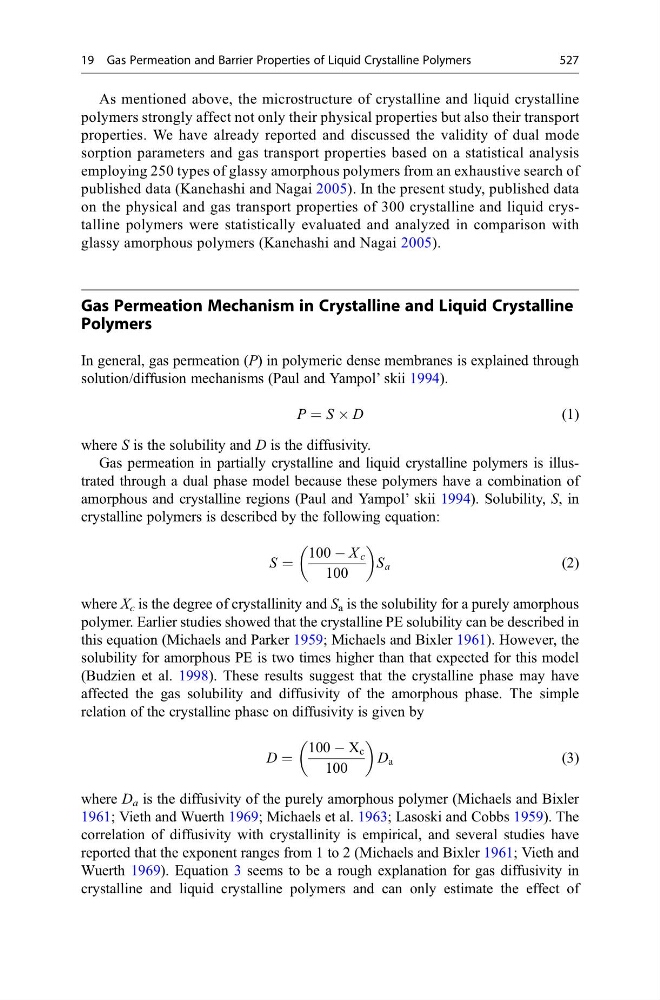
In general, gas permeation (P) in polymeric dense membranes is explained through
solution/diffusion mechanisms (Paul and Yampol’ skii 1994).
P ¼ S Â D
(1)
where S is the solubility and D is the diffusivity.
Gas permeation in partially crystalline and liquid crystalline polymers is illustrated through a dual phase model because these polymers have a combination of
amorphous and crystalline regions (Paul and Yampol’ skii 1994). Solubility, S, in
crystalline polymers is described by the following equation:
S ¼
100 À X c
100
S a
(2)
where X c is the degree of crystallinity and S a is the solubility for a purely amorphous
polymer. Earlier studies showed that the crystalline PE solubility can be described in
this equation (Michaels and Parker 1959; Michaels and Bixler 1961). However, the
solubility for amorphous PE is two times higher than that expected for this model
(Budzien et al. 1998). These results suggest that the crystalline phase may have
affected the gas solubility and diffusivity of the amorphous phase. The simple
relation of the crystalline phase on diffusivity is given by
D ¼
100 À X c
100
D a
(3)
where D a is the diffusivity of the purely amorphous polymer (Michaels and Bixler
1961; Vieth and Wuerth 1969; Michaels et al. 1963; Lasoski and Cobbs 1959). The
correlation of diffusivity with crystallinity is empirical, and several studies have
reported that the exponent ranges from 1 to 2 (Michaels and Bixler 1961; Vieth and
Wuerth 1969). Equation 3 seems to be a rough explanation for gas diffusivity in
crystalline and liquid crystalline polymers and can only estimate the effect of
19 Gas Permeation and Barrier Properties of Liquid Crystalline Polymers
527
polymers strongly affect not only their physical properties but also their transport
properties. We have already reported and discussed the validity of dual mode
sorption parameters and gas transport properties based on a statistical analysis
employing 250 types of glassy amorphous polymers from an exhaustive search of
published data (Kanehashi and Nagai 2005). In the present study, published data
on the physical and gas transport properties of 300 crystalline and liquid crystalline polymers were statistically evaluated and analyzed in comparison with
glassy amorphous polymers (Kanehashi and Nagai 2005).
Gas Permeation Mechanism in Crystalline and Liquid Crystalline
Polymers
In general, gas permeation (P) in polymeric dense membranes is explained through
solution/diffusion mechanisms (Paul and Yampol’ skii 1994).
P ¼ S Â D
(1)
where S is the solubility and D is the diffusivity.
Gas permeation in partially crystalline and liquid crystalline polymers is illustrated through a dual phase model because these polymers have a combination of
amorphous and crystalline regions (Paul and Yampol’ skii 1994). Solubility, S, in
crystalline polymers is described by the following equation:
S ¼
100 À X c
100
S a
(2)
where X c is the degree of crystallinity and S a is the solubility for a purely amorphous
polymer. Earlier studies showed that the crystalline PE solubility can be described in
this equation (Michaels and Parker 1959; Michaels and Bixler 1961). However, the
solubility for amorphous PE is two times higher than that expected for this model
(Budzien et al. 1998). These results suggest that the crystalline phase may have
affected the gas solubility and diffusivity of the amorphous phase. The simple
relation of the crystalline phase on diffusivity is given by
D ¼
100 À X c
100
D a
(3)
where D a is the diffusivity of the purely amorphous polymer (Michaels and Bixler
1961; Vieth and Wuerth 1969; Michaels et al. 1963; Lasoski and Cobbs 1959). The
correlation of diffusivity with crystallinity is empirical, and several studies have
reported that the exponent ranges from 1 to 2 (Michaels and Bixler 1961; Vieth and
Wuerth 1969). Equation 3 seems to be a rough explanation for gas diffusivity in
crystalline and liquid crystalline polymers and can only estimate the effect of
19 Gas Permeation and Barrier Properties of Liquid Crystalline Polymers
527