

films were prepared by spin-coating a filtered 2.0 wt% solution of the polymer in
high volatility (boiling point = 67
C) tetrahydrofuran (THF) or low volatility
(boiling point = 166
C) N,N-dimethylacetamide (DMAc) on quartz substrates at
3000 rpm for 30 s. The 6FDA-TeMPD polyimides were then baked at 100 or
250
C for 3 h. The resulting substrates were then allowed to cool to room
temperature.
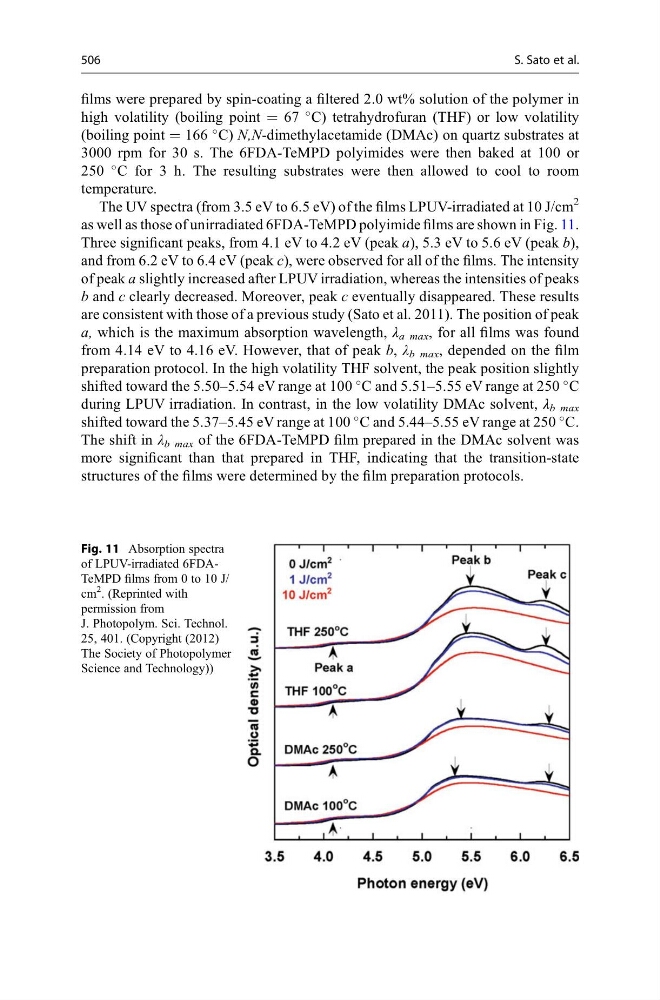
The UV spectra (from 3.5 eV to 6.5 eV) of the films LPUV-irradiated at 10 J/cm
2
as well as those of unirradiated 6FDA-TeMPD polyimide films are shown in Fig. 11.
Three significant peaks, from 4.1 eV to 4.2 eV (peak a), 5.3 eV to 5.6 eV (peak b),
and from 6.2 eV to 6.4 eV (peak c), were observed for all of the films. The intensity
of peak a slightly increased after LPUV irradiation, whereas the intensities of peaks
b and c clearly decreased. Moreover, peak c eventually disappeared. These results
are consistent with those of a previous study (Sato et al. 2011). The position of peak
a, which is the maximum absorption wavelength, λ a max , for all films was found
from 4.14 eV to 4.16 eV. However, that of peak b, λ b max , depended on the film
preparation protocol. In the high volatility THF solvent, the peak position slightly
shifted toward the 5.50–5.54 eV range at 100
C and 5.51–5.55 eV range at 250
C
during LPUV irradiation. In contrast, in the low volatility DMAc solvent, λ b max
shifted toward the 5.37–5.45 eV range at 100
C and 5.44–5.55 eV range at 250
C.
The shift in λ b max of the 6FDA-TeMPD film prepared in the DMAc solvent was
more significant than that prepared in THF, indicating that the transition-state
structures of the films were determined by the film preparation protocols.
Fig. 11 Absorption spectra
of LPUV-irradiated 6FDATeMPD films from 0 to 10 J/
cm
2
. (Reprinted with
permission from
J. Photopolym. Sci. Technol.
25, 401. (Copyright (2012)
The Society of Photopolymer
Science and Technology))
506
S. Sato et al.
high volatility (boiling point = 67
C) tetrahydrofuran (THF) or low volatility
(boiling point = 166
C) N,N-dimethylacetamide (DMAc) on quartz substrates at
3000 rpm for 30 s. The 6FDA-TeMPD polyimides were then baked at 100 or
250
C for 3 h. The resulting substrates were then allowed to cool to room
temperature.
The UV spectra (from 3.5 eV to 6.5 eV) of the films LPUV-irradiated at 10 J/cm
2
as well as those of unirradiated 6FDA-TeMPD polyimide films are shown in Fig. 11.
Three significant peaks, from 4.1 eV to 4.2 eV (peak a), 5.3 eV to 5.6 eV (peak b),
and from 6.2 eV to 6.4 eV (peak c), were observed for all of the films. The intensity
of peak a slightly increased after LPUV irradiation, whereas the intensities of peaks
b and c clearly decreased. Moreover, peak c eventually disappeared. These results
are consistent with those of a previous study (Sato et al. 2011). The position of peak
a, which is the maximum absorption wavelength, λ a max , for all films was found
from 4.14 eV to 4.16 eV. However, that of peak b, λ b max , depended on the film
preparation protocol. In the high volatility THF solvent, the peak position slightly
shifted toward the 5.50–5.54 eV range at 100
C and 5.51–5.55 eV range at 250
C
during LPUV irradiation. In contrast, in the low volatility DMAc solvent, λ b max
shifted toward the 5.37–5.45 eV range at 100
C and 5.44–5.55 eV range at 250
C.
The shift in λ b max of the 6FDA-TeMPD film prepared in the DMAc solvent was
more significant than that prepared in THF, indicating that the transition-state
structures of the films were determined by the film preparation protocols.
Fig. 11 Absorption spectra
of LPUV-irradiated 6FDATeMPD films from 0 to 10 J/
cm
2
. (Reprinted with
permission from
J. Photopolym. Sci. Technol.
25, 401. (Copyright (2012)
The Society of Photopolymer
Science and Technology))
506
S. Sato et al.