

The frontier MOs of peaks a, b, and c were analyzed in our previous study (Sato
et al. 2011). The 6FDA-TeMPD orbital compositions of the frontier MOs of these
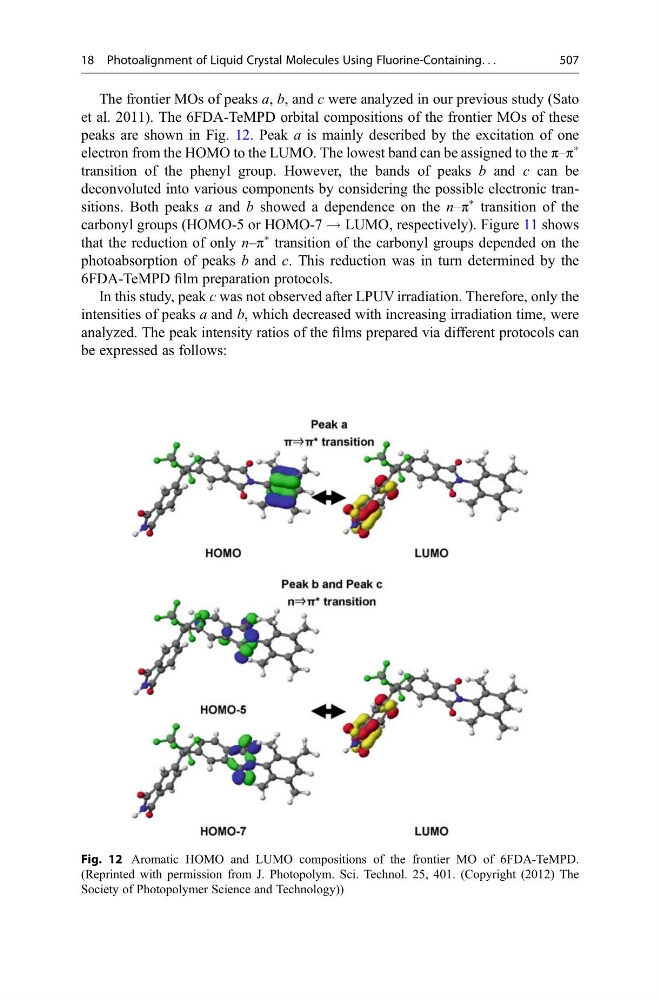
peaks are shown in Fig. 12. Peak a is mainly described by the excitation of one
electron from the HOMO to the LUMO. The lowest band can be assigned to the π–π
Ã
transition of the phenyl group. However, the bands of peaks b and c can be
deconvoluted into various components by considering the possible electronic transitions. Both peaks a and b showed a dependence on the n–π
à transition of the
carbonyl groups (HOMO-5 or HOMO-7 ! LUMO, respectively). Figure 11 shows
that the reduction of only n–π
à transition of the carbonyl groups depended on the
photoabsorption of peaks b and c. This reduction was in turn determined by the
6FDA-TeMPD film preparation protocols.
In this study, peak c was not observed after LPUV irradiation. Therefore, only the
intensities of peaks a and b, which decreased with increasing irradiation time, were
analyzed. The peak intensity ratios of the films prepared via different protocols can
be expressed as follows:
Fig. 12 Aromatic HOMO and LUMO compositions of the frontier MO of 6FDA-TeMPD.
(Reprinted with permission from J. Photopolym. Sci. Technol. 25, 401. (Copyright (2012) The
Society of Photopolymer Science and Technology))
18 Photoalignment of Liquid Crystal Molecules Using Fluorine-Containing. . .
507
et al. 2011). The 6FDA-TeMPD orbital compositions of the frontier MOs of these
peaks are shown in Fig. 12. Peak a is mainly described by the excitation of one
electron from the HOMO to the LUMO. The lowest band can be assigned to the π–π
Ã
transition of the phenyl group. However, the bands of peaks b and c can be
deconvoluted into various components by considering the possible electronic transitions. Both peaks a and b showed a dependence on the n–π
à transition of the
carbonyl groups (HOMO-5 or HOMO-7 ! LUMO, respectively). Figure 11 shows
that the reduction of only n–π
à transition of the carbonyl groups depended on the
photoabsorption of peaks b and c. This reduction was in turn determined by the
6FDA-TeMPD film preparation protocols.
In this study, peak c was not observed after LPUV irradiation. Therefore, only the
intensities of peaks a and b, which decreased with increasing irradiation time, were
analyzed. The peak intensity ratios of the films prepared via different protocols can
be expressed as follows:
Fig. 12 Aromatic HOMO and LUMO compositions of the frontier MO of 6FDA-TeMPD.
(Reprinted with permission from J. Photopolym. Sci. Technol. 25, 401. (Copyright (2012) The
Society of Photopolymer Science and Technology))
18 Photoalignment of Liquid Crystal Molecules Using Fluorine-Containing. . .
507