

photoalignment films have not been reported to date; only the effects of the
chemical structure on the LC alignment have been investigated. The film preparation protocols strongly depend on photoreactivity because of the photoreactivity dependence on both the residual casting solvent molecules and the
condensation of the polymer segments in the films. However, no direct evidence
for this hypothesis has been presented in the literature. Therefore, identifying the
crucial factors that determine the LC alignment characteristics through various
film preparation protocols is necessary in the development of high-performance
photoalignment films.
In the current study, 6FDA-TeMPD polyimide was used as a model polymer.
To date, no systematic study on the dependence of photoalignment characteristics
on film preparation conditions has been reported. Polymer chains exhibit a
variety of conformations in different casting solvents. These different conformations result in different polymer film morphologies, including chain packing
(Kanehashi et al. 2007, 2011). Thermal treatment induces the densification of
glassy polymer films. Hence, the photoalignment mechanisms of 6FDA-TeMPD
polyimide films prepared in different casting solvents were investigated. The
effects of the different film preparation protocols on the heat-treated films were
also analyzed.
The 6FDA-TeMPD polyimides used in the current research were the same as the
samples used in a previous study (Sato et al. 2011). The isotropic, dense polyimide
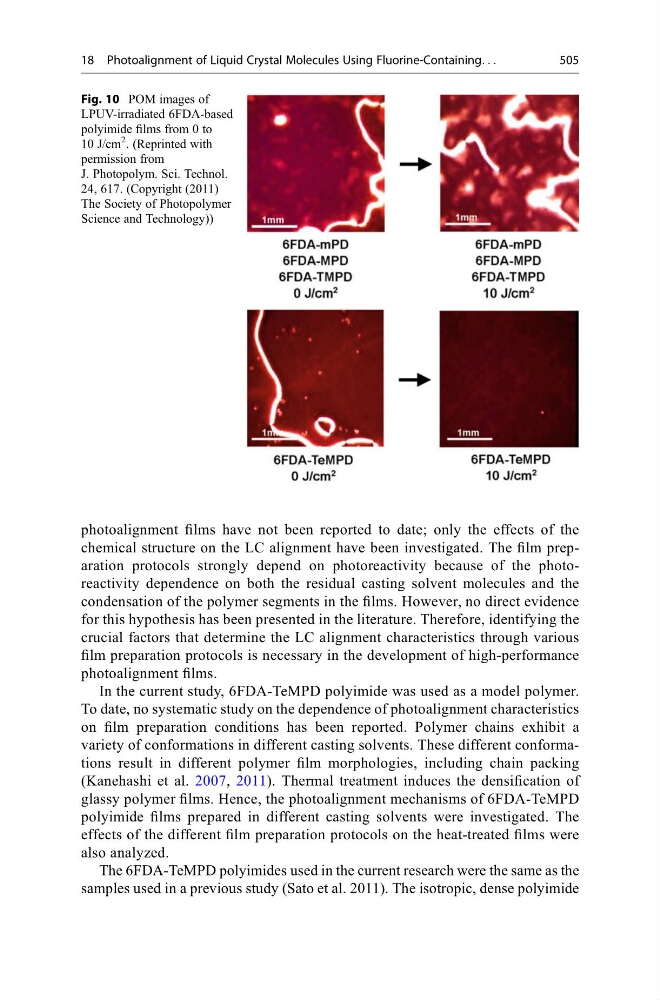
Fig. 10 POM images of
LPUV-irradiated 6FDA-based
polyimide films from 0 to
10 J/cm
2
. (Reprinted with
permission from
J. Photopolym. Sci. Technol.
24, 617. (Copyright (2011)
The Society of Photopolymer
Science and Technology))
18 Photoalignment of Liquid Crystal Molecules Using Fluorine-Containing. . .
505
chemical structure on the LC alignment have been investigated. The film preparation protocols strongly depend on photoreactivity because of the photoreactivity dependence on both the residual casting solvent molecules and the
condensation of the polymer segments in the films. However, no direct evidence
for this hypothesis has been presented in the literature. Therefore, identifying the
crucial factors that determine the LC alignment characteristics through various
film preparation protocols is necessary in the development of high-performance
photoalignment films.
In the current study, 6FDA-TeMPD polyimide was used as a model polymer.
To date, no systematic study on the dependence of photoalignment characteristics
on film preparation conditions has been reported. Polymer chains exhibit a
variety of conformations in different casting solvents. These different conformations result in different polymer film morphologies, including chain packing
(Kanehashi et al. 2007, 2011). Thermal treatment induces the densification of
glassy polymer films. Hence, the photoalignment mechanisms of 6FDA-TeMPD
polyimide films prepared in different casting solvents were investigated. The
effects of the different film preparation protocols on the heat-treated films were
also analyzed.
The 6FDA-TeMPD polyimides used in the current research were the same as the
samples used in a previous study (Sato et al. 2011). The isotropic, dense polyimide
Fig. 10 POM images of
LPUV-irradiated 6FDA-based
polyimide films from 0 to
10 J/cm
2
. (Reprinted with
permission from
J. Photopolym. Sci. Technol.
24, 617. (Copyright (2011)
The Society of Photopolymer
Science and Technology))
18 Photoalignment of Liquid Crystal Molecules Using Fluorine-Containing. . .
505