

anisotropic objects including cylindrical phases in photoresponsive block copolymers,
opening new opportunities in the field of nanopatterning as it will be shown later.
Besides orientational effects, azobenzene containing polymers are also able to
capture light patterns as surface relief gratings (SRGs). In 1995, two independent
teams, those of Kumar and Tripathy, and Rochon and Nathansohn, simultaneously
discovered this effect in thin films of amorphous azobenzene containing side chain
polymers (Kim et al. 1995; Rochon et al. 1995). Associated to holographic recording
experiments in these materials and at temperatures below T g , it was observed the
formation of SRGs with the same periodicity of the holographic interference pattern,
having this tremendous potential in the preparation of photonic elements such as
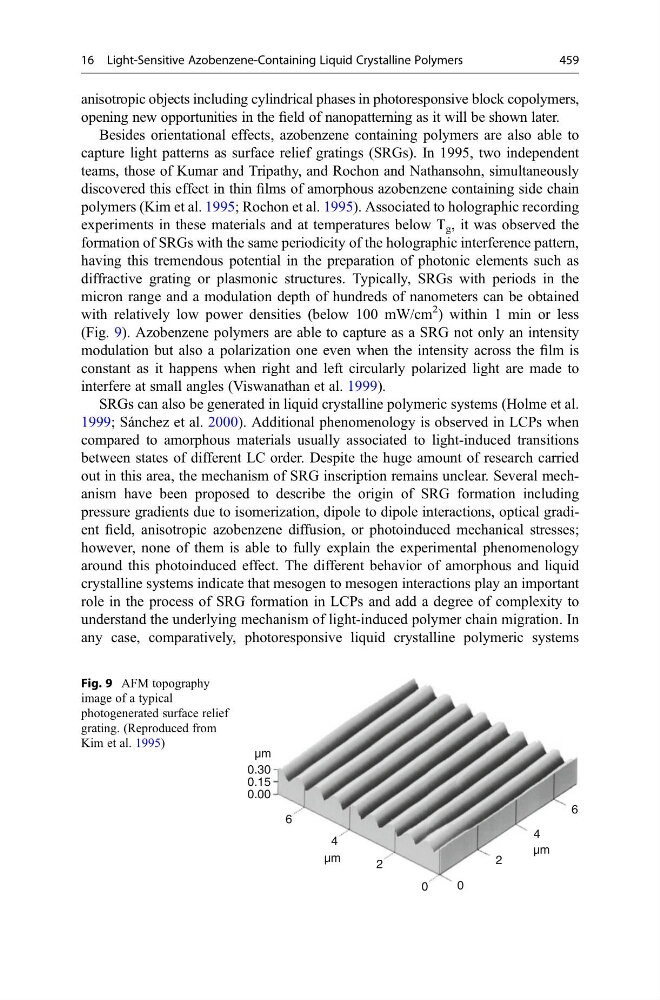
diffractive grating or plasmonic structures. Typically, SRGs with periods in the
micron range and a modulation depth of hundreds of nanometers can be obtained
with relatively low power densities (below 100 mW/cm
2 ) within 1 min or less
(Fig. 9). Azobenzene polymers are able to capture as a SRG not only an intensity
modulation but also a polarization one even when the intensity across the film is
constant as it happens when right and left circularly polarized light are made to
interfere at small angles (Viswanathan et al. 1999).
SRGs can also be generated in liquid crystalline polymeric systems (Holme et al.
1999; Sánchez et al. 2000). Additional phenomenology is observed in LCPs when
compared to amorphous materials usually associated to light-induced transitions
between states of different LC order. Despite the huge amount of research carried
out in this area, the mechanism of SRG inscription remains unclear. Several mechanism have been proposed to describe the origin of SRG formation including
pressure gradients due to isomerization, dipole to dipole interactions, optical gradient field, anisotropic azobenzene diffusion, or photoinduced mechanical stresses;
however, none of them is able to fully explain the experimental phenomenology
around this photoinduced effect. The different behavior of amorphous and liquid
crystalline systems indicate that mesogen to mesogen interactions play an important
role in the process of SRG formation in LCPs and add a degree of complexity to
understand the underlying mechanism of light-induced polymer chain migration. In
any case, comparatively, photoresponsive liquid crystalline polymeric systems
0.30
0.15
0.00
6
6
4
4
µm
µm
µm
2
2
0
0
Fig. 9 AFM topography
image of a typical
photogenerated surface relief
grating. (Reproduced from
Kim et al. 1995)
16 Light-Sensitive Azobenzene-Containing Liquid Crystalline Polymers
459
opening new opportunities in the field of nanopatterning as it will be shown later.
Besides orientational effects, azobenzene containing polymers are also able to
capture light patterns as surface relief gratings (SRGs). In 1995, two independent
teams, those of Kumar and Tripathy, and Rochon and Nathansohn, simultaneously
discovered this effect in thin films of amorphous azobenzene containing side chain
polymers (Kim et al. 1995; Rochon et al. 1995). Associated to holographic recording
experiments in these materials and at temperatures below T g , it was observed the
formation of SRGs with the same periodicity of the holographic interference pattern,
having this tremendous potential in the preparation of photonic elements such as
diffractive grating or plasmonic structures. Typically, SRGs with periods in the
micron range and a modulation depth of hundreds of nanometers can be obtained
with relatively low power densities (below 100 mW/cm
2 ) within 1 min or less
(Fig. 9). Azobenzene polymers are able to capture as a SRG not only an intensity
modulation but also a polarization one even when the intensity across the film is
constant as it happens when right and left circularly polarized light are made to
interfere at small angles (Viswanathan et al. 1999).
SRGs can also be generated in liquid crystalline polymeric systems (Holme et al.
1999; Sánchez et al. 2000). Additional phenomenology is observed in LCPs when
compared to amorphous materials usually associated to light-induced transitions
between states of different LC order. Despite the huge amount of research carried
out in this area, the mechanism of SRG inscription remains unclear. Several mechanism have been proposed to describe the origin of SRG formation including
pressure gradients due to isomerization, dipole to dipole interactions, optical gradient field, anisotropic azobenzene diffusion, or photoinduced mechanical stresses;
however, none of them is able to fully explain the experimental phenomenology
around this photoinduced effect. The different behavior of amorphous and liquid
crystalline systems indicate that mesogen to mesogen interactions play an important
role in the process of SRG formation in LCPs and add a degree of complexity to
understand the underlying mechanism of light-induced polymer chain migration. In
any case, comparatively, photoresponsive liquid crystalline polymeric systems
0.30
0.15
0.00
6
6
4
4
µm
µm
µm
2
2
0
0
Fig. 9 AFM topography
image of a typical
photogenerated surface relief
grating. (Reproduced from
Kim et al. 1995)
16 Light-Sensitive Azobenzene-Containing Liquid Crystalline Polymers
459