

require, as a general trend, larger energies (hundreds of mW/cm
2 ) than chemically
similar amorphous polymers to lead to SRG of similar modulation depth, being
sometimes SRG generation strongly inhibited in these mesomorphic materials. As a
result, amorphous photoresponsive polymers are predominantly being investigated
as a platform for the development of large-area patterning methodologies towards
the preparation of photonic devices (Priimagi and Shevchenko 2013).
Another set of photoinduced effects in azobenzene polymers has its origin in the
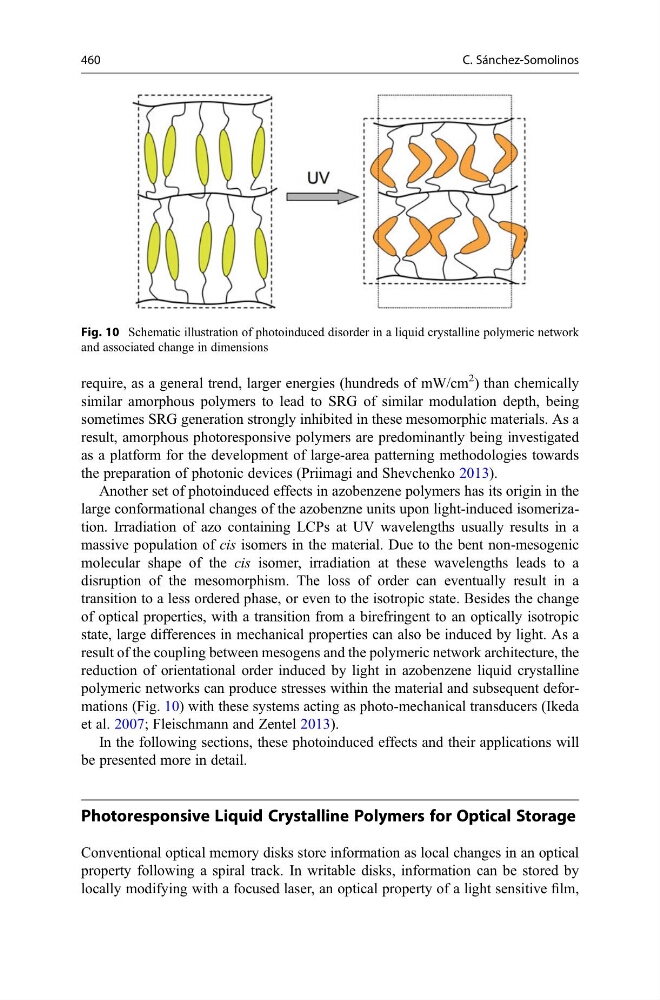
large conformational changes of the azobenzne units upon light-induced isomerization. Irradiation of azo containing LCPs at UV wavelengths usually results in a
massive population of cis isomers in the material. Due to the bent non-mesogenic
molecular shape of the cis isomer, irradiation at these wavelengths leads to a
disruption of the mesomorphism. The loss of order can eventually result in a
transition to a less ordered phase, or even to the isotropic state. Besides the change
of optical properties, with a transition from a birefringent to an optically isotropic
state, large differences in mechanical properties can also be induced by light. As a
result of the coupling between mesogens and the polymeric network architecture, the
reduction of orientational order induced by light in azobenzene liquid crystalline
polymeric networks can produce stresses within the material and subsequent deformations (Fig. 10) with these systems acting as photo-mechanical transducers (Ikeda
et al. 2007; Fleischmann and Zentel 2013).
In the following sections, these photoinduced effects and their applications will
be presented more in detail.
Photoresponsive Liquid Crystalline Polymers for Optical Storage
Conventional optical memory disks store information as local changes in an optical
property following a spiral track. In writable disks, information can be stored by
locally modifying with a focused laser, an optical property of a light sensitive film,
Fig. 10 Schematic illustration of photoinduced disorder in a liquid crystalline polymeric network
and associated change in dimensions
460
C. Sánchez-Somolinos
2 ) than chemically
similar amorphous polymers to lead to SRG of similar modulation depth, being
sometimes SRG generation strongly inhibited in these mesomorphic materials. As a
result, amorphous photoresponsive polymers are predominantly being investigated
as a platform for the development of large-area patterning methodologies towards
the preparation of photonic devices (Priimagi and Shevchenko 2013).
Another set of photoinduced effects in azobenzene polymers has its origin in the
large conformational changes of the azobenzne units upon light-induced isomerization. Irradiation of azo containing LCPs at UV wavelengths usually results in a
massive population of cis isomers in the material. Due to the bent non-mesogenic
molecular shape of the cis isomer, irradiation at these wavelengths leads to a
disruption of the mesomorphism. The loss of order can eventually result in a
transition to a less ordered phase, or even to the isotropic state. Besides the change
of optical properties, with a transition from a birefringent to an optically isotropic
state, large differences in mechanical properties can also be induced by light. As a
result of the coupling between mesogens and the polymeric network architecture, the
reduction of orientational order induced by light in azobenzene liquid crystalline
polymeric networks can produce stresses within the material and subsequent deformations (Fig. 10) with these systems acting as photo-mechanical transducers (Ikeda
et al. 2007; Fleischmann and Zentel 2013).
In the following sections, these photoinduced effects and their applications will
be presented more in detail.
Photoresponsive Liquid Crystalline Polymers for Optical Storage
Conventional optical memory disks store information as local changes in an optical
property following a spiral track. In writable disks, information can be stored by
locally modifying with a focused laser, an optical property of a light sensitive film,
Fig. 10 Schematic illustration of photoinduced disorder in a liquid crystalline polymeric network
and associated change in dimensions
460
C. Sánchez-Somolinos