

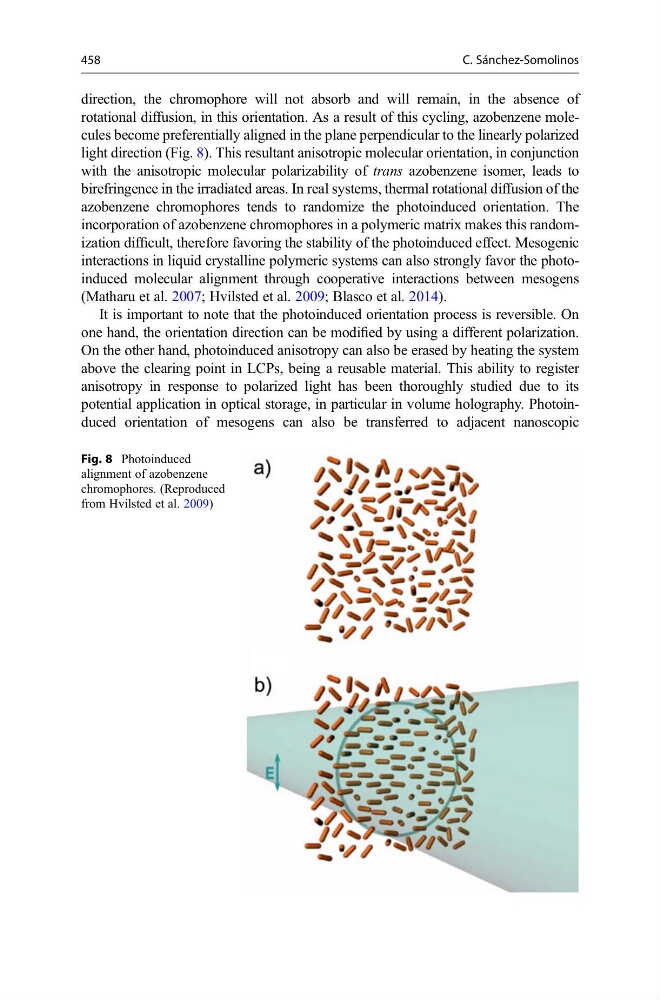
direction, the chromophore will not absorb and will remain, in the absence of
rotational diffusion, in this orientation. As a result of this cycling, azobenzene molecules become preferentially aligned in the plane perpendicular to the linearly polarized
light direction (Fig. 8). This resultant anisotropic molecular orientation, in conjunction
with the anisotropic molecular polarizability of trans azobenzene isomer, leads to
birefringence in the irradiated areas. In real systems, thermal rotational diffusion of the
azobenzene chromophores tends to randomize the photoinduced orientation. The
incorporation of azobenzene chromophores in a polymeric matrix makes this randomization difficult, therefore favoring the stability of the photoinduced effect. Mesogenic
interactions in liquid crystalline polymeric systems can also strongly favor the photoinduced molecular alignment through cooperative interactions between mesogens
(Matharu et al. 2007; Hvilsted et al. 2009; Blasco et al. 2014).
It is important to note that the photoinduced orientation process is reversible. On
one hand, the orientation direction can be modified by using a different polarization.
On the other hand, photoinduced anisotropy can also be erased by heating the system
above the clearing point in LCPs, being a reusable material. This ability to register
anisotropy in response to polarized light has been thoroughly studied due to its
potential application in optical storage, in particular in volume holography. Photoinduced orientation of mesogens can also be transferred to adjacent nanoscopic
Fig. 8 Photoinduced
alignment of azobenzene
chromophores. (Reproduced
from Hvilsted et al. 2009)
458
C. Sánchez-Somolinos
rotational diffusion, in this orientation. As a result of this cycling, azobenzene molecules become preferentially aligned in the plane perpendicular to the linearly polarized
light direction (Fig. 8). This resultant anisotropic molecular orientation, in conjunction
with the anisotropic molecular polarizability of trans azobenzene isomer, leads to
birefringence in the irradiated areas. In real systems, thermal rotational diffusion of the
azobenzene chromophores tends to randomize the photoinduced orientation. The
incorporation of azobenzene chromophores in a polymeric matrix makes this randomization difficult, therefore favoring the stability of the photoinduced effect. Mesogenic
interactions in liquid crystalline polymeric systems can also strongly favor the photoinduced molecular alignment through cooperative interactions between mesogens
(Matharu et al. 2007; Hvilsted et al. 2009; Blasco et al. 2014).
It is important to note that the photoinduced orientation process is reversible. On
one hand, the orientation direction can be modified by using a different polarization.
On the other hand, photoinduced anisotropy can also be erased by heating the system
above the clearing point in LCPs, being a reusable material. This ability to register
anisotropy in response to polarized light has been thoroughly studied due to its
potential application in optical storage, in particular in volume holography. Photoinduced orientation of mesogens can also be transferred to adjacent nanoscopic
Fig. 8 Photoinduced
alignment of azobenzene
chromophores. (Reproduced
from Hvilsted et al. 2009)
458
C. Sánchez-Somolinos