

great deal of control over the photoinduced effects. Light can produce changes in the
liquid crystal director or the liquid crystal order degree, transitions between mesophases, or even to the isotropic state. This reorganization of the material produces
changes in the optical and mechanical properties being this of great potential in
different applications.
As a prominent example of these photoinduced effects, irradiation with linearly
polarized light of the appropriate wavelength can lead to optical anisotropy in
azobenzene materials. Irradiation of azobenzenes chromophores at the overlapping
wavelength region of the absorption spectra of the two isomers results in efficient
trans-cis-trans interconversion cycles. The selection rules of the absorption process
dictate that the transition probability, when linearly polarized light is used, is proportional to cos
2
θ, θ being the angle between the electric field vector of light and the
transition dipole moment direction that in the case of azobenzene lies parallel to the
long molecular axis of the trans isomer. As a result, when an ensemble of azobenzene
molecules with isotropic orientational distribution is irradiated with linearly polarized
light, some azo chromophores, preferentially those with their long molecular axis with
an orientation close to the polarization direction, will be excited and isomerize to the
cis state, eventually isomerizing back to the trans form either by optical or thermal
means. During these trans-cis-trans isomerization cycles, the chromophore suffers
reorientations and it will finally fall in an orientation probably different from the initial
one. If the orientation after one of these cycles is perpendicular to the light polarization
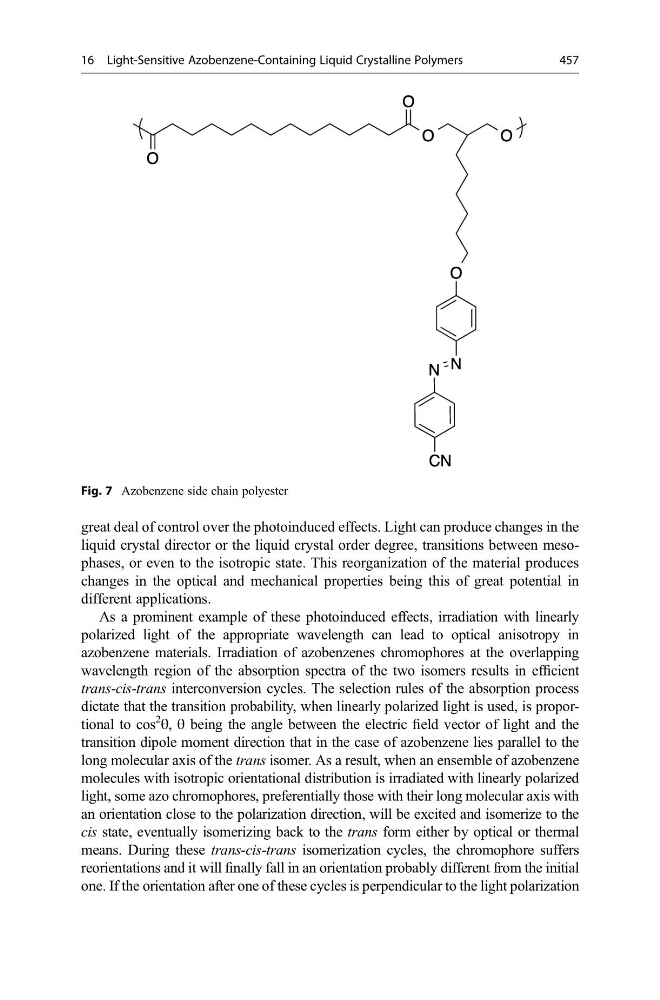
Fig. 7 Azobenzene side chain polyester
16 Light-Sensitive Azobenzene-Containing Liquid Crystalline Polymers
457
liquid crystal director or the liquid crystal order degree, transitions between mesophases, or even to the isotropic state. This reorganization of the material produces
changes in the optical and mechanical properties being this of great potential in
different applications.
As a prominent example of these photoinduced effects, irradiation with linearly
polarized light of the appropriate wavelength can lead to optical anisotropy in
azobenzene materials. Irradiation of azobenzenes chromophores at the overlapping
wavelength region of the absorption spectra of the two isomers results in efficient
trans-cis-trans interconversion cycles. The selection rules of the absorption process
dictate that the transition probability, when linearly polarized light is used, is proportional to cos
2
θ, θ being the angle between the electric field vector of light and the
transition dipole moment direction that in the case of azobenzene lies parallel to the
long molecular axis of the trans isomer. As a result, when an ensemble of azobenzene
molecules with isotropic orientational distribution is irradiated with linearly polarized
light, some azo chromophores, preferentially those with their long molecular axis with
an orientation close to the polarization direction, will be excited and isomerize to the
cis state, eventually isomerizing back to the trans form either by optical or thermal
means. During these trans-cis-trans isomerization cycles, the chromophore suffers
reorientations and it will finally fall in an orientation probably different from the initial
one. If the orientation after one of these cycles is perpendicular to the light polarization
Fig. 7 Azobenzene side chain polyester
16 Light-Sensitive Azobenzene-Containing Liquid Crystalline Polymers
457