

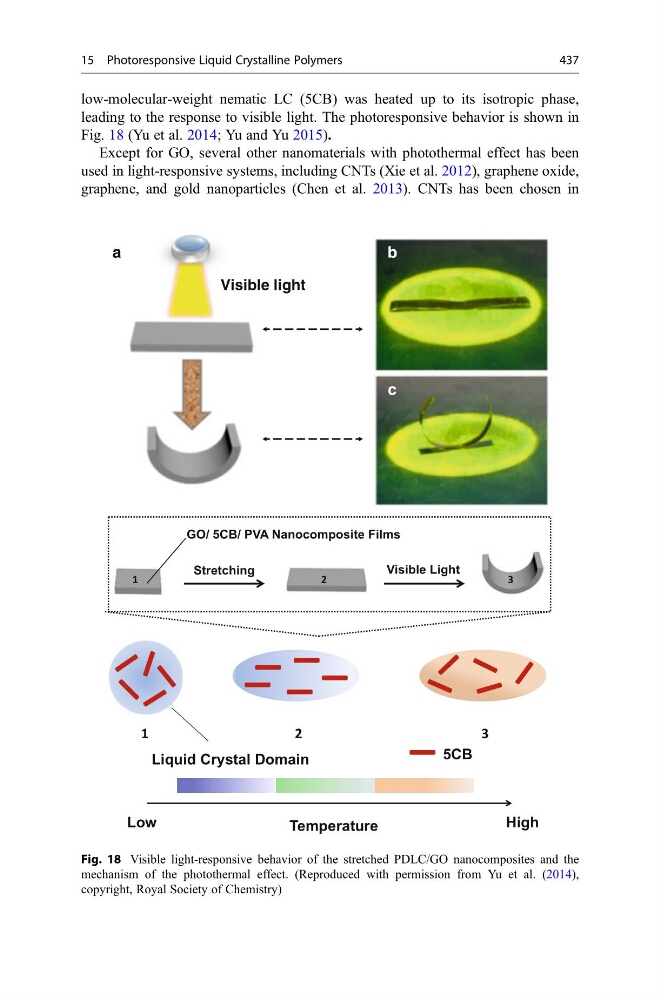
low-molecular-weight nematic LC (5CB) was heated up to its isotropic phase,
leading to the response to visible light. The photoresponsive behavior is shown in
Fig. 18 (Yu et al. 2014; Yu and Yu 2015).
Except for GO, several other nanomaterials with photothermal effect has been
used in light-responsive systems, including CNTs (Xie et al. 2012), graphene oxide,
graphene, and gold nanoparticles (Chen et al. 2013). CNTs has been chosen in
Stretching
Visible Light
1
2
3
1
2
GO/ 5CB/ PVA Nanocomposite Films
Liquid Crystal Domain
3
5CB
Temperature
Low
High
Visible light
b
a
c
Fig. 18 Visible light-responsive behavior of the stretched PDLC/GO nanocomposites and the
mechanism of the photothermal effect. (Reproduced with permission from Yu et al. (2014),
copyright, Royal Society of Chemistry)
15 Photoresponsive Liquid Crystalline Polymers
437
leading to the response to visible light. The photoresponsive behavior is shown in
Fig. 18 (Yu et al. 2014; Yu and Yu 2015).
Except for GO, several other nanomaterials with photothermal effect has been
used in light-responsive systems, including CNTs (Xie et al. 2012), graphene oxide,
graphene, and gold nanoparticles (Chen et al. 2013). CNTs has been chosen in
Stretching
Visible Light
1
2
3
1
2
GO/ 5CB/ PVA Nanocomposite Films
Liquid Crystal Domain
3
5CB
Temperature
Low
High
Visible light
b
a
c
Fig. 18 Visible light-responsive behavior of the stretched PDLC/GO nanocomposites and the
mechanism of the photothermal effect. (Reproduced with permission from Yu et al. (2014),
copyright, Royal Society of Chemistry)
15 Photoresponsive Liquid Crystalline Polymers
437