

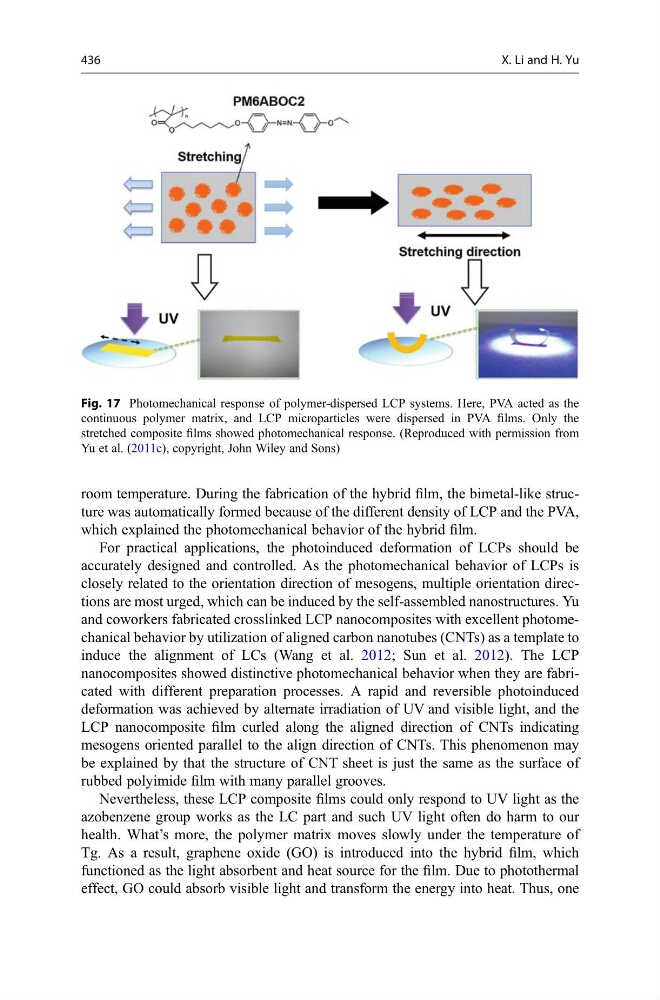
room temperature. During the fabrication of the hybrid film, the bimetal-like structure was automatically formed because of the different density of LCP and the PVA,
which explained the photomechanical behavior of the hybrid film.
For practical applications, the photoinduced deformation of LCPs should be
accurately designed and controlled. As the photomechanical behavior of LCPs is
closely related to the orientation direction of mesogens, multiple orientation directions are most urged, which can be induced by the self-assembled nanostructures. Yu
and coworkers fabricated crosslinked LCP nanocomposites with excellent photomechanical behavior by utilization of aligned carbon nanotubes (CNTs) as a template to
induce the alignment of LCs (Wang et al. 2012; Sun et al. 2012). The LCP
nanocomposites showed distinctive photomechanical behavior when they are fabricated with different preparation processes. A rapid and reversible photoinduced
deformation was achieved by alternate irradiation of UV and visible light, and the
LCP nanocomposite film curled along the aligned direction of CNTs indicating
mesogens oriented parallel to the align direction of CNTs. This phenomenon may
be explained by that the structure of CNT sheet is just the same as the surface of
rubbed polyimide film with many parallel grooves.
Nevertheless, these LCP composite films could only respond to UV light as the
azobenzene group works as the LC part and such UV light often do harm to our
health. What’s more, the polymer matrix moves slowly under the temperature of
Tg. As a result, graphene oxide (GO) is introduced into the hybrid film, which
functioned as the light absorbent and heat source for the film. Due to photothermal
effect, GO could absorb visible light and transform the energy into heat. Thus, one
Fig. 17 Photomechanical response of polymer-dispersed LCP systems. Here, PVA acted as the
continuous polymer matrix, and LCP microparticles were dispersed in PVA films. Only the
stretched composite films showed photomechanical response. (Reproduced with permission from
Yu et al. (2011c), copyright, John Wiley and Sons)
436
X. Li and H. Yu
which explained the photomechanical behavior of the hybrid film.
For practical applications, the photoinduced deformation of LCPs should be
accurately designed and controlled. As the photomechanical behavior of LCPs is
closely related to the orientation direction of mesogens, multiple orientation directions are most urged, which can be induced by the self-assembled nanostructures. Yu
and coworkers fabricated crosslinked LCP nanocomposites with excellent photomechanical behavior by utilization of aligned carbon nanotubes (CNTs) as a template to
induce the alignment of LCs (Wang et al. 2012; Sun et al. 2012). The LCP
nanocomposites showed distinctive photomechanical behavior when they are fabricated with different preparation processes. A rapid and reversible photoinduced
deformation was achieved by alternate irradiation of UV and visible light, and the
LCP nanocomposite film curled along the aligned direction of CNTs indicating
mesogens oriented parallel to the align direction of CNTs. This phenomenon may
be explained by that the structure of CNT sheet is just the same as the surface of
rubbed polyimide film with many parallel grooves.
Nevertheless, these LCP composite films could only respond to UV light as the
azobenzene group works as the LC part and such UV light often do harm to our
health. What’s more, the polymer matrix moves slowly under the temperature of
Tg. As a result, graphene oxide (GO) is introduced into the hybrid film, which
functioned as the light absorbent and heat source for the film. Due to photothermal
effect, GO could absorb visible light and transform the energy into heat. Thus, one
Fig. 17 Photomechanical response of polymer-dispersed LCP systems. Here, PVA acted as the
continuous polymer matrix, and LCP microparticles were dispersed in PVA films. Only the
stretched composite films showed photomechanical response. (Reproduced with permission from
Yu et al. (2011c), copyright, John Wiley and Sons)
436
X. Li and H. Yu