

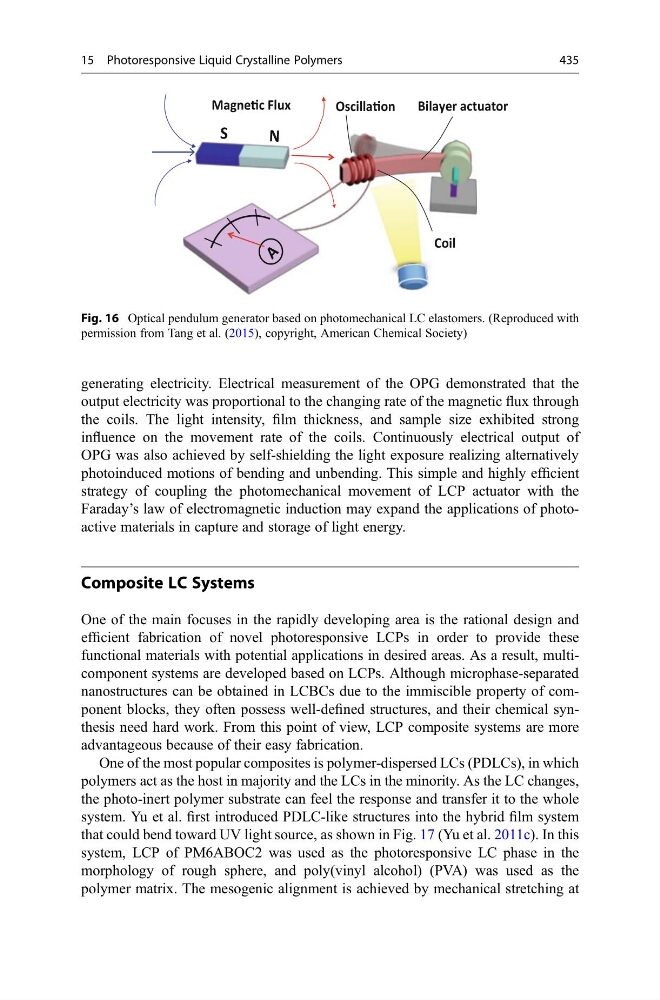
generating electricity. Electrical measurement of the OPG demonstrated that the
output electricity was proportional to the changing rate of the magnetic flux through
the coils. The light intensity, film thickness, and sample size exhibited strong
influence on the movement rate of the coils. Continuously electrical output of
OPG was also achieved by self-shielding the light exposure realizing alternatively
photoinduced motions of bending and unbending. This simple and highly efficient
strategy of coupling the photomechanical movement of LCP actuator with the
Faraday’s law of electromagnetic induction may expand the applications of photoactive materials in capture and storage of light energy.
Composite LC Systems
One of the main focuses in the rapidly developing area is the rational design and
efficient fabrication of novel photoresponsive LCPs in order to provide these
functional materials with potential applications in desired areas. As a result, multicomponent systems are developed based on LCPs. Although microphase-separated
nanostructures can be obtained in LCBCs due to the immiscible property of component blocks, they often possess well-defined structures, and their chemical synthesis need hard work. From this point of view, LCP composite systems are more
advantageous because of their easy fabrication.
One of the most popular composites is polymer-dispersed LCs (PDLCs), in which
polymers act as the host in majority and the LCs in the minority. As the LC changes,
the photo-inert polymer substrate can feel the response and transfer it to the whole
system. Yu et al. first introduced PDLC-like structures into the hybrid film system
that could bend toward UV light source, as shown in Fig. 17 (Yu et al. 2011c). In this
system, LCP of PM6ABOC2 was used as the photoresponsive LC phase in the
morphology of rough sphere, and poly(vinyl alcohol) (PVA) was used as the
polymer matrix. The mesogenic alignment is achieved by mechanical stretching at
N
S
A
Magne c Flux
Bilayer actuator
Coil
Oscilla on
Fig. 16 Optical pendulum generator based on photomechanical LC elastomers. (Reproduced with
permission from Tang et al. (2015), copyright, American Chemical Society)
15 Photoresponsive Liquid Crystalline Polymers
435
output electricity was proportional to the changing rate of the magnetic flux through
the coils. The light intensity, film thickness, and sample size exhibited strong
influence on the movement rate of the coils. Continuously electrical output of
OPG was also achieved by self-shielding the light exposure realizing alternatively
photoinduced motions of bending and unbending. This simple and highly efficient
strategy of coupling the photomechanical movement of LCP actuator with the
Faraday’s law of electromagnetic induction may expand the applications of photoactive materials in capture and storage of light energy.
Composite LC Systems
One of the main focuses in the rapidly developing area is the rational design and
efficient fabrication of novel photoresponsive LCPs in order to provide these
functional materials with potential applications in desired areas. As a result, multicomponent systems are developed based on LCPs. Although microphase-separated
nanostructures can be obtained in LCBCs due to the immiscible property of component blocks, they often possess well-defined structures, and their chemical synthesis need hard work. From this point of view, LCP composite systems are more
advantageous because of their easy fabrication.
One of the most popular composites is polymer-dispersed LCs (PDLCs), in which
polymers act as the host in majority and the LCs in the minority. As the LC changes,
the photo-inert polymer substrate can feel the response and transfer it to the whole
system. Yu et al. first introduced PDLC-like structures into the hybrid film system
that could bend toward UV light source, as shown in Fig. 17 (Yu et al. 2011c). In this
system, LCP of PM6ABOC2 was used as the photoresponsive LC phase in the
morphology of rough sphere, and poly(vinyl alcohol) (PVA) was used as the
polymer matrix. The mesogenic alignment is achieved by mechanical stretching at
N
S
A
Magne c Flux
Bilayer actuator
Coil
Oscilla on
Fig. 16 Optical pendulum generator based on photomechanical LC elastomers. (Reproduced with
permission from Tang et al. (2015), copyright, American Chemical Society)
15 Photoresponsive Liquid Crystalline Polymers
435