

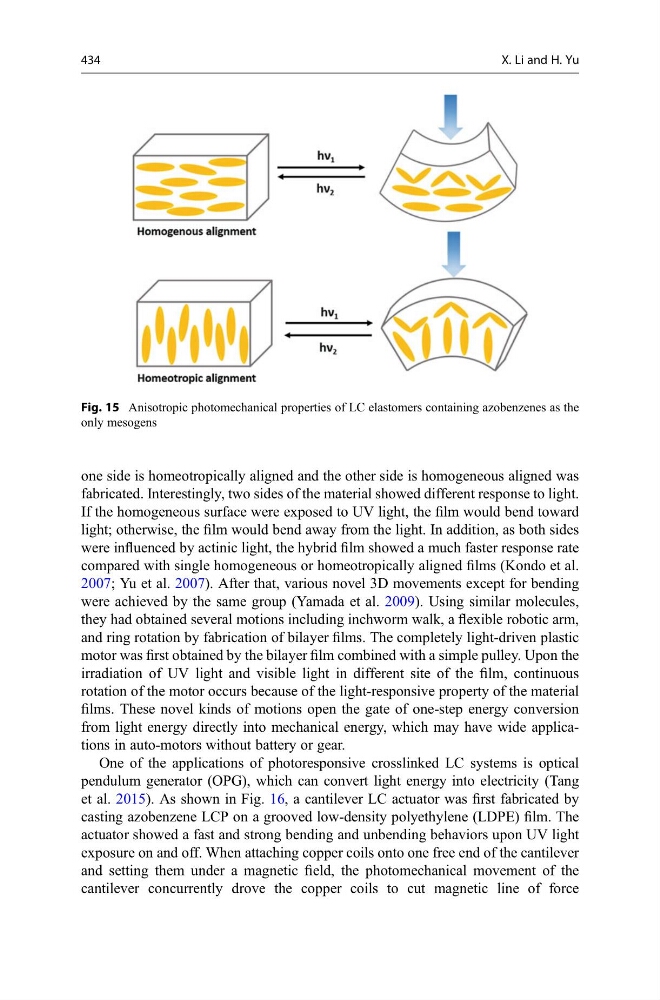
one side is homeotropically aligned and the other side is homogeneous aligned was
fabricated. Interestingly, two sides of the material showed different response to light.
If the homogeneous surface were exposed to UV light, the film would bend toward
light; otherwise, the film would bend away from the light. In addition, as both sides
were influenced by actinic light, the hybrid film showed a much faster response rate
compared with single homogeneous or homeotropically aligned films (Kondo et al.
2007; Yu et al. 2007). After that, various novel 3D movements except for bending
were achieved by the same group (Yamada et al. 2009). Using similar molecules,
they had obtained several motions including inchworm walk, a flexible robotic arm,
and ring rotation by fabrication of bilayer films. The completely light-driven plastic
motor was first obtained by the bilayer film combined with a simple pulley. Upon the
irradiation of UV light and visible light in different site of the film, continuous
rotation of the motor occurs because of the light-responsive property of the material
films. These novel kinds of motions open the gate of one-step energy conversion
from light energy directly into mechanical energy, which may have wide applications in auto-motors without battery or gear.
One of the applications of photoresponsive crosslinked LC systems is optical
pendulum generator (OPG), which can convert light energy into electricity (Tang
et al. 2015). As shown in Fig. 16, a cantilever LC actuator was first fabricated by
casting azobenzene LCP on a grooved low-density polyethylene (LDPE) film. The
actuator showed a fast and strong bending and unbending behaviors upon UV light
exposure on and off. When attaching copper coils onto one free end of the cantilever
and setting them under a magnetic field, the photomechanical movement of the
cantilever concurrently drove the copper coils to cut magnetic line of force
Fig. 15 Anisotropic photomechanical properties of LC elastomers containing azobenzenes as the
only mesogens
434
X. Li and H. Yu
fabricated. Interestingly, two sides of the material showed different response to light.
If the homogeneous surface were exposed to UV light, the film would bend toward
light; otherwise, the film would bend away from the light. In addition, as both sides
were influenced by actinic light, the hybrid film showed a much faster response rate
compared with single homogeneous or homeotropically aligned films (Kondo et al.
2007; Yu et al. 2007). After that, various novel 3D movements except for bending
were achieved by the same group (Yamada et al. 2009). Using similar molecules,
they had obtained several motions including inchworm walk, a flexible robotic arm,
and ring rotation by fabrication of bilayer films. The completely light-driven plastic
motor was first obtained by the bilayer film combined with a simple pulley. Upon the
irradiation of UV light and visible light in different site of the film, continuous
rotation of the motor occurs because of the light-responsive property of the material
films. These novel kinds of motions open the gate of one-step energy conversion
from light energy directly into mechanical energy, which may have wide applications in auto-motors without battery or gear.
One of the applications of photoresponsive crosslinked LC systems is optical
pendulum generator (OPG), which can convert light energy into electricity (Tang
et al. 2015). As shown in Fig. 16, a cantilever LC actuator was first fabricated by
casting azobenzene LCP on a grooved low-density polyethylene (LDPE) film. The
actuator showed a fast and strong bending and unbending behaviors upon UV light
exposure on and off. When attaching copper coils onto one free end of the cantilever
and setting them under a magnetic field, the photomechanical movement of the
cantilever concurrently drove the copper coils to cut magnetic line of force
Fig. 15 Anisotropic photomechanical properties of LC elastomers containing azobenzenes as the
only mesogens
434
X. Li and H. Yu