

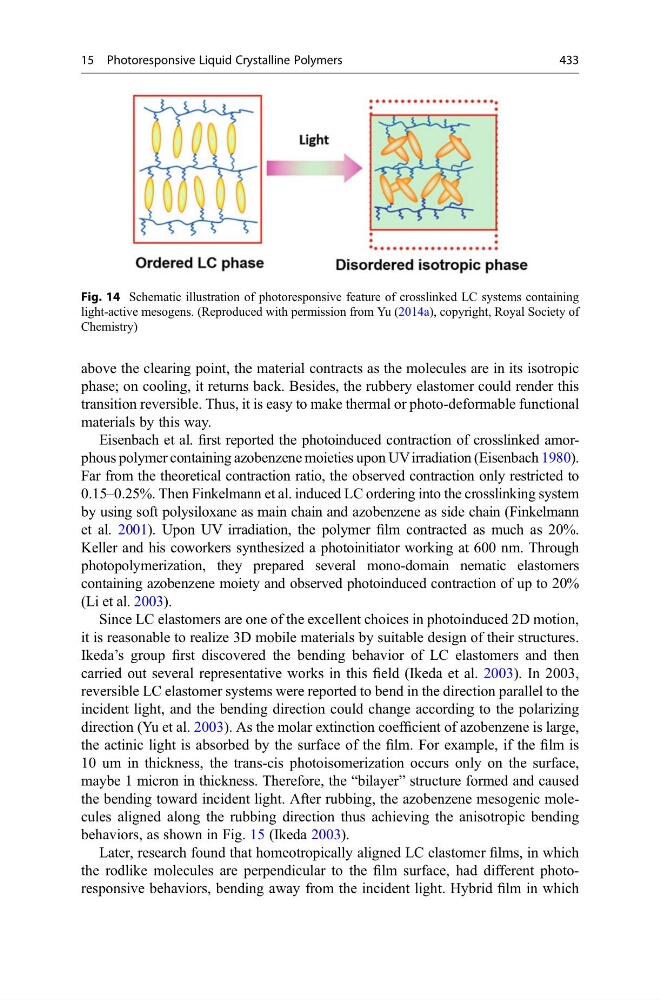
above the clearing point, the material contracts as the molecules are in its isotropic
phase; on cooling, it returns back. Besides, the rubbery elastomer could render this
transition reversible. Thus, it is easy to make thermal or photo-deformable functional
materials by this way.
Eisenbach et al. first reported the photoinduced contraction of crosslinked amorphous polymer containing azobenzene moieties upon UV irradiation (Eisenbach 1980).
Far from the theoretical contraction ratio, the observed contraction only restricted to
0.15–0.25%. Then Finkelmann et al. induced LC ordering into the crosslinking system
by using soft polysiloxane as main chain and azobenzene as side chain (Finkelmann
et al. 2001). Upon UV irradiation, the polymer film contracted as much as 20%.
Keller and his coworkers synthesized a photoinitiator working at 600 nm. Through
photopolymerization, they prepared several mono-domain nematic elastomers
containing azobenzene moiety and observed photoinduced contraction of up to 20%
(Li et al. 2003).
Since LC elastomers are one of the excellent choices in photoinduced 2D motion,
it is reasonable to realize 3D mobile materials by suitable design of their structures.
Ikeda’s group first discovered the bending behavior of LC elastomers and then
carried out several representative works in this field (Ikeda et al. 2003). In 2003,
reversible LC elastomer systems were reported to bend in the direction parallel to the
incident light, and the bending direction could change according to the polarizing
direction (Yu et al. 2003). As the molar extinction coefficient of azobenzene is large,
the actinic light is absorbed by the surface of the film. For example, if the film is
10 um in thickness, the trans-cis photoisomerization occurs only on the surface,
maybe 1 micron in thickness. Therefore, the “bilayer” structure formed and caused
the bending toward incident light. After rubbing, the azobenzene mesogenic molecules aligned along the rubbing direction thus achieving the anisotropic bending
behaviors, as shown in Fig. 15 (Ikeda 2003).
Later, research found that homeotropically aligned LC elastomer films, in which
the rodlike molecules are perpendicular to the film surface, had different photoresponsive behaviors, bending away from the incident light. Hybrid film in which
Fig. 14 Schematic illustration of photoresponsive feature of crosslinked LC systems containing
light-active mesogens. (Reproduced with permission from Yu (2014a), copyright, Royal Society of
Chemistry)
15 Photoresponsive Liquid Crystalline Polymers
433
phase; on cooling, it returns back. Besides, the rubbery elastomer could render this
transition reversible. Thus, it is easy to make thermal or photo-deformable functional
materials by this way.
Eisenbach et al. first reported the photoinduced contraction of crosslinked amorphous polymer containing azobenzene moieties upon UV irradiation (Eisenbach 1980).
Far from the theoretical contraction ratio, the observed contraction only restricted to
0.15–0.25%. Then Finkelmann et al. induced LC ordering into the crosslinking system
by using soft polysiloxane as main chain and azobenzene as side chain (Finkelmann
et al. 2001). Upon UV irradiation, the polymer film contracted as much as 20%.
Keller and his coworkers synthesized a photoinitiator working at 600 nm. Through
photopolymerization, they prepared several mono-domain nematic elastomers
containing azobenzene moiety and observed photoinduced contraction of up to 20%
(Li et al. 2003).
Since LC elastomers are one of the excellent choices in photoinduced 2D motion,
it is reasonable to realize 3D mobile materials by suitable design of their structures.
Ikeda’s group first discovered the bending behavior of LC elastomers and then
carried out several representative works in this field (Ikeda et al. 2003). In 2003,
reversible LC elastomer systems were reported to bend in the direction parallel to the
incident light, and the bending direction could change according to the polarizing
direction (Yu et al. 2003). As the molar extinction coefficient of azobenzene is large,
the actinic light is absorbed by the surface of the film. For example, if the film is
10 um in thickness, the trans-cis photoisomerization occurs only on the surface,
maybe 1 micron in thickness. Therefore, the “bilayer” structure formed and caused
the bending toward incident light. After rubbing, the azobenzene mesogenic molecules aligned along the rubbing direction thus achieving the anisotropic bending
behaviors, as shown in Fig. 15 (Ikeda 2003).
Later, research found that homeotropically aligned LC elastomer films, in which
the rodlike molecules are perpendicular to the film surface, had different photoresponsive behaviors, bending away from the incident light. Hybrid film in which
Fig. 14 Schematic illustration of photoresponsive feature of crosslinked LC systems containing
light-active mesogens. (Reproduced with permission from Yu (2014a), copyright, Royal Society of
Chemistry)
15 Photoresponsive Liquid Crystalline Polymers
433