

PS-based block copolymers (Morikawa et al. 2007). This system shows clear
memory effect upon the irradiation of linearly polarized light of different directions,
which would have potential application in the field of information storage. Microphase separation in LCBCs containing PEO cylinders has been used as the templates
to obtain regular Ag nanoparticles. By soaking PEO cylinders into the AgNO 3
solution, Ag
+ is coordinated with PEO, and after the etching of PEO and reduction
of Ag
+
, regular alignment of Ag nanoparticles would appear on the substrate
(Li et al. 2007). We just summarized a part of the results in photoresponsive
LCBCs, related research is still under the way, and promising applications would
appear in the near future.
Crosslinked LC Systems
By crosslinking, linear polymers can be turned into network, acquiring the property
of rubbery elastomers with freestanding feature. Combining the mechanical property
of elastomers and the self-organized structure of LCs, the order-disorder transition in
LC elastomers could occur rapidly, as shown in Fig. 14. Besides, the addition of
photoresponsive chromophores such as azobenzene could easily lead to interesting
photomechanical behaviors (Yu and Ikeda 2011b). Usually, the crosslinking density
is one of the most important parameters in LC elastomers. As the crosslinking
density increased, the mobility of mesogens was suppressed. Then, the response to
external stimuli would be magnified when the linear polymer is crosslinked into 3D
network. This magnification effect has been confirmed through experiments
(Kurihara et al. 1998).
Based on the photochemical phase transition or photoinduced change in mesogenic ordering, several kinds of photomechanical behaviors have been explored in
crosslinked LCP systems. Initial work mainly focused on the photoinduced 2D
motions such as contraction and expansion, and later work turned into more
complexed 3D motions including bending, twisting, and rotation driven by light.
In an azobenzene molecule, the distance between the 4- and 4
0 - carbon atoms is
9.0 Å in the trans-state, while it shortened to 5.5 Å in the cis-state (Xie et al. 1993).
Such an isomerization transition demonstrates a large contraction ratio, which is
suitable for the photoinduced deformable materials. When the temperature goes
70 nm
0 nm
100 nm
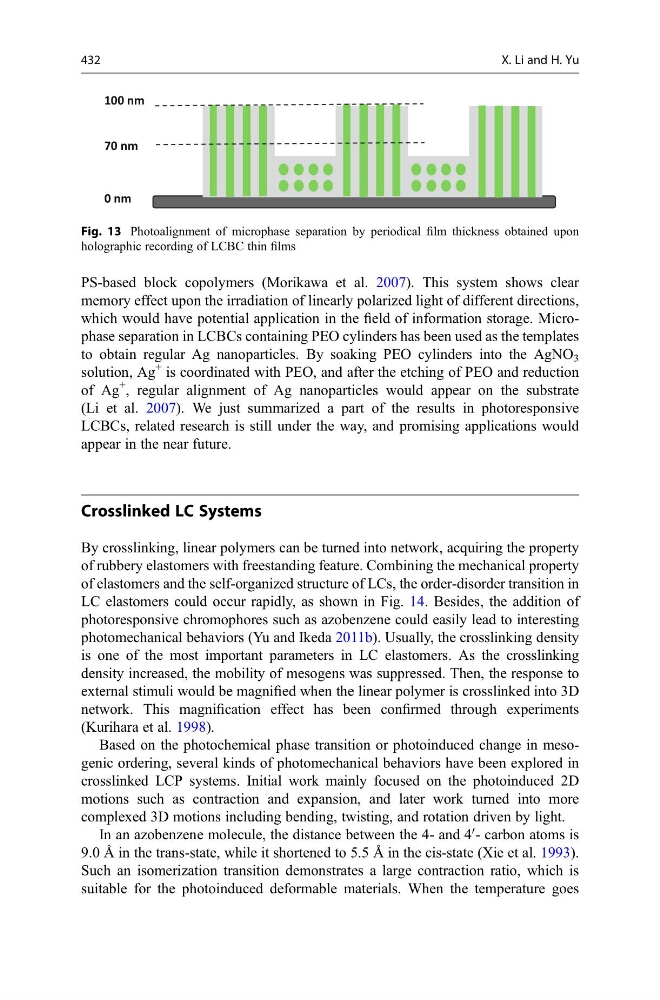
Fig. 13 Photoalignment of microphase separation by periodical film thickness obtained upon
holographic recording of LCBC thin films
432
X. Li and H. Yu
memory effect upon the irradiation of linearly polarized light of different directions,
which would have potential application in the field of information storage. Microphase separation in LCBCs containing PEO cylinders has been used as the templates
to obtain regular Ag nanoparticles. By soaking PEO cylinders into the AgNO 3
solution, Ag
+ is coordinated with PEO, and after the etching of PEO and reduction
of Ag
+
, regular alignment of Ag nanoparticles would appear on the substrate
(Li et al. 2007). We just summarized a part of the results in photoresponsive
LCBCs, related research is still under the way, and promising applications would
appear in the near future.
Crosslinked LC Systems
By crosslinking, linear polymers can be turned into network, acquiring the property
of rubbery elastomers with freestanding feature. Combining the mechanical property
of elastomers and the self-organized structure of LCs, the order-disorder transition in
LC elastomers could occur rapidly, as shown in Fig. 14. Besides, the addition of
photoresponsive chromophores such as azobenzene could easily lead to interesting
photomechanical behaviors (Yu and Ikeda 2011b). Usually, the crosslinking density
is one of the most important parameters in LC elastomers. As the crosslinking
density increased, the mobility of mesogens was suppressed. Then, the response to
external stimuli would be magnified when the linear polymer is crosslinked into 3D
network. This magnification effect has been confirmed through experiments
(Kurihara et al. 1998).
Based on the photochemical phase transition or photoinduced change in mesogenic ordering, several kinds of photomechanical behaviors have been explored in
crosslinked LCP systems. Initial work mainly focused on the photoinduced 2D
motions such as contraction and expansion, and later work turned into more
complexed 3D motions including bending, twisting, and rotation driven by light.
In an azobenzene molecule, the distance between the 4- and 4
0 - carbon atoms is
9.0 Å in the trans-state, while it shortened to 5.5 Å in the cis-state (Xie et al. 1993).
Such an isomerization transition demonstrates a large contraction ratio, which is
suitable for the photoinduced deformable materials. When the temperature goes
70 nm
0 nm
100 nm
Fig. 13 Photoalignment of microphase separation by periodical film thickness obtained upon
holographic recording of LCBC thin films
432
X. Li and H. Yu