

photo-deformable film as its strong absorption for visible and NIR light (Ahir and
Terentjev 2005, Yang et al. 2008 and Ji et al. 2010). However, good dispersion and
excellent alignment are required for CNTs, which is hard to realize and thus
restricting the application of CNTs in photo-deformable materials.
Recently, upconversion nanomaterials have been used as nanocomposites to
induce deformation of LCPs upon NIR light (Wu et al. 2011). In general,
upconversion nanomaterials are “frequency modulation” particles that can absorb
a characteristic light with the wavelength of λ1 and then emit a typical light with the
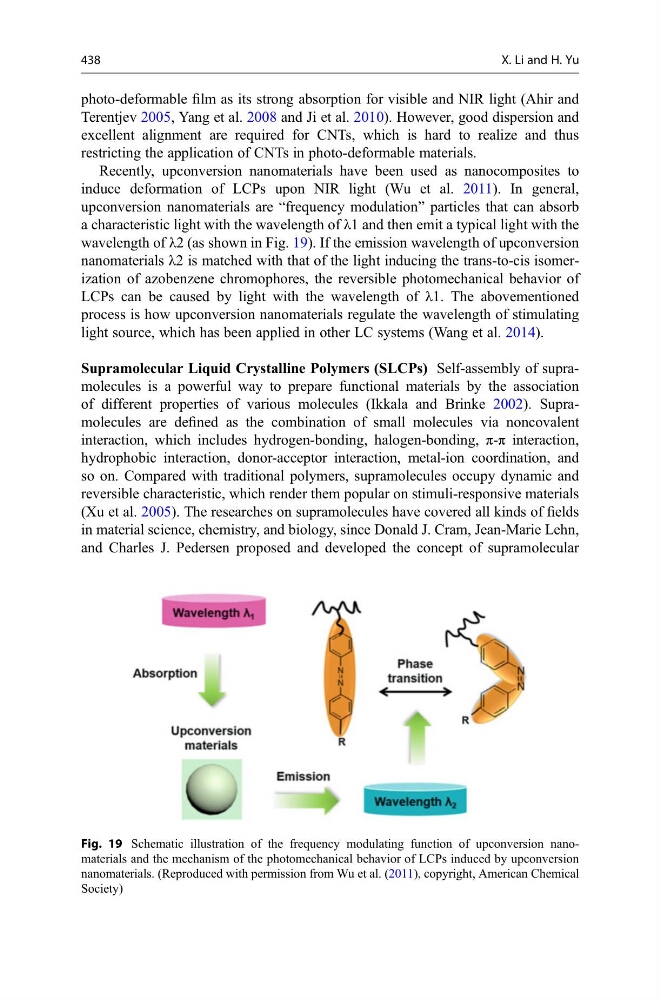
wavelength of λ2 (as shown in Fig. 19). If the emission wavelength of upconversion
nanomaterials λ2 is matched with that of the light inducing the trans-to-cis isomerization of azobenzene chromophores, the reversible photomechanical behavior of
LCPs can be caused by light with the wavelength of λ1. The abovementioned
process is how upconversion nanomaterials regulate the wavelength of stimulating
light source, which has been applied in other LC systems (Wang et al. 2014).
Supramolecular Liquid Crystalline Polymers (SLCPs) Self-assembly of supramolecules is a powerful way to prepare functional materials by the association
of different properties of various molecules (Ikkala and Brinke 2002). Supramolecules are defined as the combination of small molecules via noncovalent
interaction, which includes hydrogen-bonding, halogen-bonding, π-π interaction,
hydrophobic interaction, donor-acceptor interaction, metal-ion coordination, and
so on. Compared with traditional polymers, supramolecules occupy dynamic and
reversible characteristic, which render them popular on stimuli-responsive materials
(Xu et al. 2005). The researches on supramolecules have covered all kinds of fields
in material science, chemistry, and biology, since Donald J. Cram, Jean-Marie Lehn,
and Charles J. Pedersen proposed and developed the concept of supramolecular
Fig. 19 Schematic illustration of the frequency modulating function of upconversion nanomaterials and the mechanism of the photomechanical behavior of LCPs induced by upconversion
nanomaterials. (Reproduced with permission from Wu et al. (2011), copyright, American Chemical
Society)
438
X. Li and H. Yu
Terentjev 2005, Yang et al. 2008 and Ji et al. 2010). However, good dispersion and
excellent alignment are required for CNTs, which is hard to realize and thus
restricting the application of CNTs in photo-deformable materials.
Recently, upconversion nanomaterials have been used as nanocomposites to
induce deformation of LCPs upon NIR light (Wu et al. 2011). In general,
upconversion nanomaterials are “frequency modulation” particles that can absorb
a characteristic light with the wavelength of λ1 and then emit a typical light with the
wavelength of λ2 (as shown in Fig. 19). If the emission wavelength of upconversion
nanomaterials λ2 is matched with that of the light inducing the trans-to-cis isomerization of azobenzene chromophores, the reversible photomechanical behavior of
LCPs can be caused by light with the wavelength of λ1. The abovementioned
process is how upconversion nanomaterials regulate the wavelength of stimulating
light source, which has been applied in other LC systems (Wang et al. 2014).
Supramolecular Liquid Crystalline Polymers (SLCPs) Self-assembly of supramolecules is a powerful way to prepare functional materials by the association
of different properties of various molecules (Ikkala and Brinke 2002). Supramolecules are defined as the combination of small molecules via noncovalent
interaction, which includes hydrogen-bonding, halogen-bonding, π-π interaction,
hydrophobic interaction, donor-acceptor interaction, metal-ion coordination, and
so on. Compared with traditional polymers, supramolecules occupy dynamic and
reversible characteristic, which render them popular on stimuli-responsive materials
(Xu et al. 2005). The researches on supramolecules have covered all kinds of fields
in material science, chemistry, and biology, since Donald J. Cram, Jean-Marie Lehn,
and Charles J. Pedersen proposed and developed the concept of supramolecular
Fig. 19 Schematic illustration of the frequency modulating function of upconversion nanomaterials and the mechanism of the photomechanical behavior of LCPs induced by upconversion
nanomaterials. (Reproduced with permission from Wu et al. (2011), copyright, American Chemical
Society)
438
X. Li and H. Yu