

ones. By utilizing this properties, photoisomerization upon the light irradiation
would change the hydrophobicity of azobenzene-containing LCBCs. Zhao et al.
prepared reversible photoresponsive micelles composed of amphiphilic LCBCs
based on the photochemical phase transition of azobenzene mesogenic moieties
(Wang et al. 2004), as seen in Fig. 12.
Firstly, the amphiphilic LCBC (PAzoMA-b-PAA) was synthesized by ATRP
followed by hydrolysis. The micelle or vesicle aggregates formed when water was
added into the dioxane solution of PAzoMA-b-PAA. Upon UV irradiation, the
aggregates would break up into polymer segments, and they assemble into micelles
again under visible light. Zhao’s work further proved that photoirradiation could not
only result in the aggregation and cleavage of micelles (Su et al. 2007) but also
reversibly change the morphologies of them. Seki reported that the photoalignment
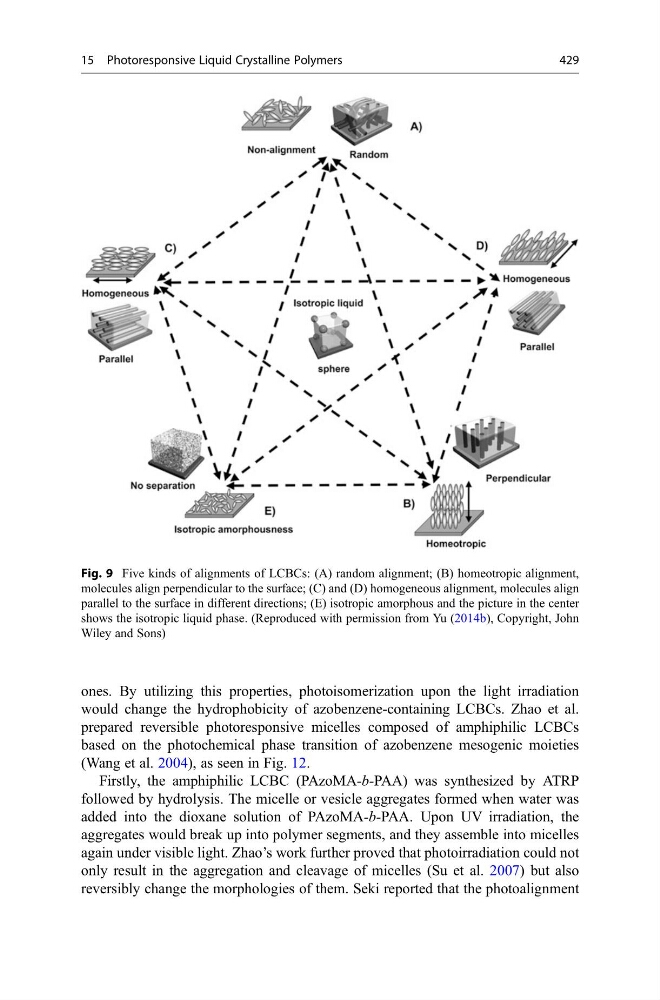
Fig. 9 Five kinds of alignments of LCBCs: (A) random alignment; (B) homeotropic alignment,
molecules align perpendicular to the surface; (C) and (D) homogeneous alignment, molecules align
parallel to the surface in different directions; (E) isotropic amorphous and the picture in the center
shows the isotropic liquid phase. (Reproduced with permission from Yu (2014b), Copyright, John
Wiley and Sons)
15 Photoresponsive Liquid Crystalline Polymers
429
would change the hydrophobicity of azobenzene-containing LCBCs. Zhao et al.
prepared reversible photoresponsive micelles composed of amphiphilic LCBCs
based on the photochemical phase transition of azobenzene mesogenic moieties
(Wang et al. 2004), as seen in Fig. 12.
Firstly, the amphiphilic LCBC (PAzoMA-b-PAA) was synthesized by ATRP
followed by hydrolysis. The micelle or vesicle aggregates formed when water was
added into the dioxane solution of PAzoMA-b-PAA. Upon UV irradiation, the
aggregates would break up into polymer segments, and they assemble into micelles
again under visible light. Zhao’s work further proved that photoirradiation could not
only result in the aggregation and cleavage of micelles (Su et al. 2007) but also
reversibly change the morphologies of them. Seki reported that the photoalignment
Fig. 9 Five kinds of alignments of LCBCs: (A) random alignment; (B) homeotropic alignment,
molecules align perpendicular to the surface; (C) and (D) homogeneous alignment, molecules align
parallel to the surface in different directions; (E) isotropic amorphous and the picture in the center
shows the isotropic liquid phase. (Reproduced with permission from Yu (2014b), Copyright, John
Wiley and Sons)
15 Photoresponsive Liquid Crystalline Polymers
429