

Later, they prepared triblock LC copolymer containing both azobenzenes and
cyanobiphenyl (CBs) moieties (Yu et al. 2007a). Upon microphase separation, the
block of azobenzenes and CBs self-assembled into spherical domain. Due to the
effect of molecular cooperative motion, the CBs in the nanospheres can be easily
aligned according to the behavior of azobenzenes, which leads to a large anisotropy
and stable birefringence. Novel wormlike nanostructures were prepared in bulk films
of diblock copolymer with PMMA as matrix and azobenzene moieties exhibiting
smectic LC phase. The azobenzene moieties may self-assemble into wormlike
nanostructures, eliminating the scattering of visible light and showing outstanding
transparency (Yu et al. 2007b). Later, they systematically examined a series of
polymers containing azobenzene moieties including homopolymer, random copolymer, and diblock copolymer. These polymers demonstrate different behaviors in
photoinduced alignment and holographic recording due to the varied contents of
mesogens. For instance, LCBCs with azobenzene moieties as majority phase show
similar photoalignment behavior with homopolymer. But the mass transport was
partially prohibited when the mesogenic block forms the separated phase upon
microphase separation, as shown in Fig. 11. LCBCs are advantageous over random
copolymers since the LC phase can be easily obtained with lower mesogenic
contents in BCs (Yu HF et al. 2008a).
It is well-known that the dipole moment of cis-azobenzene is larger than that of
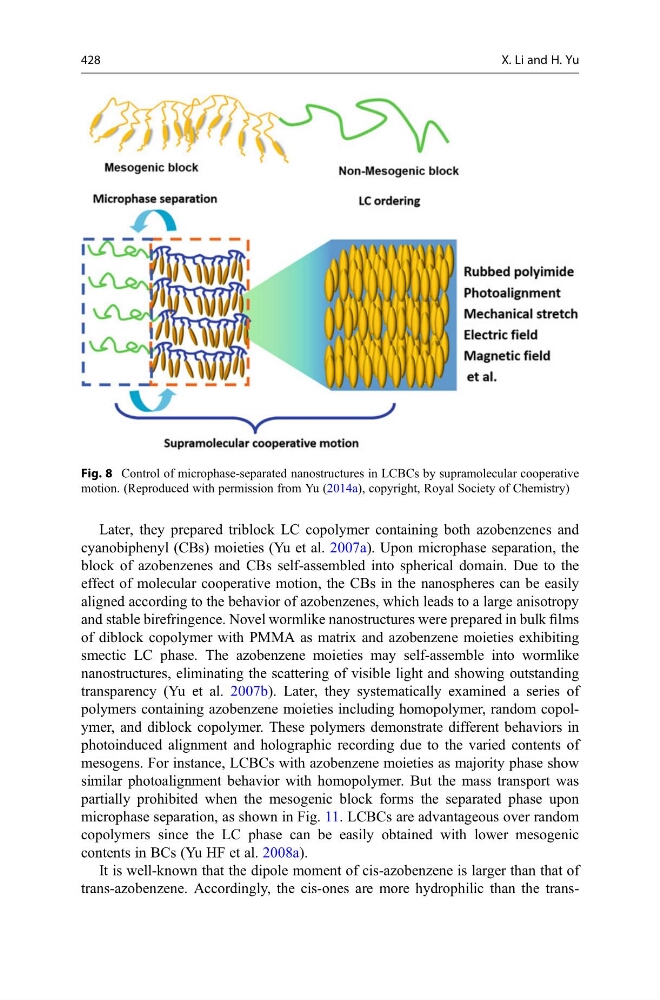
trans-azobenzene. Accordingly, the cis-ones are more hydrophilic than the transFig. 8 Control of microphase-separated nanostructures in LCBCs by supramolecular cooperative
motion. (Reproduced with permission from Yu (2014a), copyright, Royal Society of Chemistry)
428
X. Li and H. Yu
cyanobiphenyl (CBs) moieties (Yu et al. 2007a). Upon microphase separation, the
block of azobenzenes and CBs self-assembled into spherical domain. Due to the
effect of molecular cooperative motion, the CBs in the nanospheres can be easily
aligned according to the behavior of azobenzenes, which leads to a large anisotropy
and stable birefringence. Novel wormlike nanostructures were prepared in bulk films
of diblock copolymer with PMMA as matrix and azobenzene moieties exhibiting
smectic LC phase. The azobenzene moieties may self-assemble into wormlike
nanostructures, eliminating the scattering of visible light and showing outstanding
transparency (Yu et al. 2007b). Later, they systematically examined a series of
polymers containing azobenzene moieties including homopolymer, random copolymer, and diblock copolymer. These polymers demonstrate different behaviors in
photoinduced alignment and holographic recording due to the varied contents of
mesogens. For instance, LCBCs with azobenzene moieties as majority phase show
similar photoalignment behavior with homopolymer. But the mass transport was
partially prohibited when the mesogenic block forms the separated phase upon
microphase separation, as shown in Fig. 11. LCBCs are advantageous over random
copolymers since the LC phase can be easily obtained with lower mesogenic
contents in BCs (Yu HF et al. 2008a).
It is well-known that the dipole moment of cis-azobenzene is larger than that of
trans-azobenzene. Accordingly, the cis-ones are more hydrophilic than the transFig. 8 Control of microphase-separated nanostructures in LCBCs by supramolecular cooperative
motion. (Reproduced with permission from Yu (2014a), copyright, Royal Society of Chemistry)
428
X. Li and H. Yu