

of LCBCs is efficiently influenced by the periodic film thickness upon holographic
recording, as shown in Fig. 13 (Seki et al. 2013).
As we have discussed above, the azobenzene chromophores were aligned perpendicularly to the linearly polarized light. However, if the films were thinner than
60 nm, they would lead to a planar orientation. Thus, it is reasonable to
get alternating orientations through inducing wavelike mass transition by interfered
polarized beams upon holographic recording. In the thicker parts, the nanocylinders
were perpendicular to the surface due to the supramolecular cooperative motion.
While in the thinner ones, they aligned along the plane (Morikawa et al. 2006).
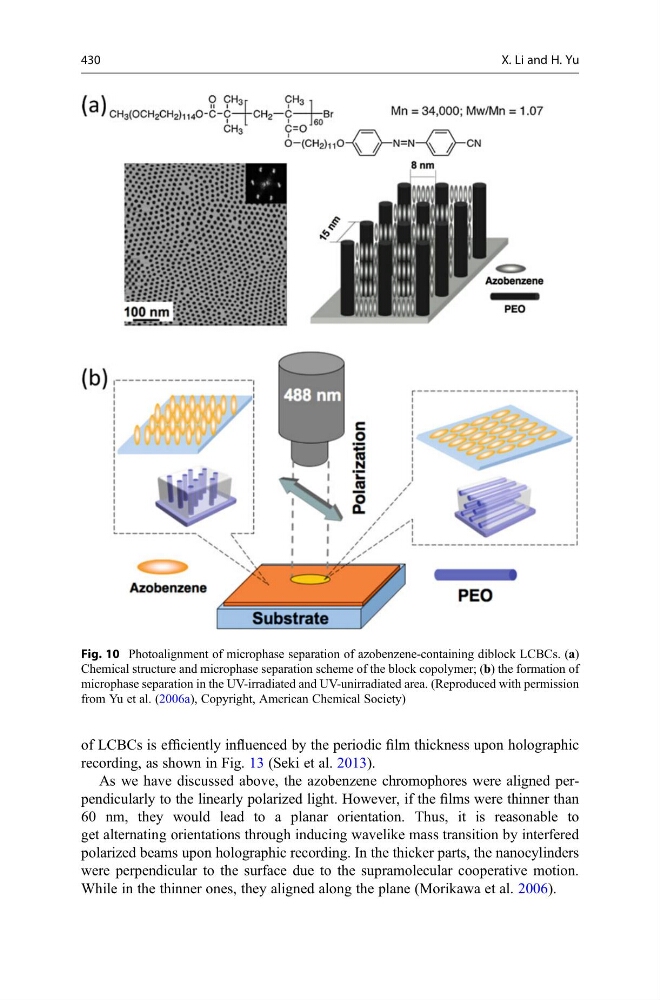
Fig. 10 Photoalignment of microphase separation of azobenzene-containing diblock LCBCs. (a)
Chemical structure and microphase separation scheme of the block copolymer; (b) the formation of
microphase separation in the UV-irradiated and UV-unirradiated area. (Reproduced with permission
from Yu et al. (2006a), Copyright, American Chemical Society)
430
X. Li and H. Yu
recording, as shown in Fig. 13 (Seki et al. 2013).
As we have discussed above, the azobenzene chromophores were aligned perpendicularly to the linearly polarized light. However, if the films were thinner than
60 nm, they would lead to a planar orientation. Thus, it is reasonable to
get alternating orientations through inducing wavelike mass transition by interfered
polarized beams upon holographic recording. In the thicker parts, the nanocylinders
were perpendicular to the surface due to the supramolecular cooperative motion.
While in the thinner ones, they aligned along the plane (Morikawa et al. 2006).
Fig. 10 Photoalignment of microphase separation of azobenzene-containing diblock LCBCs. (a)
Chemical structure and microphase separation scheme of the block copolymer; (b) the formation of
microphase separation in the UV-irradiated and UV-unirradiated area. (Reproduced with permission
from Yu et al. (2006a), Copyright, American Chemical Society)
430
X. Li and H. Yu