

onto an azobenzene molecule to prepare an azotolane mesogen, as shown in Fig. 7a.
The azotolane group possesses a far longer molecular conjugation length than one
single tolane or an azobenzene moiety, enabling the azotolane-containing LCPs to
show a huge photoinduced change in birefringence.
Recently, a post-functionalization method was elegantly explored to an
azobenzene-containing LCP precursor to control the content of azotolane in the
LCPs with the degree of functionalization (Yu et al. 2009). Thus, precise control of
photoinduced birefringence was successfully obtained. The molecular architecture
of azotolane LCPs with a giant photoinduced change in birefringence is useful for
extensive optical applications in high-performance photonic devices (such as highdensity optical recording, as well as holographic and multi-bit recording) and photoswitching materials.
Liquid Crystalline Block Copolymers (LCBCs)
BCs are composed of at least two kinds of polymers with different chemical characters integrated through covalent bonding. If polymer components in BCs are immiscible with each other, then the polymers would assemble into different phaseseparated nanostructures according to the contents of each block. Usually, the size
of the nanostructure is about 10–100 nm. The morphologies vary from spheres,
cylinders, to lamellae phases with various volume ratio of polymers (Fasolka and
Mayes 2001; Bates and Fredrickson 1990; Thomas et al. 1994). So far, researches on
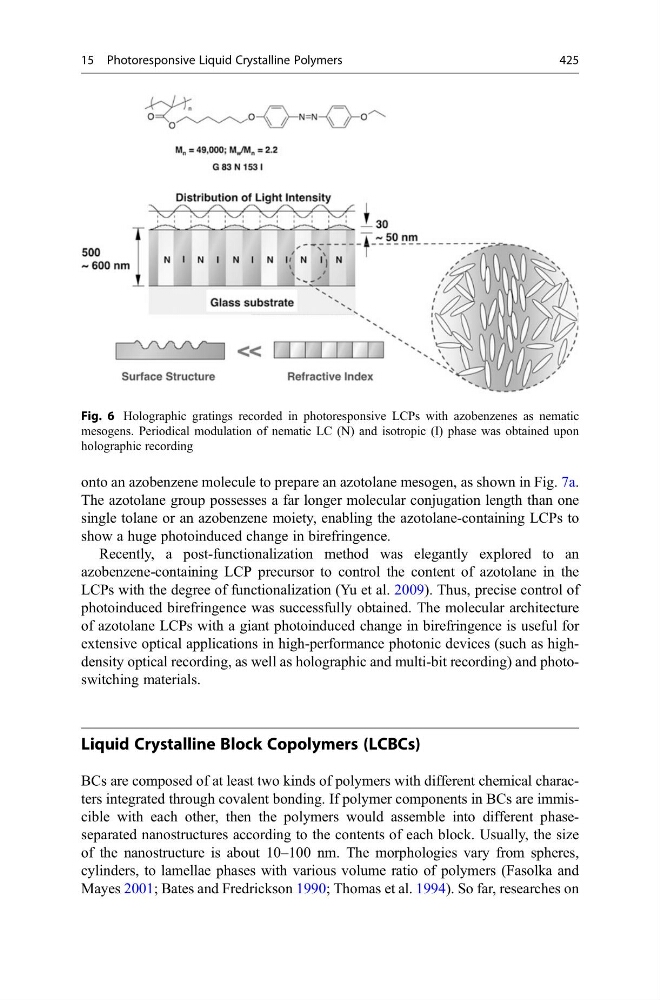
Fig. 6 Holographic gratings recorded in photoresponsive LCPs with azobenzenes as nematic
mesogens. Periodical modulation of nematic LC (N) and isotropic (I) phase was obtained upon
holographic recording
15 Photoresponsive Liquid Crystalline Polymers
425
The azotolane group possesses a far longer molecular conjugation length than one
single tolane or an azobenzene moiety, enabling the azotolane-containing LCPs to
show a huge photoinduced change in birefringence.
Recently, a post-functionalization method was elegantly explored to an
azobenzene-containing LCP precursor to control the content of azotolane in the
LCPs with the degree of functionalization (Yu et al. 2009). Thus, precise control of
photoinduced birefringence was successfully obtained. The molecular architecture
of azotolane LCPs with a giant photoinduced change in birefringence is useful for
extensive optical applications in high-performance photonic devices (such as highdensity optical recording, as well as holographic and multi-bit recording) and photoswitching materials.
Liquid Crystalline Block Copolymers (LCBCs)
BCs are composed of at least two kinds of polymers with different chemical characters integrated through covalent bonding. If polymer components in BCs are immiscible with each other, then the polymers would assemble into different phaseseparated nanostructures according to the contents of each block. Usually, the size
of the nanostructure is about 10–100 nm. The morphologies vary from spheres,
cylinders, to lamellae phases with various volume ratio of polymers (Fasolka and
Mayes 2001; Bates and Fredrickson 1990; Thomas et al. 1994). So far, researches on
Fig. 6 Holographic gratings recorded in photoresponsive LCPs with azobenzenes as nematic
mesogens. Periodical modulation of nematic LC (N) and isotropic (I) phase was obtained upon
holographic recording
15 Photoresponsive Liquid Crystalline Polymers
425