

microphase separation are focused on exquisite structures, which may be applied in
photonics, novel nanomaterials, and fine processing technology.
Liquid crystalline block copolymers (LCBCs) are the combination of BCs and
LCs, the two soft matters with self-organization capability (Yu and Ikeda 2011b).
When light-active chromophores are introduced as mesogens, LCBCs could respond
to the incident actinic light and show the photoresponsive properties, for example,
photoinduced phase transition, photocontrolled alignment, and photoinduced mass
transition, just like that of the LCP homopolymer. These properties offer the
fundamental of novel functions in this kind of materials.
To get ordered nanostructures in thin films upon microphase separation, the
polymer structure must be well-defined and the molecular weight should be larger
enough in LCBCs (Yu 2014b). Methods to synthesize LCBCs usually contain
anionic polymerization, cationic polymerization, and conventional and controlled
radical polymerizations. The earliest way to synthesize photoresponsive LCBCs is
by anionic polymerization. However, the reaction condition is hard to reach: (1) the
monomer must be purified, (2) the environment should be dry enough, (3) it is
difficult to purify macromolecular initiator, and (4) the polymerization temperature is
relatively low. Therefore, controlled radical polymerization has been widely used in
synthesizing BCs, including atom transfer radical polymerization (ATRP), reversible
addition-fragmentation chain transfer (RAFT) polymerization, nitroxide-mediated
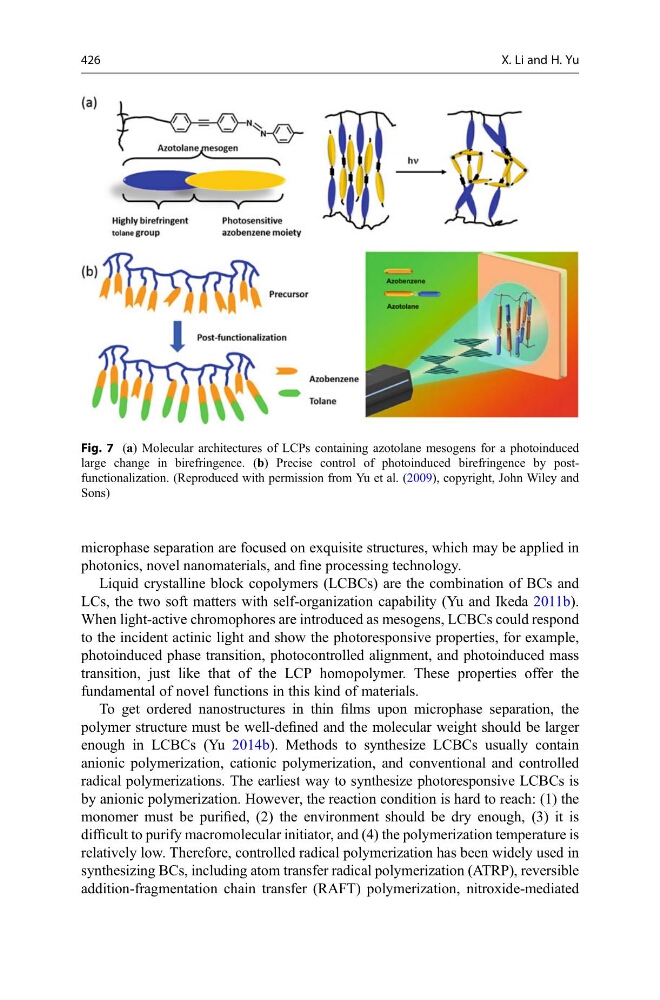
Fig. 7 (a) Molecular architectures of LCPs containing azotolane mesogens for a photoinduced
large change in birefringence. (b) Precise control of photoinduced birefringence by postfunctionalization. (Reproduced with permission from Yu et al. (2009), copyright, John Wiley and
Sons)
426
X. Li and H. Yu
photonics, novel nanomaterials, and fine processing technology.
Liquid crystalline block copolymers (LCBCs) are the combination of BCs and
LCs, the two soft matters with self-organization capability (Yu and Ikeda 2011b).
When light-active chromophores are introduced as mesogens, LCBCs could respond
to the incident actinic light and show the photoresponsive properties, for example,
photoinduced phase transition, photocontrolled alignment, and photoinduced mass
transition, just like that of the LCP homopolymer. These properties offer the
fundamental of novel functions in this kind of materials.
To get ordered nanostructures in thin films upon microphase separation, the
polymer structure must be well-defined and the molecular weight should be larger
enough in LCBCs (Yu 2014b). Methods to synthesize LCBCs usually contain
anionic polymerization, cationic polymerization, and conventional and controlled
radical polymerizations. The earliest way to synthesize photoresponsive LCBCs is
by anionic polymerization. However, the reaction condition is hard to reach: (1) the
monomer must be purified, (2) the environment should be dry enough, (3) it is
difficult to purify macromolecular initiator, and (4) the polymerization temperature is
relatively low. Therefore, controlled radical polymerization has been widely used in
synthesizing BCs, including atom transfer radical polymerization (ATRP), reversible
addition-fragmentation chain transfer (RAFT) polymerization, nitroxide-mediated
Fig. 7 (a) Molecular architectures of LCPs containing azotolane mesogens for a photoinduced
large change in birefringence. (b) Precise control of photoinduced birefringence by postfunctionalization. (Reproduced with permission from Yu et al. (2009), copyright, John Wiley and
Sons)
426
X. Li and H. Yu