

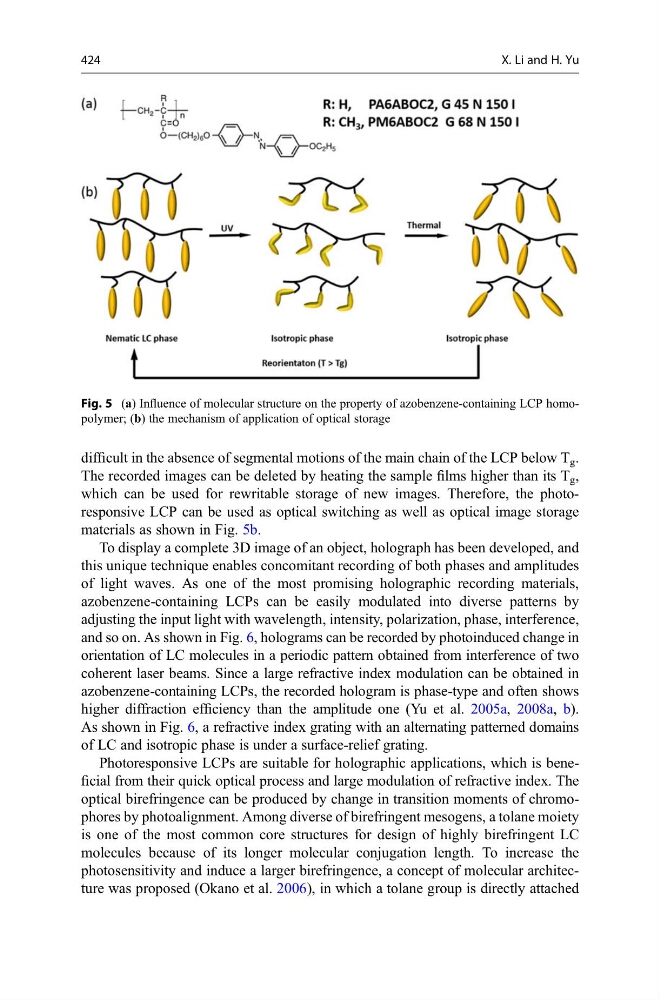
difficult in the absence of segmental motions of the main chain of the LCP below T g .
The recorded images can be deleted by heating the sample films higher than its T g ,
which can be used for rewritable storage of new images. Therefore, the photoresponsive LCP can be used as optical switching as well as optical image storage
materials as shown in Fig. 5b.
To display a complete 3D image of an object, holograph has been developed, and
this unique technique enables concomitant recording of both phases and amplitudes
of light waves. As one of the most promising holographic recording materials,
azobenzene-containing LCPs can be easily modulated into diverse patterns by
adjusting the input light with wavelength, intensity, polarization, phase, interference,
and so on. As shown in Fig. 6, holograms can be recorded by photoinduced change in
orientation of LC molecules in a periodic pattern obtained from interference of two
coherent laser beams. Since a large refractive index modulation can be obtained in
azobenzene-containing LCPs, the recorded hologram is phase-type and often shows
higher diffraction efficiency than the amplitude one (Yu et al. 2005a, 2008a, b).
As shown in Fig. 6, a refractive index grating with an alternating patterned domains
of LC and isotropic phase is under a surface-relief grating.
Photoresponsive LCPs are suitable for holographic applications, which is beneficial from their quick optical process and large modulation of refractive index. The
optical birefringence can be produced by change in transition moments of chromophores by photoalignment. Among diverse of birefringent mesogens, a tolane moiety
is one of the most common core structures for design of highly birefringent LC
molecules because of its longer molecular conjugation length. To increase the
photosensitivity and induce a larger birefringence, a concept of molecular architecture was proposed (Okano et al. 2006), in which a tolane group is directly attached
Fig. 5 (a) Influence of molecular structure on the property of azobenzene-containing LCP homopolymer; (b) the mechanism of application of optical storage
424
X. Li and H. Yu
The recorded images can be deleted by heating the sample films higher than its T g ,
which can be used for rewritable storage of new images. Therefore, the photoresponsive LCP can be used as optical switching as well as optical image storage
materials as shown in Fig. 5b.
To display a complete 3D image of an object, holograph has been developed, and
this unique technique enables concomitant recording of both phases and amplitudes
of light waves. As one of the most promising holographic recording materials,
azobenzene-containing LCPs can be easily modulated into diverse patterns by
adjusting the input light with wavelength, intensity, polarization, phase, interference,
and so on. As shown in Fig. 6, holograms can be recorded by photoinduced change in
orientation of LC molecules in a periodic pattern obtained from interference of two
coherent laser beams. Since a large refractive index modulation can be obtained in
azobenzene-containing LCPs, the recorded hologram is phase-type and often shows
higher diffraction efficiency than the amplitude one (Yu et al. 2005a, 2008a, b).
As shown in Fig. 6, a refractive index grating with an alternating patterned domains
of LC and isotropic phase is under a surface-relief grating.
Photoresponsive LCPs are suitable for holographic applications, which is beneficial from their quick optical process and large modulation of refractive index. The
optical birefringence can be produced by change in transition moments of chromophores by photoalignment. Among diverse of birefringent mesogens, a tolane moiety
is one of the most common core structures for design of highly birefringent LC
molecules because of its longer molecular conjugation length. To increase the
photosensitivity and induce a larger birefringence, a concept of molecular architecture was proposed (Okano et al. 2006), in which a tolane group is directly attached
Fig. 5 (a) Influence of molecular structure on the property of azobenzene-containing LCP homopolymer; (b) the mechanism of application of optical storage
424
X. Li and H. Yu