

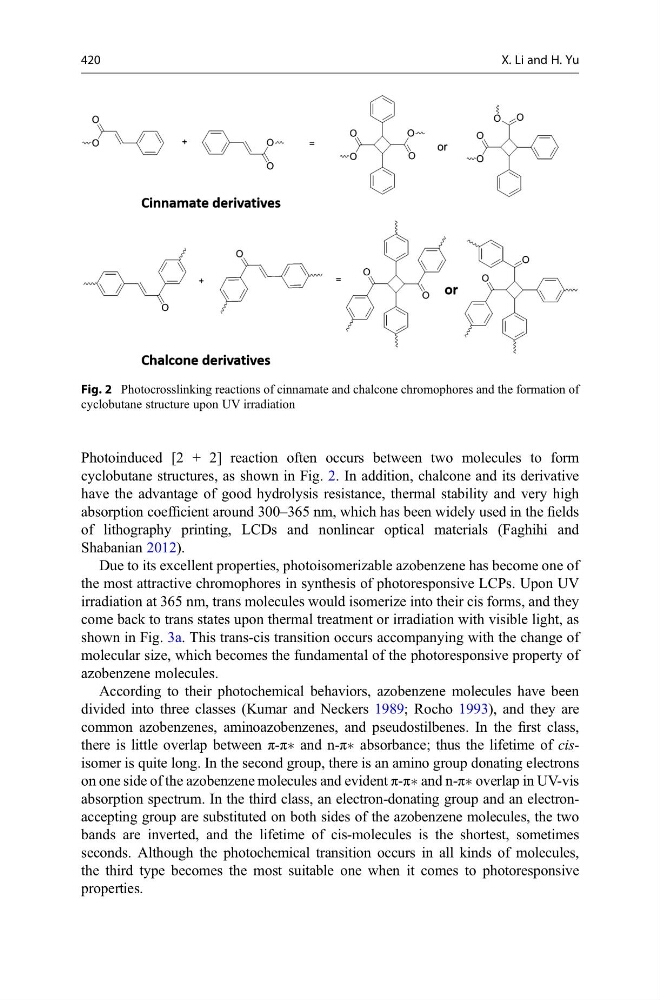
Photoinduced [2 + 2] reaction often occurs between two molecules to form
cyclobutane structures, as shown in Fig. 2. In addition, chalcone and its derivative
have the advantage of good hydrolysis resistance, thermal stability and very high
absorption coefficient around 300–365 nm, which has been widely used in the fields
of lithography printing, LCDs and nonlinear optical materials (Faghihi and
Shabanian 2012).
Due to its excellent properties, photoisomerizable azobenzene has become one of
the most attractive chromophores in synthesis of photoresponsive LCPs. Upon UV
irradiation at 365 nm, trans molecules would isomerize into their cis forms, and they
come back to trans states upon thermal treatment or irradiation with visible light, as
shown in Fig. 3a. This trans-cis transition occurs accompanying with the change of
molecular size, which becomes the fundamental of the photoresponsive property of
azobenzene molecules.
According to their photochemical behaviors, azobenzene molecules have been
divided into three classes (Kumar and Neckers 1989; Rocho 1993), and they are
common azobenzenes, aminoazobenzenes, and pseudostilbenes. In the first class,
there is little overlap between π-πà and n-πà absorbance; thus the lifetime of cisisomer is quite long. In the second group, there is an amino group donating electrons
on one side of the azobenzene molecules and evident π-πà and n-πà overlap in UV-vis
absorption spectrum. In the third class, an electron-donating group and an electronaccepting group are substituted on both sides of the azobenzene molecules, the two
bands are inverted, and the lifetime of cis-molecules is the shortest, sometimes
seconds. Although the photochemical transition occurs in all kinds of molecules,
the third type becomes the most suitable one when it comes to photoresponsive
properties.
Fig. 2 Photocrosslinking reactions of cinnamate and chalcone chromophores and the formation of
cyclobutane structure upon UV irradiation
420
X. Li and H. Yu
cyclobutane structures, as shown in Fig. 2. In addition, chalcone and its derivative
have the advantage of good hydrolysis resistance, thermal stability and very high
absorption coefficient around 300–365 nm, which has been widely used in the fields
of lithography printing, LCDs and nonlinear optical materials (Faghihi and
Shabanian 2012).
Due to its excellent properties, photoisomerizable azobenzene has become one of
the most attractive chromophores in synthesis of photoresponsive LCPs. Upon UV
irradiation at 365 nm, trans molecules would isomerize into their cis forms, and they
come back to trans states upon thermal treatment or irradiation with visible light, as
shown in Fig. 3a. This trans-cis transition occurs accompanying with the change of
molecular size, which becomes the fundamental of the photoresponsive property of
azobenzene molecules.
According to their photochemical behaviors, azobenzene molecules have been
divided into three classes (Kumar and Neckers 1989; Rocho 1993), and they are
common azobenzenes, aminoazobenzenes, and pseudostilbenes. In the first class,
there is little overlap between π-πà and n-πà absorbance; thus the lifetime of cisisomer is quite long. In the second group, there is an amino group donating electrons
on one side of the azobenzene molecules and evident π-πà and n-πà overlap in UV-vis
absorption spectrum. In the third class, an electron-donating group and an electronaccepting group are substituted on both sides of the azobenzene molecules, the two
bands are inverted, and the lifetime of cis-molecules is the shortest, sometimes
seconds. Although the photochemical transition occurs in all kinds of molecules,
the third type becomes the most suitable one when it comes to photoresponsive
properties.
Fig. 2 Photocrosslinking reactions of cinnamate and chalcone chromophores and the formation of
cyclobutane structure upon UV irradiation
420
X. Li and H. Yu