

If azobenzene molecules are incorporated into a polymer chain, a series of motions
can be acquired following the interesting photoisomerization. The photoinduced
motions have been classified into three levels (Natansohn and Rochon 2002). The
first level is the chromophore motion, influenced by the light polarization. Upon
irradiation of linearly polarized light, the molecules, whose axes are parallel to the
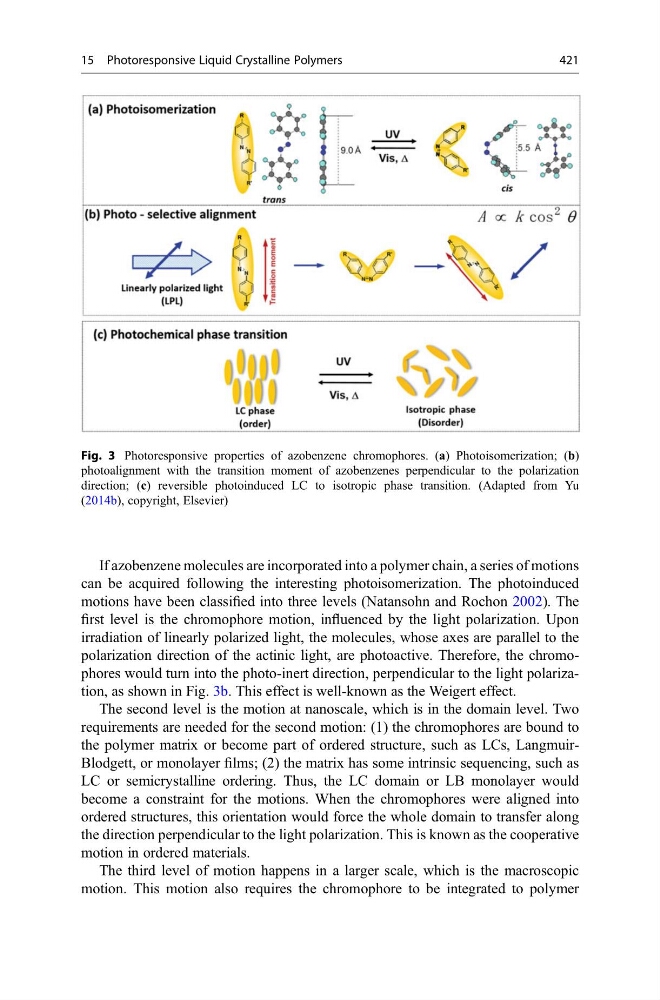
polarization direction of the actinic light, are photoactive. Therefore, the chromophores would turn into the photo-inert direction, perpendicular to the light polarization, as shown in Fig. 3b. This effect is well-known as the Weigert effect.
The second level is the motion at nanoscale, which is in the domain level. Two
requirements are needed for the second motion: (1) the chromophores are bound to
the polymer matrix or become part of ordered structure, such as LCs, LangmuirBlodgett, or monolayer films; (2) the matrix has some intrinsic sequencing, such as
LC or semicrystalline ordering. Thus, the LC domain or LB monolayer would
become a constraint for the motions. When the chromophores were aligned into
ordered structures, this orientation would force the whole domain to transfer along
the direction perpendicular to the light polarization. This is known as the cooperative
motion in ordered materials.
The third level of motion happens in a larger scale, which is the macroscopic
motion. This motion also requires the chromophore to be integrated to polymer
Fig. 3 Photoresponsive properties of azobenzene chromophores. (a) Photoisomerization; (b)
photoalignment with the transition moment of azobenzenes perpendicular to the polarization
direction; (c) reversible photoinduced LC to isotropic phase transition. (Adapted from Yu
(2014b), copyright, Elsevier)
15 Photoresponsive Liquid Crystalline Polymers
421
can be acquired following the interesting photoisomerization. The photoinduced
motions have been classified into three levels (Natansohn and Rochon 2002). The
first level is the chromophore motion, influenced by the light polarization. Upon
irradiation of linearly polarized light, the molecules, whose axes are parallel to the
polarization direction of the actinic light, are photoactive. Therefore, the chromophores would turn into the photo-inert direction, perpendicular to the light polarization, as shown in Fig. 3b. This effect is well-known as the Weigert effect.
The second level is the motion at nanoscale, which is in the domain level. Two
requirements are needed for the second motion: (1) the chromophores are bound to
the polymer matrix or become part of ordered structure, such as LCs, LangmuirBlodgett, or monolayer films; (2) the matrix has some intrinsic sequencing, such as
LC or semicrystalline ordering. Thus, the LC domain or LB monolayer would
become a constraint for the motions. When the chromophores were aligned into
ordered structures, this orientation would force the whole domain to transfer along
the direction perpendicular to the light polarization. This is known as the cooperative
motion in ordered materials.
The third level of motion happens in a larger scale, which is the macroscopic
motion. This motion also requires the chromophore to be integrated to polymer
Fig. 3 Photoresponsive properties of azobenzene chromophores. (a) Photoisomerization; (b)
photoalignment with the transition moment of azobenzenes perpendicular to the polarization
direction; (c) reversible photoinduced LC to isotropic phase transition. (Adapted from Yu
(2014b), copyright, Elsevier)
15 Photoresponsive Liquid Crystalline Polymers
421