

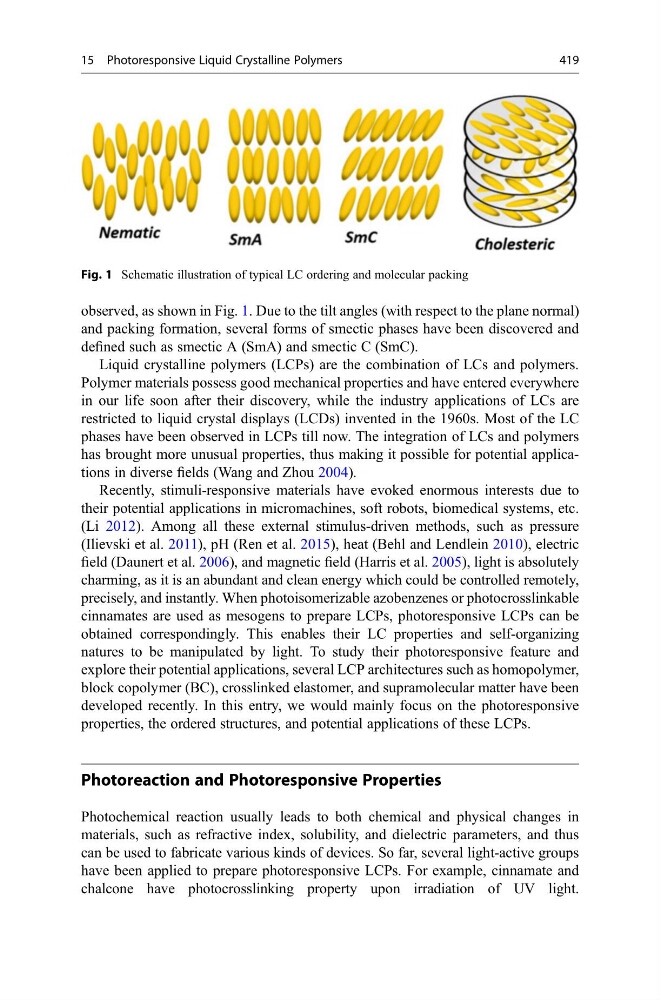
observed, as shown in Fig. 1. Due to the tilt angles (with respect to the plane normal)
and packing formation, several forms of smectic phases have been discovered and
defined such as smectic A (SmA) and smectic C (SmC).
Liquid crystalline polymers (LCPs) are the combination of LCs and polymers.
Polymer materials possess good mechanical properties and have entered everywhere
in our life soon after their discovery, while the industry applications of LCs are
restricted to liquid crystal displays (LCDs) invented in the 1960s. Most of the LC
phases have been observed in LCPs till now. The integration of LCs and polymers
has brought more unusual properties, thus making it possible for potential applications in diverse fields (Wang and Zhou 2004).
Recently, stimuli-responsive materials have evoked enormous interests due to
their potential applications in micromachines, soft robots, biomedical systems, etc.
(Li 2012). Among all these external stimulus-driven methods, such as pressure
(Ilievski et al. 2011), pH (Ren et al. 2015), heat (Behl and Lendlein 2010), electric
field (Daunert et al. 2006), and magnetic field (Harris et al. 2005), light is absolutely
charming, as it is an abundant and clean energy which could be controlled remotely,
precisely, and instantly. When photoisomerizable azobenzenes or photocrosslinkable
cinnamates are used as mesogens to prepare LCPs, photoresponsive LCPs can be
obtained correspondingly. This enables their LC properties and self-organizing
natures to be manipulated by light. To study their photoresponsive feature and
explore their potential applications, several LCP architectures such as homopolymer,
block copolymer (BC), crosslinked elastomer, and supramolecular matter have been
developed recently. In this entry, we would mainly focus on the photoresponsive
properties, the ordered structures, and potential applications of these LCPs.
Photoreaction and Photoresponsive Properties
Photochemical reaction usually leads to both chemical and physical changes in
materials, such as refractive index, solubility, and dielectric parameters, and thus
can be used to fabricate various kinds of devices. So far, several light-active groups
have been applied to prepare photoresponsive LCPs. For example, cinnamate and
chalcone have photocrosslinking property upon irradiation of UV light.
Fig. 1 Schematic illustration of typical LC ordering and molecular packing
15 Photoresponsive Liquid Crystalline Polymers
419
and packing formation, several forms of smectic phases have been discovered and
defined such as smectic A (SmA) and smectic C (SmC).
Liquid crystalline polymers (LCPs) are the combination of LCs and polymers.
Polymer materials possess good mechanical properties and have entered everywhere
in our life soon after their discovery, while the industry applications of LCs are
restricted to liquid crystal displays (LCDs) invented in the 1960s. Most of the LC
phases have been observed in LCPs till now. The integration of LCs and polymers
has brought more unusual properties, thus making it possible for potential applications in diverse fields (Wang and Zhou 2004).
Recently, stimuli-responsive materials have evoked enormous interests due to
their potential applications in micromachines, soft robots, biomedical systems, etc.
(Li 2012). Among all these external stimulus-driven methods, such as pressure
(Ilievski et al. 2011), pH (Ren et al. 2015), heat (Behl and Lendlein 2010), electric
field (Daunert et al. 2006), and magnetic field (Harris et al. 2005), light is absolutely
charming, as it is an abundant and clean energy which could be controlled remotely,
precisely, and instantly. When photoisomerizable azobenzenes or photocrosslinkable
cinnamates are used as mesogens to prepare LCPs, photoresponsive LCPs can be
obtained correspondingly. This enables their LC properties and self-organizing
natures to be manipulated by light. To study their photoresponsive feature and
explore their potential applications, several LCP architectures such as homopolymer,
block copolymer (BC), crosslinked elastomer, and supramolecular matter have been
developed recently. In this entry, we would mainly focus on the photoresponsive
properties, the ordered structures, and potential applications of these LCPs.
Photoreaction and Photoresponsive Properties
Photochemical reaction usually leads to both chemical and physical changes in
materials, such as refractive index, solubility, and dielectric parameters, and thus
can be used to fabricate various kinds of devices. So far, several light-active groups
have been applied to prepare photoresponsive LCPs. For example, cinnamate and
chalcone have photocrosslinking property upon irradiation of UV light.
Fig. 1 Schematic illustration of typical LC ordering and molecular packing
15 Photoresponsive Liquid Crystalline Polymers
419