

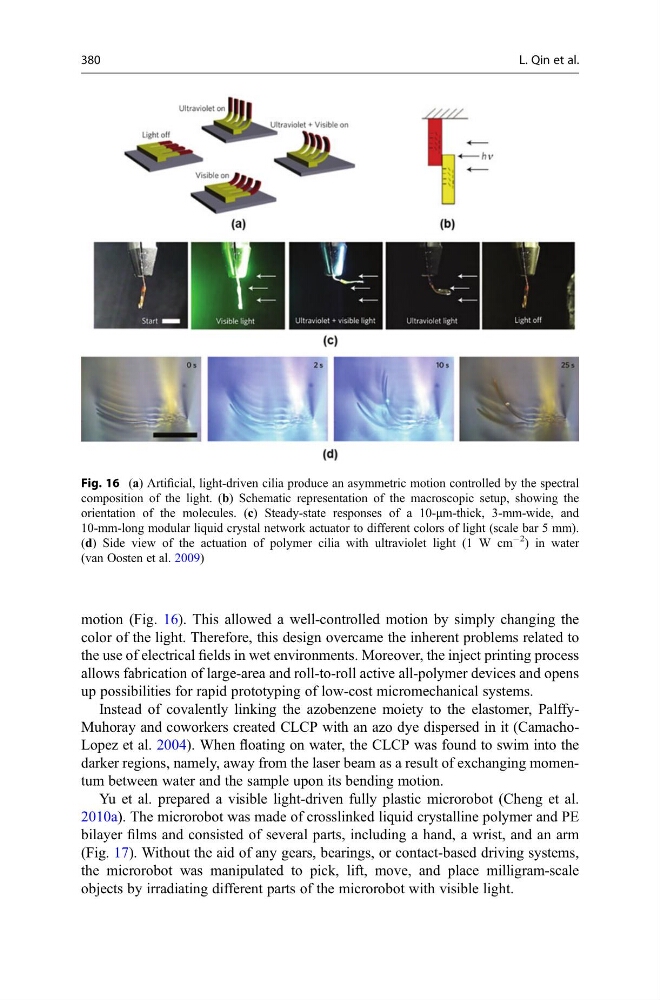
motion (Fig. 16). This allowed a well-controlled motion by simply changing the
color of the light. Therefore, this design overcame the inherent problems related to
the use of electrical fields in wet environments. Moreover, the inject printing process
allows fabrication of large-area and roll-to-roll active all-polymer devices and opens
up possibilities for rapid prototyping of low-cost micromechanical systems.
Instead of covalently linking the azobenzene moiety to the elastomer, PalffyMuhoray and coworkers created CLCP with an azo dye dispersed in it (CamachoLopez et al. 2004). When floating on water, the CLCP was found to swim into the
darker regions, namely, away from the laser beam as a result of exchanging momentum between water and the sample upon its bending motion.
Yu et al. prepared a visible light-driven fully plastic microrobot (Cheng et al.
2010a). The microrobot was made of crosslinked liquid crystalline polymer and PE
bilayer films and consisted of several parts, including a hand, a wrist, and an arm
(Fig. 17). Without the aid of any gears, bearings, or contact-based driving systems,
the microrobot was manipulated to pick, lift, move, and place milligram-scale
objects by irradiating different parts of the microrobot with visible light.
Fig. 16 (a) Artificial, light-driven cilia produce an asymmetric motion controlled by the spectral
composition of the light. (b) Schematic representation of the macroscopic setup, showing the
orientation of the molecules. (c) Steady-state responses of a 10-μm-thick, 3-mm-wide, and
10-mm-long modular liquid crystal network actuator to different colors of light (scale bar 5 mm).
(d) Side view of the actuation of polymer cilia with ultraviolet light (1 W cm
À2
) in water
(van Oosten et al. 2009)
380
L. Qin et al.
color of the light. Therefore, this design overcame the inherent problems related to
the use of electrical fields in wet environments. Moreover, the inject printing process
allows fabrication of large-area and roll-to-roll active all-polymer devices and opens
up possibilities for rapid prototyping of low-cost micromechanical systems.
Instead of covalently linking the azobenzene moiety to the elastomer, PalffyMuhoray and coworkers created CLCP with an azo dye dispersed in it (CamachoLopez et al. 2004). When floating on water, the CLCP was found to swim into the
darker regions, namely, away from the laser beam as a result of exchanging momentum between water and the sample upon its bending motion.
Yu et al. prepared a visible light-driven fully plastic microrobot (Cheng et al.
2010a). The microrobot was made of crosslinked liquid crystalline polymer and PE
bilayer films and consisted of several parts, including a hand, a wrist, and an arm
(Fig. 17). Without the aid of any gears, bearings, or contact-based driving systems,
the microrobot was manipulated to pick, lift, move, and place milligram-scale
objects by irradiating different parts of the microrobot with visible light.
Fig. 16 (a) Artificial, light-driven cilia produce an asymmetric motion controlled by the spectral
composition of the light. (b) Schematic representation of the macroscopic setup, showing the
orientation of the molecules. (c) Steady-state responses of a 10-μm-thick, 3-mm-wide, and
10-mm-long modular liquid crystal network actuator to different colors of light (scale bar 5 mm).
(d) Side view of the actuation of polymer cilia with ultraviolet light (1 W cm
À2
) in water
(van Oosten et al. 2009)
380
L. Qin et al.