

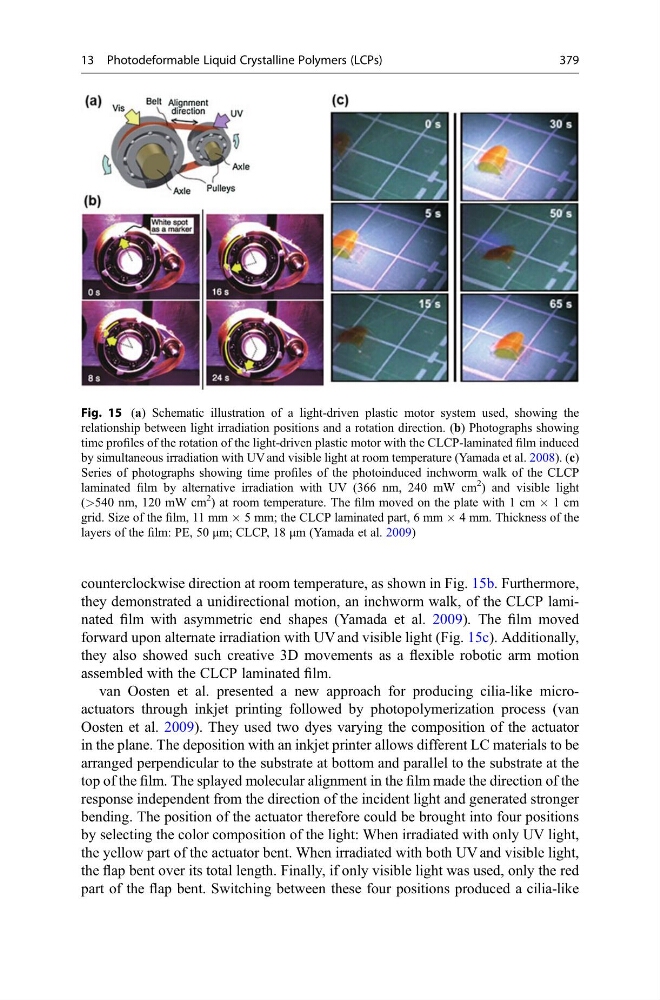
counterclockwise direction at room temperature, as shown in Fig. 15b. Furthermore,
they demonstrated a unidirectional motion, an inchworm walk, of the CLCP laminated film with asymmetric end shapes (Yamada et al. 2009). The film moved
forward upon alternate irradiation with UV and visible light (Fig. 15c). Additionally,
they also showed such creative 3D movements as a flexible robotic arm motion
assembled with the CLCP laminated film.
van Oosten et al. presented a new approach for producing cilia-like microactuators through inkjet printing followed by photopolymerization process (van
Oosten et al. 2009). They used two dyes varying the composition of the actuator
in the plane. The deposition with an inkjet printer allows different LC materials to be
arranged perpendicular to the substrate at bottom and parallel to the substrate at the
top of the film. The splayed molecular alignment in the film made the direction of the
response independent from the direction of the incident light and generated stronger
bending. The position of the actuator therefore could be brought into four positions
by selecting the color composition of the light: When irradiated with only UV light,
the yellow part of the actuator bent. When irradiated with both UV and visible light,
the flap bent over its total length. Finally, if only visible light was used, only the red
part of the flap bent. Switching between these four positions produced a cilia-like
Fig. 15 (a) Schematic illustration of a light-driven plastic motor system used, showing the
relationship between light irradiation positions and a rotation direction. (b) Photographs showing
time profiles of the rotation of the light-driven plastic motor with the CLCP-laminated film induced
by simultaneous irradiation with UV and visible light at room temperature (Yamada et al. 2008). (c)
Series of photographs showing time profiles of the photoinduced inchworm walk of the CLCP
laminated film by alternative irradiation with UV (366 nm, 240 mW cm
2
) and visible light
(>540 nm, 120 mW cm
2
) at room temperature. The film moved on the plate with 1 cm  1 cm
grid. Size of the film, 11 mm  5 mm; the CLCP laminated part, 6 mm  4 mm. Thickness of the
layers of the film: PE, 50 μm; CLCP, 18 μm (Yamada et al. 2009)
13 Photodeformable Liquid Crystalline Polymers (LCPs)
379
they demonstrated a unidirectional motion, an inchworm walk, of the CLCP laminated film with asymmetric end shapes (Yamada et al. 2009). The film moved
forward upon alternate irradiation with UV and visible light (Fig. 15c). Additionally,
they also showed such creative 3D movements as a flexible robotic arm motion
assembled with the CLCP laminated film.
van Oosten et al. presented a new approach for producing cilia-like microactuators through inkjet printing followed by photopolymerization process (van
Oosten et al. 2009). They used two dyes varying the composition of the actuator
in the plane. The deposition with an inkjet printer allows different LC materials to be
arranged perpendicular to the substrate at bottom and parallel to the substrate at the
top of the film. The splayed molecular alignment in the film made the direction of the
response independent from the direction of the incident light and generated stronger
bending. The position of the actuator therefore could be brought into four positions
by selecting the color composition of the light: When irradiated with only UV light,
the yellow part of the actuator bent. When irradiated with both UV and visible light,
the flap bent over its total length. Finally, if only visible light was used, only the red
part of the flap bent. Switching between these four positions produced a cilia-like
Fig. 15 (a) Schematic illustration of a light-driven plastic motor system used, showing the
relationship between light irradiation positions and a rotation direction. (b) Photographs showing
time profiles of the rotation of the light-driven plastic motor with the CLCP-laminated film induced
by simultaneous irradiation with UV and visible light at room temperature (Yamada et al. 2008). (c)
Series of photographs showing time profiles of the photoinduced inchworm walk of the CLCP
laminated film by alternative irradiation with UV (366 nm, 240 mW cm
2
) and visible light
(>540 nm, 120 mW cm
2
) at room temperature. The film moved on the plate with 1 cm  1 cm
grid. Size of the film, 11 mm  5 mm; the CLCP laminated part, 6 mm  4 mm. Thickness of the
layers of the film: PE, 50 μm; CLCP, 18 μm (Yamada et al. 2009)
13 Photodeformable Liquid Crystalline Polymers (LCPs)
379