

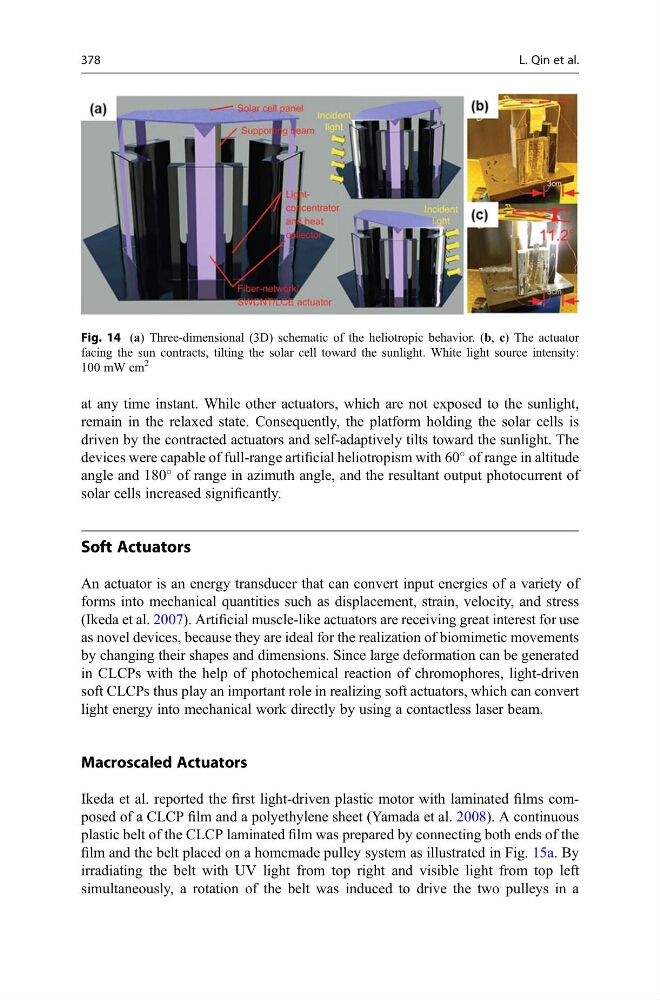
at any time instant. While other actuators, which are not exposed to the sunlight,
remain in the relaxed state. Consequently, the platform holding the solar cells is
driven by the contracted actuators and self-adaptively tilts toward the sunlight. The
devices were capable of full-range artificial heliotropism with 60
of range in altitude
angle and 180
of range in azimuth angle, and the resultant output photocurrent of
solar cells increased significantly.
Soft Actuators
An actuator is an energy transducer that can convert input energies of a variety of
forms into mechanical quantities such as displacement, strain, velocity, and stress
(Ikeda et al. 2007). Artificial muscle-like actuators are receiving great interest for use
as novel devices, because they are ideal for the realization of biomimetic movements
by changing their shapes and dimensions. Since large deformation can be generated
in CLCPs with the help of photochemical reaction of chromophores, light-driven
soft CLCPs thus play an important role in realizing soft actuators, which can convert
light energy into mechanical work directly by using a contactless laser beam.
Macroscaled Actuators
Ikeda et al. reported the first light-driven plastic motor with laminated films composed of a CLCP film and a polyethylene sheet (Yamada et al. 2008). A continuous
plastic belt of the CLCP laminated film was prepared by connecting both ends of the
film and the belt placed on a homemade pulley system as illustrated in Fig. 15a. By
irradiating the belt with UV light from top right and visible light from top left
simultaneously, a rotation of the belt was induced to drive the two pulleys in a
Fig. 14 (a) Three-dimensional (3D) schematic of the heliotropic behavior. (b, c) The actuator
facing the sun contracts, tilting the solar cell toward the sunlight. White light source intensity:
100 mW cm
2
378
L. Qin et al.
remain in the relaxed state. Consequently, the platform holding the solar cells is
driven by the contracted actuators and self-adaptively tilts toward the sunlight. The
devices were capable of full-range artificial heliotropism with 60
of range in altitude
angle and 180
of range in azimuth angle, and the resultant output photocurrent of
solar cells increased significantly.
Soft Actuators
An actuator is an energy transducer that can convert input energies of a variety of
forms into mechanical quantities such as displacement, strain, velocity, and stress
(Ikeda et al. 2007). Artificial muscle-like actuators are receiving great interest for use
as novel devices, because they are ideal for the realization of biomimetic movements
by changing their shapes and dimensions. Since large deformation can be generated
in CLCPs with the help of photochemical reaction of chromophores, light-driven
soft CLCPs thus play an important role in realizing soft actuators, which can convert
light energy into mechanical work directly by using a contactless laser beam.
Macroscaled Actuators
Ikeda et al. reported the first light-driven plastic motor with laminated films composed of a CLCP film and a polyethylene sheet (Yamada et al. 2008). A continuous
plastic belt of the CLCP laminated film was prepared by connecting both ends of the
film and the belt placed on a homemade pulley system as illustrated in Fig. 15a. By
irradiating the belt with UV light from top right and visible light from top left
simultaneously, a rotation of the belt was induced to drive the two pulleys in a
Fig. 14 (a) Three-dimensional (3D) schematic of the heliotropic behavior. (b, c) The actuator
facing the sun contracts, tilting the solar cell toward the sunlight. White light source intensity:
100 mW cm
2
378
L. Qin et al.