

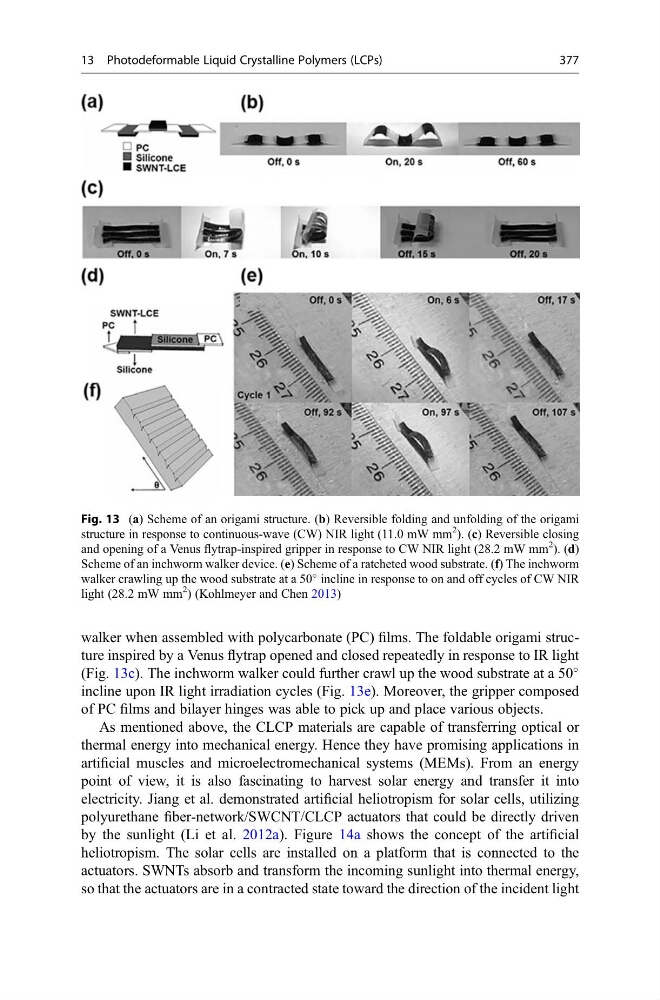
walker when assembled with polycarbonate (PC) films. The foldable origami structure inspired by a Venus flytrap opened and closed repeatedly in response to IR light
(Fig. 13c). The inchworm walker could further crawl up the wood substrate at a 50
incline upon IR light irradiation cycles (Fig. 13e). Moreover, the gripper composed
of PC films and bilayer hinges was able to pick up and place various objects.
As mentioned above, the CLCP materials are capable of transferring optical or
thermal energy into mechanical energy. Hence they have promising applications in
artificial muscles and microelectromechanical systems (MEMs). From an energy
point of view, it is also fascinating to harvest solar energy and transfer it into
electricity. Jiang et al. demonstrated artificial heliotropism for solar cells, utilizing
polyurethane fiber-network/SWCNT/CLCP actuators that could be directly driven
by the sunlight (Li et al. 2012a). Figure 14a shows the concept of the artificial
heliotropism. The solar cells are installed on a platform that is connected to the
actuators. SWNTs absorb and transform the incoming sunlight into thermal energy,
so that the actuators are in a contracted state toward the direction of the incident light
Fig. 13 (a) Scheme of an origami structure. (b) Reversible folding and unfolding of the origami
structure in response to continuous-wave (CW) NIR light (11.0 mW mm
2
). (c) Reversible closing
and opening of a Venus flytrap-inspired gripper in response to CW NIR light (28.2 mW mm
2
). (d)
Scheme of an inchworm walker device. (e) Scheme of a ratcheted wood substrate. (f) The inchworm
walker crawling up the wood substrate at a 50
incline in response to on and off cycles of CW NIR
light (28.2 mW mm
2
) (Kohlmeyer and Chen 2013)
13 Photodeformable Liquid Crystalline Polymers (LCPs)
377
(Fig. 13c). The inchworm walker could further crawl up the wood substrate at a 50
incline upon IR light irradiation cycles (Fig. 13e). Moreover, the gripper composed
of PC films and bilayer hinges was able to pick up and place various objects.
As mentioned above, the CLCP materials are capable of transferring optical or
thermal energy into mechanical energy. Hence they have promising applications in
artificial muscles and microelectromechanical systems (MEMs). From an energy
point of view, it is also fascinating to harvest solar energy and transfer it into
electricity. Jiang et al. demonstrated artificial heliotropism for solar cells, utilizing
polyurethane fiber-network/SWCNT/CLCP actuators that could be directly driven
by the sunlight (Li et al. 2012a). Figure 14a shows the concept of the artificial
heliotropism. The solar cells are installed on a platform that is connected to the
actuators. SWNTs absorb and transform the incoming sunlight into thermal energy,
so that the actuators are in a contracted state toward the direction of the incident light
Fig. 13 (a) Scheme of an origami structure. (b) Reversible folding and unfolding of the origami
structure in response to continuous-wave (CW) NIR light (11.0 mW mm
2
). (c) Reversible closing
and opening of a Venus flytrap-inspired gripper in response to CW NIR light (28.2 mW mm
2
). (d)
Scheme of an inchworm walker device. (e) Scheme of a ratcheted wood substrate. (f) The inchworm
walker crawling up the wood substrate at a 50
incline in response to on and off cycles of CW NIR
light (28.2 mW mm
2
) (Kohlmeyer and Chen 2013)
13 Photodeformable Liquid Crystalline Polymers (LCPs)
377