

nanoparticles or nanorods, carbon nanotubes, and gold nanoparticles were added to
the CLCPs, which offers the possibility to induce thermal phase changes locally in
their environment, since the absorption of photons by carbon nanotubes or gold
nanoparticles is radiated as heat and heat transfer triggers thermomechanical effects
in the CLCPs. As for magnetic nanoparticles, they are known to transfer energy from
electromagnetic irradiation into heat due to relaxation processes.
Schenning and Broer et al. used photoalignment technique to align polymerizable
LCs and prepare freestanding CLCP films with complex order (de Haan et al. 2012).
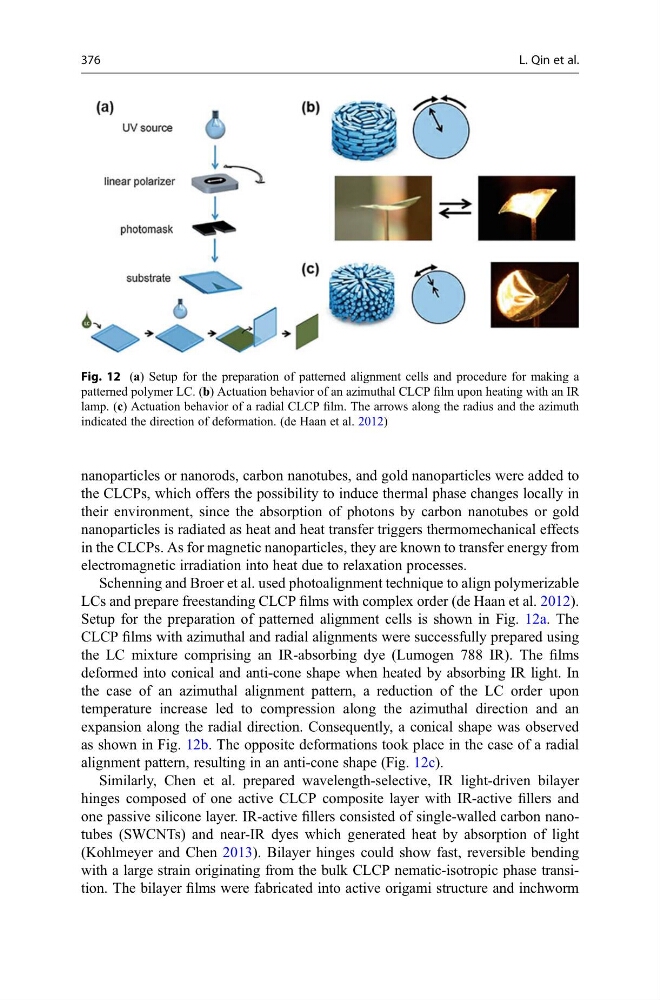
Setup for the preparation of patterned alignment cells is shown in Fig. 12a. The
CLCP films with azimuthal and radial alignments were successfully prepared using
the LC mixture comprising an IR-absorbing dye (Lumogen 788 IR). The films
deformed into conical and anti-cone shape when heated by absorbing IR light. In
the case of an azimuthal alignment pattern, a reduction of the LC order upon
temperature increase led to compression along the azimuthal direction and an
expansion along the radial direction. Consequently, a conical shape was observed
as shown in Fig. 12b. The opposite deformations took place in the case of a radial
alignment pattern, resulting in an anti-cone shape (Fig. 12c).
Similarly, Chen et al. prepared wavelength-selective, IR light-driven bilayer
hinges composed of one active CLCP composite layer with IR-active fillers and
one passive silicone layer. IR-active fillers consisted of single-walled carbon nanotubes (SWCNTs) and near-IR dyes which generated heat by absorption of light
(Kohlmeyer and Chen 2013). Bilayer hinges could show fast, reversible bending
with a large strain originating from the bulk CLCP nematic-isotropic phase transition. The bilayer films were fabricated into active origami structure and inchworm
Fig. 12 (a) Setup for the preparation of patterned alignment cells and procedure for making a
patterned polymer LC. (b) Actuation behavior of an azimuthal CLCP film upon heating with an IR
lamp. (c) Actuation behavior of a radial CLCP film. The arrows along the radius and the azimuth
indicated the direction of deformation. (de Haan et al. 2012)
376
L. Qin et al.
the CLCPs, which offers the possibility to induce thermal phase changes locally in
their environment, since the absorption of photons by carbon nanotubes or gold
nanoparticles is radiated as heat and heat transfer triggers thermomechanical effects
in the CLCPs. As for magnetic nanoparticles, they are known to transfer energy from
electromagnetic irradiation into heat due to relaxation processes.
Schenning and Broer et al. used photoalignment technique to align polymerizable
LCs and prepare freestanding CLCP films with complex order (de Haan et al. 2012).
Setup for the preparation of patterned alignment cells is shown in Fig. 12a. The
CLCP films with azimuthal and radial alignments were successfully prepared using
the LC mixture comprising an IR-absorbing dye (Lumogen 788 IR). The films
deformed into conical and anti-cone shape when heated by absorbing IR light. In
the case of an azimuthal alignment pattern, a reduction of the LC order upon
temperature increase led to compression along the azimuthal direction and an
expansion along the radial direction. Consequently, a conical shape was observed
as shown in Fig. 12b. The opposite deformations took place in the case of a radial
alignment pattern, resulting in an anti-cone shape (Fig. 12c).
Similarly, Chen et al. prepared wavelength-selective, IR light-driven bilayer
hinges composed of one active CLCP composite layer with IR-active fillers and
one passive silicone layer. IR-active fillers consisted of single-walled carbon nanotubes (SWCNTs) and near-IR dyes which generated heat by absorption of light
(Kohlmeyer and Chen 2013). Bilayer hinges could show fast, reversible bending
with a large strain originating from the bulk CLCP nematic-isotropic phase transition. The bilayer films were fabricated into active origami structure and inchworm
Fig. 12 (a) Setup for the preparation of patterned alignment cells and procedure for making a
patterned polymer LC. (b) Actuation behavior of an azimuthal CLCP film upon heating with an IR
lamp. (c) Actuation behavior of a radial CLCP film. The arrows along the radius and the azimuth
indicated the direction of deformation. (de Haan et al. 2012)
376
L. Qin et al.