

system based on the TTA-UCL technology but also introduces a new technological
application of the TTA-based upconversion system in photonic devices.
Photodeformation Based on Photothermal Effect
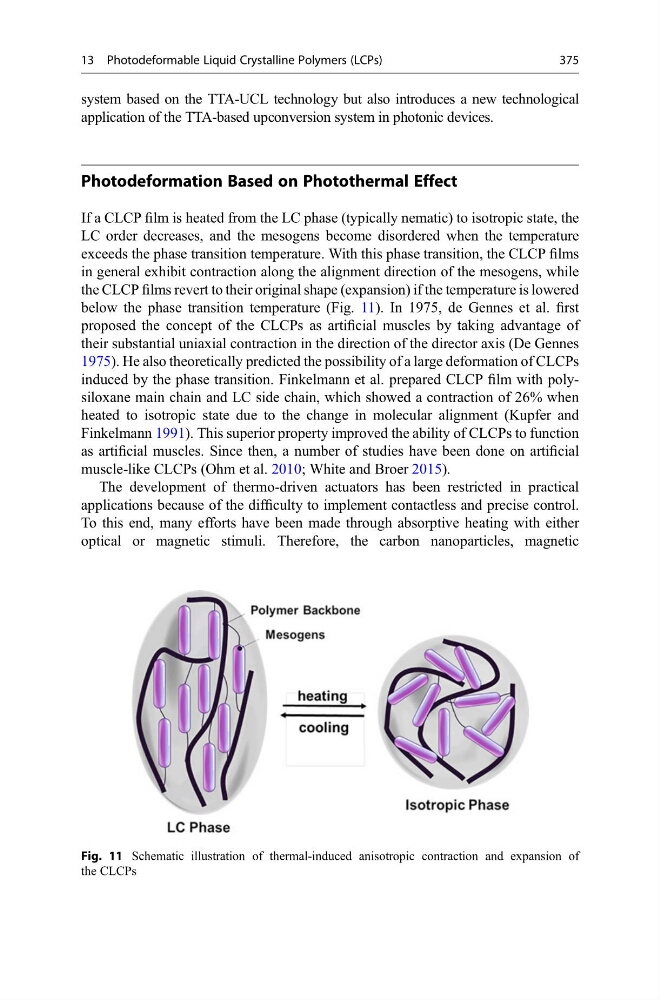
If a CLCP film is heated from the LC phase (typically nematic) to isotropic state, the
LC order decreases, and the mesogens become disordered when the temperature
exceeds the phase transition temperature. With this phase transition, the CLCP films
in general exhibit contraction along the alignment direction of the mesogens, while
the CLCP films revert to their original shape (expansion) if the temperature is lowered
below the phase transition temperature (Fig. 11). In 1975, de Gennes et al. first
proposed the concept of the CLCPs as artificial muscles by taking advantage of
their substantial uniaxial contraction in the direction of the director axis (De Gennes
1975). He also theoretically predicted the possibility of a large deformation of CLCPs
induced by the phase transition. Finkelmann et al. prepared CLCP film with polysiloxane main chain and LC side chain, which showed a contraction of 26% when
heated to isotropic state due to the change in molecular alignment (Kupfer and
Finkelmann 1991). This superior property improved the ability of CLCPs to function
as artificial muscles. Since then, a number of studies have been done on artificial
muscle-like CLCPs (Ohm et al. 2010; White and Broer 2015).
The development of thermo-driven actuators has been restricted in practical
applications because of the difficulty to implement contactless and precise control.
To this end, many efforts have been made through absorptive heating with either
optical or magnetic stimuli. Therefore, the carbon nanoparticles, magnetic
Fig. 11 Schematic illustration of thermal-induced anisotropic contraction and expansion of
the CLCPs
13 Photodeformable Liquid Crystalline Polymers (LCPs)
375
application of the TTA-based upconversion system in photonic devices.
Photodeformation Based on Photothermal Effect
If a CLCP film is heated from the LC phase (typically nematic) to isotropic state, the
LC order decreases, and the mesogens become disordered when the temperature
exceeds the phase transition temperature. With this phase transition, the CLCP films
in general exhibit contraction along the alignment direction of the mesogens, while
the CLCP films revert to their original shape (expansion) if the temperature is lowered
below the phase transition temperature (Fig. 11). In 1975, de Gennes et al. first
proposed the concept of the CLCPs as artificial muscles by taking advantage of
their substantial uniaxial contraction in the direction of the director axis (De Gennes
1975). He also theoretically predicted the possibility of a large deformation of CLCPs
induced by the phase transition. Finkelmann et al. prepared CLCP film with polysiloxane main chain and LC side chain, which showed a contraction of 26% when
heated to isotropic state due to the change in molecular alignment (Kupfer and
Finkelmann 1991). This superior property improved the ability of CLCPs to function
as artificial muscles. Since then, a number of studies have been done on artificial
muscle-like CLCPs (Ohm et al. 2010; White and Broer 2015).
The development of thermo-driven actuators has been restricted in practical
applications because of the difficulty to implement contactless and precise control.
To this end, many efforts have been made through absorptive heating with either
optical or magnetic stimuli. Therefore, the carbon nanoparticles, magnetic
Fig. 11 Schematic illustration of thermal-induced anisotropic contraction and expansion of
the CLCPs
13 Photodeformable Liquid Crystalline Polymers (LCPs)
375