

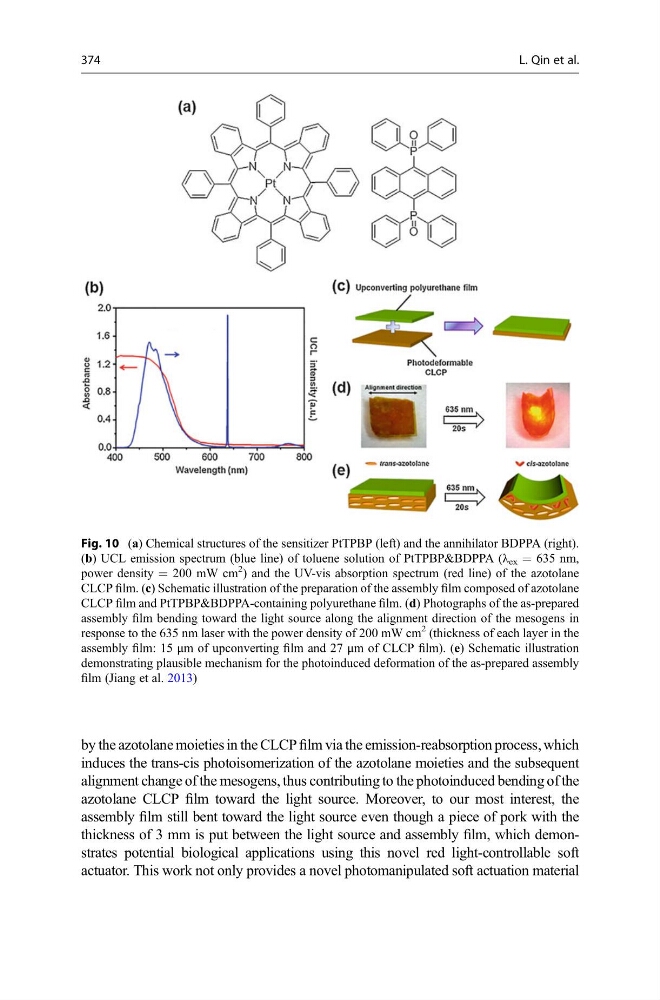
by the azotolane moieties in the CLCP film via the emission-reabsorption process, which
induces the trans-cis photoisomerization of the azotolane moieties and the subsequent
alignment change of the mesogens, thus contributing to the photoinduced bending of the
azotolane CLCP film toward the light source. Moreover, to our most interest, the
assembly film still bent toward the light source even though a piece of pork with the
thickness of 3 mm is put between the light source and assembly film, which demonstrates potential biological applications using this novel red light-controllable soft
actuator. This work not only provides a novel photomanipulated soft actuation material
Fig. 10 (a) Chemical structures of the sensitizer PtTPBP (left) and the annihilator BDPPA (right).
(b) UCL emission spectrum (blue line) of toluene solution of PtTPBP&BDPPA (λ ex = 635 nm,
power density = 200 mW cm
2
) and the UV-vis absorption spectrum (red line) of the azotolane
CLCP film. (c) Schematic illustration of the preparation of the assembly film composed of azotolane
CLCP film and PtTPBP&BDPPA-containing polyurethane film. (d) Photographs of the as-prepared
assembly film bending toward the light source along the alignment direction of the mesogens in
response to the 635 nm laser with the power density of 200 mW cm
2 (thickness of each layer in the
assembly film: 15 μm of upconverting film and 27 μm of CLCP film). (e) Schematic illustration
demonstrating plausible mechanism for the photoinduced deformation of the as-prepared assembly
film (Jiang et al. 2013)
374
L. Qin et al.
induces the trans-cis photoisomerization of the azotolane moieties and the subsequent
alignment change of the mesogens, thus contributing to the photoinduced bending of the
azotolane CLCP film toward the light source. Moreover, to our most interest, the
assembly film still bent toward the light source even though a piece of pork with the
thickness of 3 mm is put between the light source and assembly film, which demonstrates potential biological applications using this novel red light-controllable soft
actuator. This work not only provides a novel photomanipulated soft actuation material
Fig. 10 (a) Chemical structures of the sensitizer PtTPBP (left) and the annihilator BDPPA (right).
(b) UCL emission spectrum (blue line) of toluene solution of PtTPBP&BDPPA (λ ex = 635 nm,
power density = 200 mW cm
2
) and the UV-vis absorption spectrum (red line) of the azotolane
CLCP film. (c) Schematic illustration of the preparation of the assembly film composed of azotolane
CLCP film and PtTPBP&BDPPA-containing polyurethane film. (d) Photographs of the as-prepared
assembly film bending toward the light source along the alignment direction of the mesogens in
response to the 635 nm laser with the power density of 200 mW cm
2 (thickness of each layer in the
assembly film: 15 μm of upconverting film and 27 μm of CLCP film). (e) Schematic illustration
demonstrating plausible mechanism for the photoinduced deformation of the as-prepared assembly
film (Jiang et al. 2013)
374
L. Qin et al.