

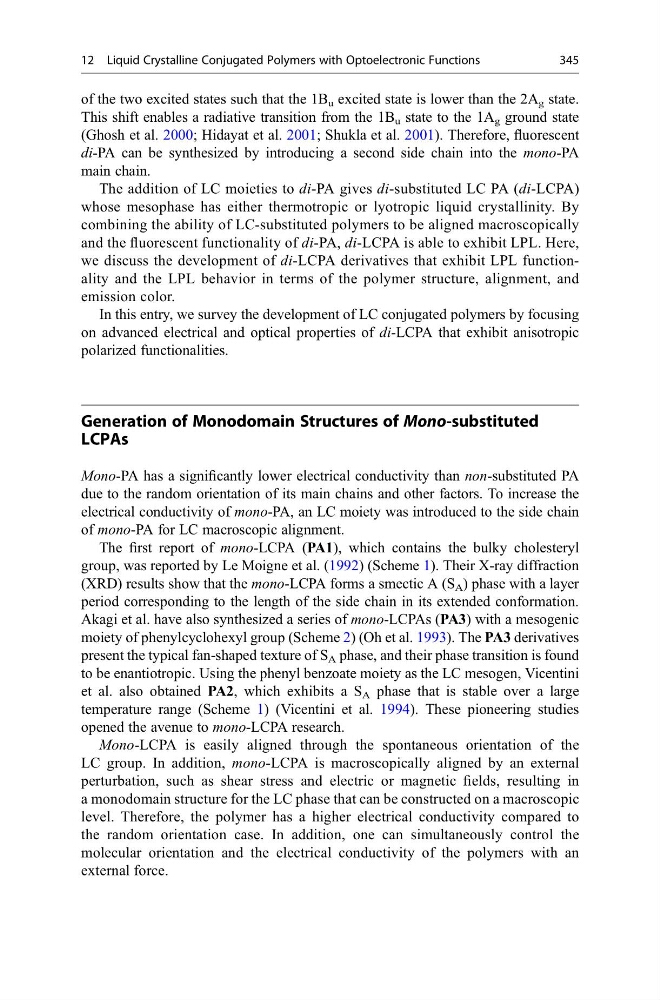
of the two excited states such that the 1B u excited state is lower than the 2A g state.
This shift enables a radiative transition from the 1B u state to the 1A g ground state
(Ghosh et al. 2000; Hidayat et al. 2001; Shukla et al. 2001). Therefore, fluorescent
di-PA can be synthesized by introducing a second side chain into the mono-PA
main chain.
The addition of LC moieties to di-PA gives di-substituted LC PA (di-LCPA)
whose mesophase has either thermotropic or lyotropic liquid crystallinity. By
combining the ability of LC-substituted polymers to be aligned macroscopically
and the fluorescent functionality of di-PA, di-LCPA is able to exhibit LPL. Here,
we discuss the development of di-LCPA derivatives that exhibit LPL functionality and the LPL behavior in terms of the polymer structure, alignment, and
emission color.
In this entry, we survey the development of LC conjugated polymers by focusing
on advanced electrical and optical properties of di-LCPA that exhibit anisotropic
polarized functionalities.
Generation of Monodomain Structures of Mono-substituted
LCPAs
Mono-PA has a significantly lower electrical conductivity than non-substituted PA
due to the random orientation of its main chains and other factors. To increase the
electrical conductivity of mono-PA, an LC moiety was introduced to the side chain
of mono-PA for LC macroscopic alignment.
The first report of mono-LCPA (PA1), which contains the bulky cholesteryl
group, was reported by Le Moigne et al. (1992) (Scheme 1). Their X-ray diffraction
(XRD) results show that the mono-LCPA forms a smectic A (S A ) phase with a layer
period corresponding to the length of the side chain in its extended conformation.
Akagi et al. have also synthesized a series of mono-LCPAs (PA3) with a mesogenic
moiety of phenylcyclohexyl group (Scheme 2) (Oh et al. 1993). The PA3 derivatives
present the typical fan-shaped texture of S A phase, and their phase transition is found
to be enantiotropic. Using the phenyl benzoate moiety as the LC mesogen, Vicentini
et al. also obtained PA2, which exhibits a S A phase that is stable over a large
temperature range (Scheme 1) (Vicentini et al. 1994). These pioneering studies
opened the avenue to mono-LCPA research.
Mono-LCPA is easily aligned through the spontaneous orientation of the
LC group. In addition, mono-LCPA is macroscopically aligned by an external
perturbation, such as shear stress and electric or magnetic fields, resulting in
a monodomain structure for the LC phase that can be constructed on a macroscopic
level. Therefore, the polymer has a higher electrical conductivity compared to
the random orientation case. In addition, one can simultaneously control the
molecular orientation and the electrical conductivity of the polymers with an
external force.
12 Liquid Crystalline Conjugated Polymers with Optoelectronic Functions
345
This shift enables a radiative transition from the 1B u state to the 1A g ground state
(Ghosh et al. 2000; Hidayat et al. 2001; Shukla et al. 2001). Therefore, fluorescent
di-PA can be synthesized by introducing a second side chain into the mono-PA
main chain.
The addition of LC moieties to di-PA gives di-substituted LC PA (di-LCPA)
whose mesophase has either thermotropic or lyotropic liquid crystallinity. By
combining the ability of LC-substituted polymers to be aligned macroscopically
and the fluorescent functionality of di-PA, di-LCPA is able to exhibit LPL. Here,
we discuss the development of di-LCPA derivatives that exhibit LPL functionality and the LPL behavior in terms of the polymer structure, alignment, and
emission color.
In this entry, we survey the development of LC conjugated polymers by focusing
on advanced electrical and optical properties of di-LCPA that exhibit anisotropic
polarized functionalities.
Generation of Monodomain Structures of Mono-substituted
LCPAs
Mono-PA has a significantly lower electrical conductivity than non-substituted PA
due to the random orientation of its main chains and other factors. To increase the
electrical conductivity of mono-PA, an LC moiety was introduced to the side chain
of mono-PA for LC macroscopic alignment.
The first report of mono-LCPA (PA1), which contains the bulky cholesteryl
group, was reported by Le Moigne et al. (1992) (Scheme 1). Their X-ray diffraction
(XRD) results show that the mono-LCPA forms a smectic A (S A ) phase with a layer
period corresponding to the length of the side chain in its extended conformation.
Akagi et al. have also synthesized a series of mono-LCPAs (PA3) with a mesogenic
moiety of phenylcyclohexyl group (Scheme 2) (Oh et al. 1993). The PA3 derivatives
present the typical fan-shaped texture of S A phase, and their phase transition is found
to be enantiotropic. Using the phenyl benzoate moiety as the LC mesogen, Vicentini
et al. also obtained PA2, which exhibits a S A phase that is stable over a large
temperature range (Scheme 1) (Vicentini et al. 1994). These pioneering studies
opened the avenue to mono-LCPA research.
Mono-LCPA is easily aligned through the spontaneous orientation of the
LC group. In addition, mono-LCPA is macroscopically aligned by an external
perturbation, such as shear stress and electric or magnetic fields, resulting in
a monodomain structure for the LC phase that can be constructed on a macroscopic
level. Therefore, the polymer has a higher electrical conductivity compared to
the random orientation case. In addition, one can simultaneously control the
molecular orientation and the electrical conductivity of the polymers with an
external force.
12 Liquid Crystalline Conjugated Polymers with Optoelectronic Functions
345