

Structures and Liquid Crystallinity of the Mono-LCPAs
A series of mono-LCPA derivatives including PA3 and PA4 (Scheme 2) have been
synthesized (Oh et al. 1993). The LC substituent on the monomers was composed
of a phenylcyclohexyl (PCH) moiety for PA3 or a biphenyl (BP) one for PA4 as the
mesogenic core, a methylene chain linked with an ether-type oxygen atom
(À(CH 2 ) 3 O) as the spacer, and an alkyl chain (–C m H 2m + 1 , m = 5, 8) as the
terminal group.
The polymers exhibited thermal stability and thermotropic liquid crystallinity
with an enantiotropic nature. PA3 and PA4 exhibited fan-shaped textures and
uniaxial conoscopic patterns under a polarizing optical microscope (POM) that are
characteristic of the S A phase (Dierking 2003). For PA3, the transition temperature
from the S A to the isotropic phase increased as the terminal alkyl chain length
increased, which indicates that the liquid crystal state is stabilized better by the
longer alkyl chains used as the terminal moiety of the LC group. It was demonstrated
that mono-LCPA derivatives were uniaxially aligned from the shear stress or magnetically forced alignment of the LC side chain to yield a monodomain structure. The
electrical conductivity of the mono-LCPA derivatives was enhanced to 10
À6 S/cm
and gave rise to a notable electrical anisotropy.
Additional functional aligned mono-LCPA derivatives have also been developed
(Scheme 3). Tang et al. synthesized PA5 containing phenyl benzoate mesogens with
octyl spacers and cyano or methoxy tails that exhibit well-ordered parallel bands
after the application of shear force (Kong and Tang 1998). Akagi et al. developed
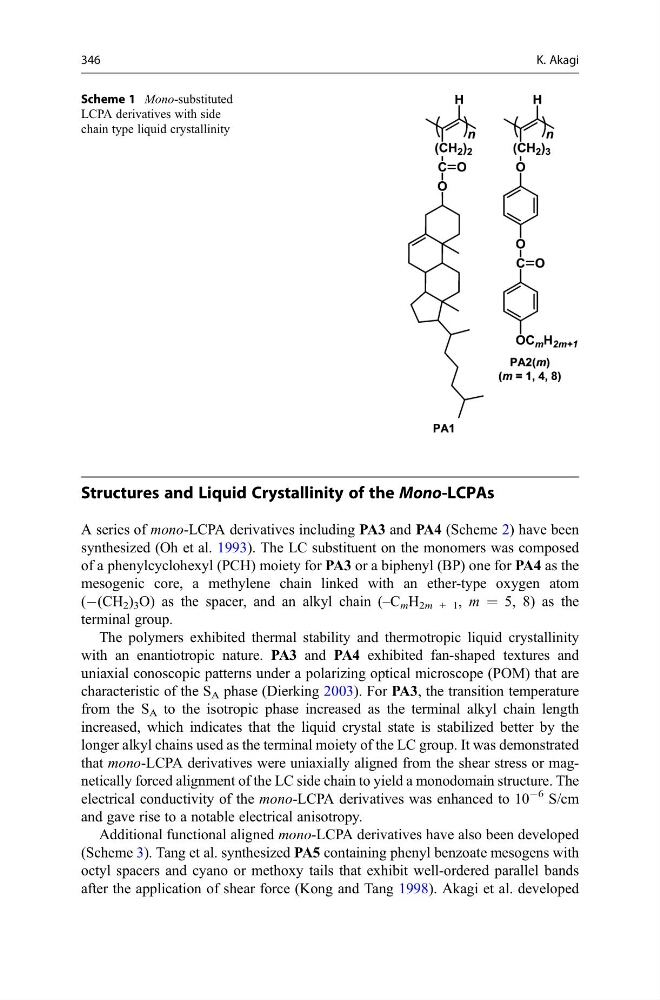
Scheme 1 Mono-substituted
LCPA derivatives with side
chain type liquid crystallinity
346
K. Akagi
A series of mono-LCPA derivatives including PA3 and PA4 (Scheme 2) have been
synthesized (Oh et al. 1993). The LC substituent on the monomers was composed
of a phenylcyclohexyl (PCH) moiety for PA3 or a biphenyl (BP) one for PA4 as the
mesogenic core, a methylene chain linked with an ether-type oxygen atom
(À(CH 2 ) 3 O) as the spacer, and an alkyl chain (–C m H 2m + 1 , m = 5, 8) as the
terminal group.
The polymers exhibited thermal stability and thermotropic liquid crystallinity
with an enantiotropic nature. PA3 and PA4 exhibited fan-shaped textures and
uniaxial conoscopic patterns under a polarizing optical microscope (POM) that are
characteristic of the S A phase (Dierking 2003). For PA3, the transition temperature
from the S A to the isotropic phase increased as the terminal alkyl chain length
increased, which indicates that the liquid crystal state is stabilized better by the
longer alkyl chains used as the terminal moiety of the LC group. It was demonstrated
that mono-LCPA derivatives were uniaxially aligned from the shear stress or magnetically forced alignment of the LC side chain to yield a monodomain structure. The
electrical conductivity of the mono-LCPA derivatives was enhanced to 10
À6 S/cm
and gave rise to a notable electrical anisotropy.
Additional functional aligned mono-LCPA derivatives have also been developed
(Scheme 3). Tang et al. synthesized PA5 containing phenyl benzoate mesogens with
octyl spacers and cyano or methoxy tails that exhibit well-ordered parallel bands
after the application of shear force (Kong and Tang 1998). Akagi et al. developed
Scheme 1 Mono-substituted
LCPA derivatives with side
chain type liquid crystallinity
346
K. Akagi