

of mono-LCPA as well as representative results of this research have been investigated in detail (Akagi et al 1995; Akagi 2007, 2009).
Compared to aromatic conjugated polymers, such as poly(para-phenylene) (PPP)
and polythiophene (PT), mono-substituted PA (mono-PA) is generally considered
non-emissive due to the coulombic interactions between π-electrons (Shukla and
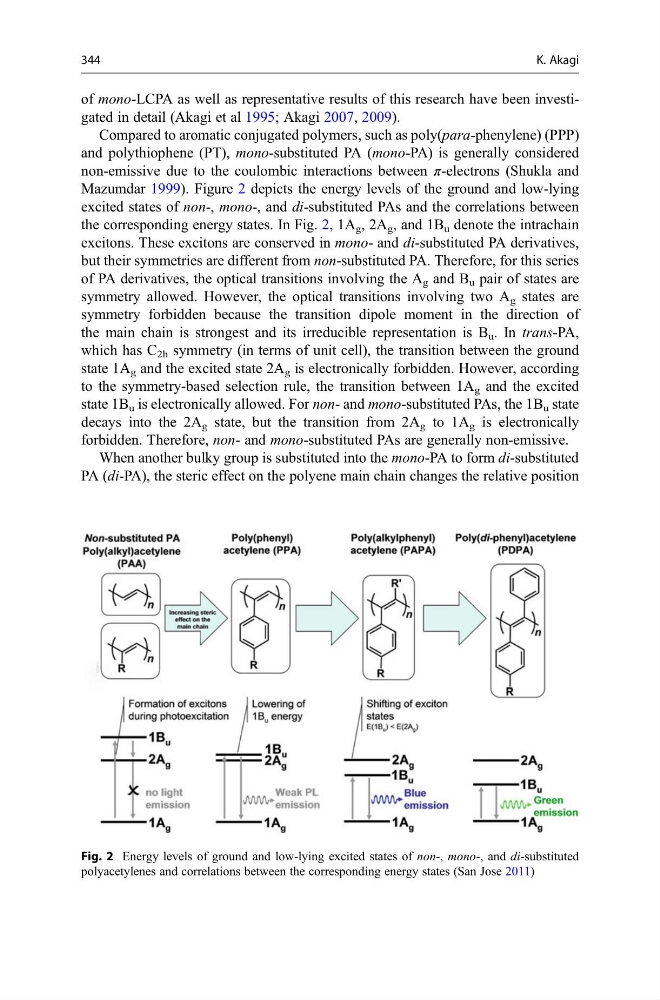
Mazumdar 1999). Figure 2 depicts the energy levels of the ground and low-lying
excited states of non-, mono-, and di-substituted PAs and the correlations between
the corresponding energy states. In Fig. 2, 1A g , 2A g , and 1B u denote the intrachain
excitons. These excitons are conserved in mono- and di-substituted PA derivatives,
but their symmetries are different from non-substituted PA. Therefore, for this series
of PA derivatives, the optical transitions involving the A g and B u pair of states are
symmetry allowed. However, the optical transitions involving two A g states are
symmetry forbidden because the transition dipole moment in the direction of
the main chain is strongest and its irreducible representation is B u . In trans-PA,
which has C 2h symmetry (in terms of unit cell), the transition between the ground
state 1A g and the excited state 2A g is electronically forbidden. However, according
to the symmetry-based selection rule, the transition between 1A g and the excited
state 1B u is electronically allowed. For non- and mono-substituted PAs, the 1B u state
decays into the 2A g state, but the transition from 2A g to 1A g is electronically
forbidden. Therefore, non- and mono-substituted PAs are generally non-emissive.
When another bulky group is substituted into the mono-PA to form di-substituted
PA (di-PA), the steric effect on the polyene main chain changes the relative position
Fig. 2 Energy levels of ground and low-lying excited states of non-, mono-, and di-substituted
polyacetylenes and correlations between the corresponding energy states (San Jose 2011)
344
K. Akagi
Compared to aromatic conjugated polymers, such as poly(para-phenylene) (PPP)
and polythiophene (PT), mono-substituted PA (mono-PA) is generally considered
non-emissive due to the coulombic interactions between π-electrons (Shukla and
Mazumdar 1999). Figure 2 depicts the energy levels of the ground and low-lying
excited states of non-, mono-, and di-substituted PAs and the correlations between
the corresponding energy states. In Fig. 2, 1A g , 2A g , and 1B u denote the intrachain
excitons. These excitons are conserved in mono- and di-substituted PA derivatives,
but their symmetries are different from non-substituted PA. Therefore, for this series
of PA derivatives, the optical transitions involving the A g and B u pair of states are
symmetry allowed. However, the optical transitions involving two A g states are
symmetry forbidden because the transition dipole moment in the direction of
the main chain is strongest and its irreducible representation is B u . In trans-PA,
which has C 2h symmetry (in terms of unit cell), the transition between the ground
state 1A g and the excited state 2A g is electronically forbidden. However, according
to the symmetry-based selection rule, the transition between 1A g and the excited
state 1B u is electronically allowed. For non- and mono-substituted PAs, the 1B u state
decays into the 2A g state, but the transition from 2A g to 1A g is electronically
forbidden. Therefore, non- and mono-substituted PAs are generally non-emissive.
When another bulky group is substituted into the mono-PA to form di-substituted
PA (di-PA), the steric effect on the polyene main chain changes the relative position
Fig. 2 Energy levels of ground and low-lying excited states of non-, mono-, and di-substituted
polyacetylenes and correlations between the corresponding energy states (San Jose 2011)
344
K. Akagi