

enough. This means that the real phase diagram contains domains for both micro- and
macrophase separation and should be plotted as a function of T and f for a given Àe.
An example of conjugated hairy-rod supramolecule demonstrating both microand macrophase separation is given in Knaapila et al. (2003). This involves complexation of polypyridine P8 by methane sulfonic acid (MSA) and amphiphile octyl
gallate (OG). Fig. 11 shows polarized optical micrographs of this material above and
below the order-disorder transition (ODT) into an Iso phase when the degree of
complexation is 0.75. LC domains are yellow, while Iso phase becomes black. This
system corresponds to small Àe and short side chains which together mean microand macrophase separated phase regimes and dominance of Lam microstructure.
Fig. 12 plots corresponding theoretical and experimental phase diagrams. The
experimental case follows the theoretical prediction but contain also Hex2 phase
(or an Obl phase) and square Sq phase that is not theoretically expected for this
particular system.
Lyotropic Behavior
Solvent is another factor in the phase behavior of conjugated hairy-rod supramolecules.
A prime example that illustrates not only lyotropic but also thermotropic phase
(a)
–ε
N, a, ν
d
b
(Hex1)
(Hex2)
Lam
Sq
(b)
Obl
(Lam)
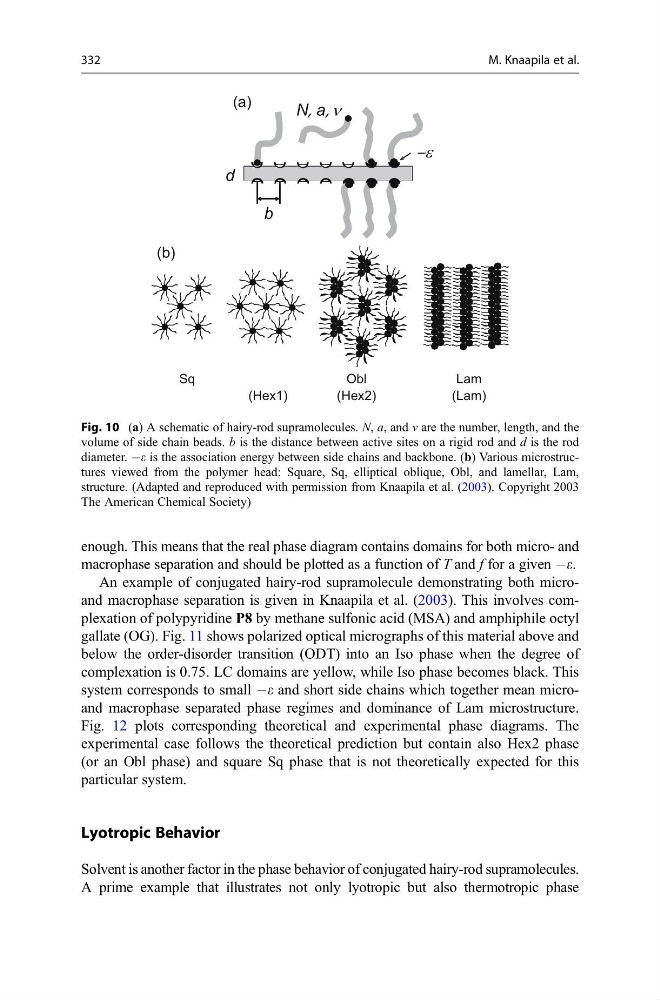
Fig. 10 (a) A schematic of hairy-rod supramolecules. N, a, and v are the number, length, and the
volume of side chain beads. b is the distance between active sites on a rigid rod and d is the rod
diameter. Àe is the association energy between side chains and backbone. (b) Various microstructures viewed from the polymer head: Square, Sq, elliptical oblique, Obl, and lamellar, Lam,
structure. (Adapted and reproduced with permission from Knaapila et al. (2003). Copyright 2003
The American Chemical Society)
332
M. Knaapila et al.
macrophase separation and should be plotted as a function of T and f for a given Àe.
An example of conjugated hairy-rod supramolecule demonstrating both microand macrophase separation is given in Knaapila et al. (2003). This involves complexation of polypyridine P8 by methane sulfonic acid (MSA) and amphiphile octyl
gallate (OG). Fig. 11 shows polarized optical micrographs of this material above and
below the order-disorder transition (ODT) into an Iso phase when the degree of
complexation is 0.75. LC domains are yellow, while Iso phase becomes black. This
system corresponds to small Àe and short side chains which together mean microand macrophase separated phase regimes and dominance of Lam microstructure.
Fig. 12 plots corresponding theoretical and experimental phase diagrams. The
experimental case follows the theoretical prediction but contain also Hex2 phase
(or an Obl phase) and square Sq phase that is not theoretically expected for this
particular system.
Lyotropic Behavior
Solvent is another factor in the phase behavior of conjugated hairy-rod supramolecules.
A prime example that illustrates not only lyotropic but also thermotropic phase
(a)
–ε
N, a, ν
d
b
(Hex1)
(Hex2)
Lam
Sq
(b)
Obl
(Lam)
Fig. 10 (a) A schematic of hairy-rod supramolecules. N, a, and v are the number, length, and the
volume of side chain beads. b is the distance between active sites on a rigid rod and d is the rod
diameter. Àe is the association energy between side chains and backbone. (b) Various microstructures viewed from the polymer head: Square, Sq, elliptical oblique, Obl, and lamellar, Lam,
structure. (Adapted and reproduced with permission from Knaapila et al. (2003). Copyright 2003
The American Chemical Society)
332
M. Knaapila et al.