

behavior is given by Osuji and coworkers (Zhang et al. 2010). This involves stoichiometric complexation of aqueous polythiophene P9 by cetrimonium bromide (CTAB).
Figure 13a shows a photo of this mixture after centrifugation showing, from top
to bottom, fluid-like, gel-like, and slurry phases. This phase separation is attributed
to the wide polydispersity with the highest molecular weight fraction populating the
bottom phase. The attraction through charge transfer between SO 3
À and N(CH 3 ) 3
+
groups is strong (and thus isÀe high). Hence, the separation occurs between the
solvent and complex and not between the backbone and side chains. Fig. 13b shows
a photo of the middle layer demonstrating gel-like nature with high viscosity. The
structure of gel depends on the supramolecule fraction and temperature. As an
example, Fig. 14 shows two-dimensional X-ray scattering pattern and polarized
optical micrograph of shear aligned 70% gel. In this polymer fraction, the material
shows Hex phase with LC nature as indicated by strong birefringence. Fig. 15 shows
schematics of this example and the overall phase diagram as a function of temperature and polymer fraction (or concentration). The thermotropic behavior from
crystalline structures to the LC phase is a special case with 100% polymer
concentration.
Challenge
Although the chemical synthesis of main-chain-type conjugated polymers has gone
through tremendous advancements, much of their LC phase behavior can be understood in terms of hairy-rod polymers and hairy-rod supramolecules, whereby most of
the chemical details can be effectively ignored. In this work, polyfluorenes have
proved to be one successful model compound for both thermotropic and lyotropic
behavior. We believe that this knowledge provides a starting point for various
expansions.
0.2 mm
b
a
MSA
OG
H
H
H
H
CH 3 SO 3
O
O
O
COOC 8 H 17
N
n
P8
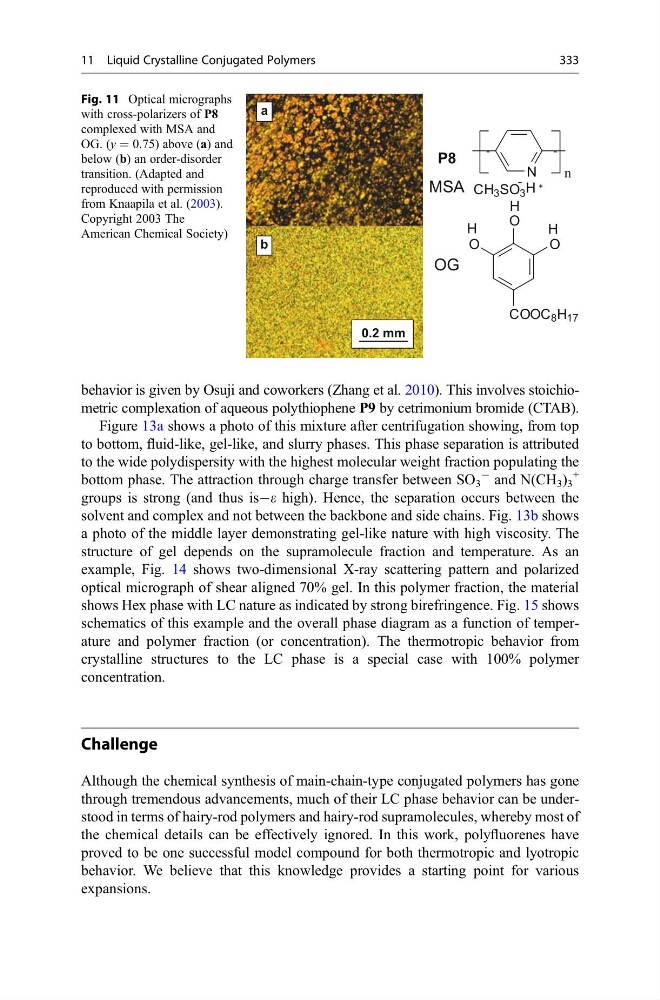
Fig. 11 Optical micrographs
with cross-polarizers of P8
complexed with MSA and
OG. (y = 0.75) above (a) and
below (b) an order-disorder
transition. (Adapted and
reproduced with permission
from Knaapila et al. (2003).
Copyright 2003 The
American Chemical Society)
11 Liquid Crystalline Conjugated Polymers
333
Figure 13a shows a photo of this mixture after centrifugation showing, from top
to bottom, fluid-like, gel-like, and slurry phases. This phase separation is attributed
to the wide polydispersity with the highest molecular weight fraction populating the
bottom phase. The attraction through charge transfer between SO 3
À and N(CH 3 ) 3
+
groups is strong (and thus isÀe high). Hence, the separation occurs between the
solvent and complex and not between the backbone and side chains. Fig. 13b shows
a photo of the middle layer demonstrating gel-like nature with high viscosity. The
structure of gel depends on the supramolecule fraction and temperature. As an
example, Fig. 14 shows two-dimensional X-ray scattering pattern and polarized
optical micrograph of shear aligned 70% gel. In this polymer fraction, the material
shows Hex phase with LC nature as indicated by strong birefringence. Fig. 15 shows
schematics of this example and the overall phase diagram as a function of temperature and polymer fraction (or concentration). The thermotropic behavior from
crystalline structures to the LC phase is a special case with 100% polymer
concentration.
Challenge
Although the chemical synthesis of main-chain-type conjugated polymers has gone
through tremendous advancements, much of their LC phase behavior can be understood in terms of hairy-rod polymers and hairy-rod supramolecules, whereby most of
the chemical details can be effectively ignored. In this work, polyfluorenes have
proved to be one successful model compound for both thermotropic and lyotropic
behavior. We believe that this knowledge provides a starting point for various
expansions.
0.2 mm
b
a
MSA
OG
H
H
H
H
CH 3 SO 3
O
O
O
COOC 8 H 17
N
n
P8
Fig. 11 Optical micrographs
with cross-polarizers of P8
complexed with MSA and
OG. (y = 0.75) above (a) and
below (b) an order-disorder
transition. (Adapted and
reproduced with permission
from Knaapila et al. (2003).
Copyright 2003 The
American Chemical Society)
11 Liquid Crystalline Conjugated Polymers
333