

of the interpenetration region between the pure rod and pure coil phase. As discussed in
Subbotin et al. (2003), the formation of microphases can be understood from an analysis
of the free energies of the different phases. In general, the free energy F is written as
F
T
ffi
γ
T
S þ
F el
T
,
(26)
where S is the interface area describing unfavorable contacts between rods and side
chains and F el the stretching energy describing stretching of side chains. The former
term dominates for short and the latter for long side chains, but both also depend on
the geometry of the microphases. The free energy can be calculated from the number
of side chain beads, N, and the ratio between the volumes of coil and backbone
sections between two consecutive branching sites, κ = v/(πd
2 b/4). Minimization of
free energy against the rod fraction f corresponds to various microstructures. Moreover, a Nem structure is expected for very short side chains and an isotropic high
temperature structure for very long side chains.
Unlike covalently bound hairy-rod polymers, hairy-rod supramolecules can macrophase separate to rod-rich and coil-rich phases or all the way to pure constituents
because of the limited mixing entropy of rod-like polymers (Flory 1984). Microphase
separation occurs only if the association energy between rods and coils Àe is high
0
20
40
60
80
100 120 140
0
5
10
15
20
25
30
35
40
n
o
i
t
p
r
o
s
b
A
n
i
o
i
t
a
R
c
i
o
r
h
c
i
D
M n (kg/mol)
Nem
Hex
10
50
90
1
10
100
R
M n (kg/mol)
M n *
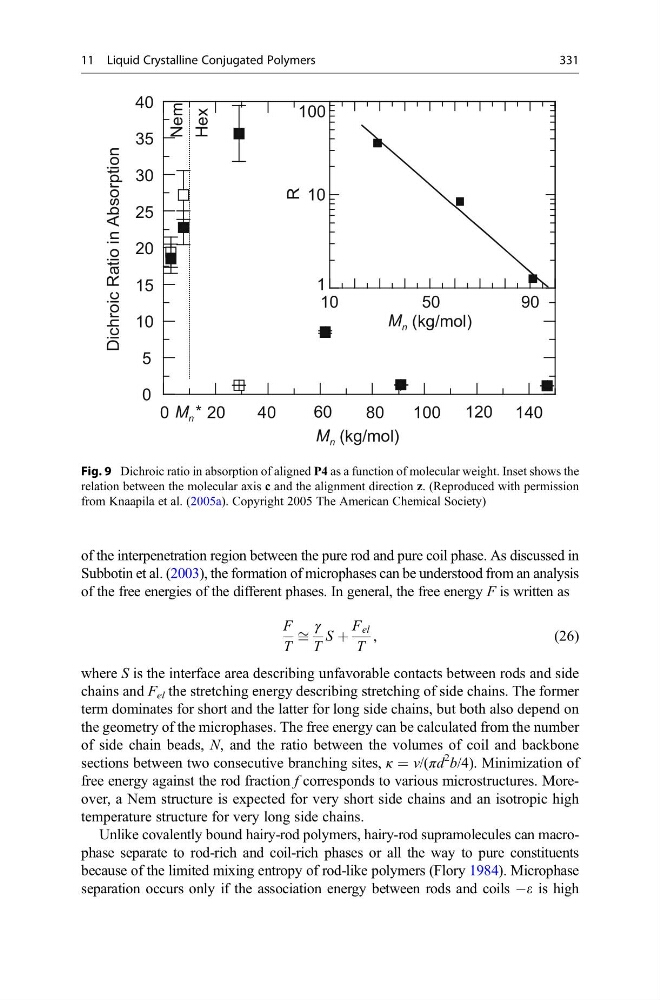
Fig. 9 Dichroic ratio in absorption of aligned P4 as a function of molecular weight. Inset shows the
relation between the molecular axis c and the alignment direction z. (Reproduced with permission
from Knaapila et al. (2005a). Copyright 2005 The American Chemical Society)
11 Liquid Crystalline Conjugated Polymers
331
Subbotin et al. (2003), the formation of microphases can be understood from an analysis
of the free energies of the different phases. In general, the free energy F is written as
F
T
ffi
γ
T
S þ
F el
T
,
(26)
where S is the interface area describing unfavorable contacts between rods and side
chains and F el the stretching energy describing stretching of side chains. The former
term dominates for short and the latter for long side chains, but both also depend on
the geometry of the microphases. The free energy can be calculated from the number
of side chain beads, N, and the ratio between the volumes of coil and backbone
sections between two consecutive branching sites, κ = v/(πd
2 b/4). Minimization of
free energy against the rod fraction f corresponds to various microstructures. Moreover, a Nem structure is expected for very short side chains and an isotropic high
temperature structure for very long side chains.
Unlike covalently bound hairy-rod polymers, hairy-rod supramolecules can macrophase separate to rod-rich and coil-rich phases or all the way to pure constituents
because of the limited mixing entropy of rod-like polymers (Flory 1984). Microphase
separation occurs only if the association energy between rods and coils Àe is high
0
20
40
60
80
100 120 140
0
5
10
15
20
25
30
35
40
n
o
i
t
p
r
o
s
b
A
n
i
o
i
t
a
R
c
i
o
r
h
c
i
D
M n (kg/mol)
Nem
Hex
10
50
90
1
10
100
R
M n (kg/mol)
M n *
Fig. 9 Dichroic ratio in absorption of aligned P4 as a function of molecular weight. Inset shows the
relation between the molecular axis c and the alignment direction z. (Reproduced with permission
from Knaapila et al. (2005a). Copyright 2005 The American Chemical Society)
11 Liquid Crystalline Conjugated Polymers
331