

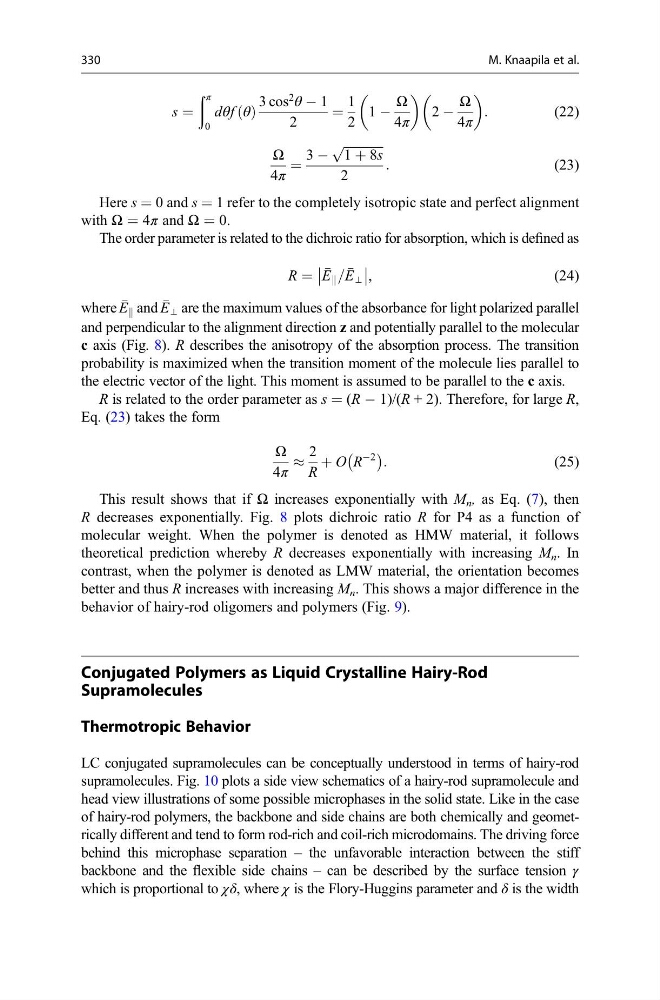
s ¼
ð π
0
dθf θ
ð Þ
3 cos
2
θ À 1
2
¼
1
2
1 À
Ω
4π
2 À
Ω
4π
:
(22)
Ω
4π
¼
3 À
ffiffiffiffiffiffiffiffiffiffiffiffi ffi
1 þ 8s
p
2
:
(23)
Here s = 0 and s = 1 refer to the completely isotropic state and perfect alignment
with Ω = 4π and Ω = 0.
The order parameter is related to the dichroic ratio for absorption, which is defined as
R ¼
E k =
E ⊥
,
(24)
where
E k and
E ⊥ are the maximum values of the absorbance for light polarized parallel
and perpendicular to the alignment direction z and potentially parallel to the molecular
c axis (Fig. 8). R describes the anisotropy of the absorption process. The transition
probability is maximized when the transition moment of the molecule lies parallel to
the electric vector of the light. This moment is assumed to be parallel to the c axis.
R is related to the order parameter as s = (R À 1)/(R + 2). Therefore, for large R,
Eq. (23) takes the form
Ω
4π
%
2
R
þ O R
À2
À
Á :
(25)
This result shows that if Ω increases exponentially with M n , as Eq. (7), then
R decreases exponentially. Fig. 8 plots dichroic ratio R for P4 as a function of
molecular weight. When the polymer is denoted as HMW material, it follows
theoretical prediction whereby R decreases exponentially with increasing M n . In
contrast, when the polymer is denoted as LMW material, the orientation becomes
better and thus R increases with increasing M n . This shows a major difference in the
behavior of hairy-rod oligomers and polymers (Fig. 9).
Conjugated Polymers as Liquid Crystalline Hairy-Rod
Supramolecules
Thermotropic Behavior
LC conjugated supramolecules can be conceptually understood in terms of hairy-rod
supramolecules. Fig. 10 plots a side view schematics of a hairy-rod supramolecule and
head view illustrations of some possible microphases in the solid state. Like in the case
of hairy-rod polymers, the backbone and side chains are both chemically and geometrically different and tend to form rod-rich and coil-rich microdomains. The driving force
behind this microphase separation – the unfavorable interaction between the stiff
backbone and the flexible side chains – can be described by the surface tension γ
which is proportional to χδ, where χ is the Flory-Huggins parameter and δ is the width
330
M. Knaapila et al.
ð π
0
dθf θ
ð Þ
3 cos
2
θ À 1
2
¼
1
2
1 À
Ω
4π
2 À
Ω
4π
:
(22)
Ω
4π
¼
3 À
ffiffiffiffiffiffiffiffiffiffiffiffi ffi
1 þ 8s
p
2
:
(23)
Here s = 0 and s = 1 refer to the completely isotropic state and perfect alignment
with Ω = 4π and Ω = 0.
The order parameter is related to the dichroic ratio for absorption, which is defined as
R ¼
E k =
E ⊥
,
(24)
where
E k and
E ⊥ are the maximum values of the absorbance for light polarized parallel
and perpendicular to the alignment direction z and potentially parallel to the molecular
c axis (Fig. 8). R describes the anisotropy of the absorption process. The transition
probability is maximized when the transition moment of the molecule lies parallel to
the electric vector of the light. This moment is assumed to be parallel to the c axis.
R is related to the order parameter as s = (R À 1)/(R + 2). Therefore, for large R,
Eq. (23) takes the form
Ω
4π
%
2
R
þ O R
À2
À
Á :
(25)
This result shows that if Ω increases exponentially with M n , as Eq. (7), then
R decreases exponentially. Fig. 8 plots dichroic ratio R for P4 as a function of
molecular weight. When the polymer is denoted as HMW material, it follows
theoretical prediction whereby R decreases exponentially with increasing M n . In
contrast, when the polymer is denoted as LMW material, the orientation becomes
better and thus R increases with increasing M n . This shows a major difference in the
behavior of hairy-rod oligomers and polymers (Fig. 9).
Conjugated Polymers as Liquid Crystalline Hairy-Rod
Supramolecules
Thermotropic Behavior
LC conjugated supramolecules can be conceptually understood in terms of hairy-rod
supramolecules. Fig. 10 plots a side view schematics of a hairy-rod supramolecule and
head view illustrations of some possible microphases in the solid state. Like in the case
of hairy-rod polymers, the backbone and side chains are both chemically and geometrically different and tend to form rod-rich and coil-rich microdomains. The driving force
behind this microphase separation – the unfavorable interaction between the stiff
backbone and the flexible side chains – can be described by the surface tension γ
which is proportional to χδ, where χ is the Flory-Huggins parameter and δ is the width
330
M. Knaapila et al.